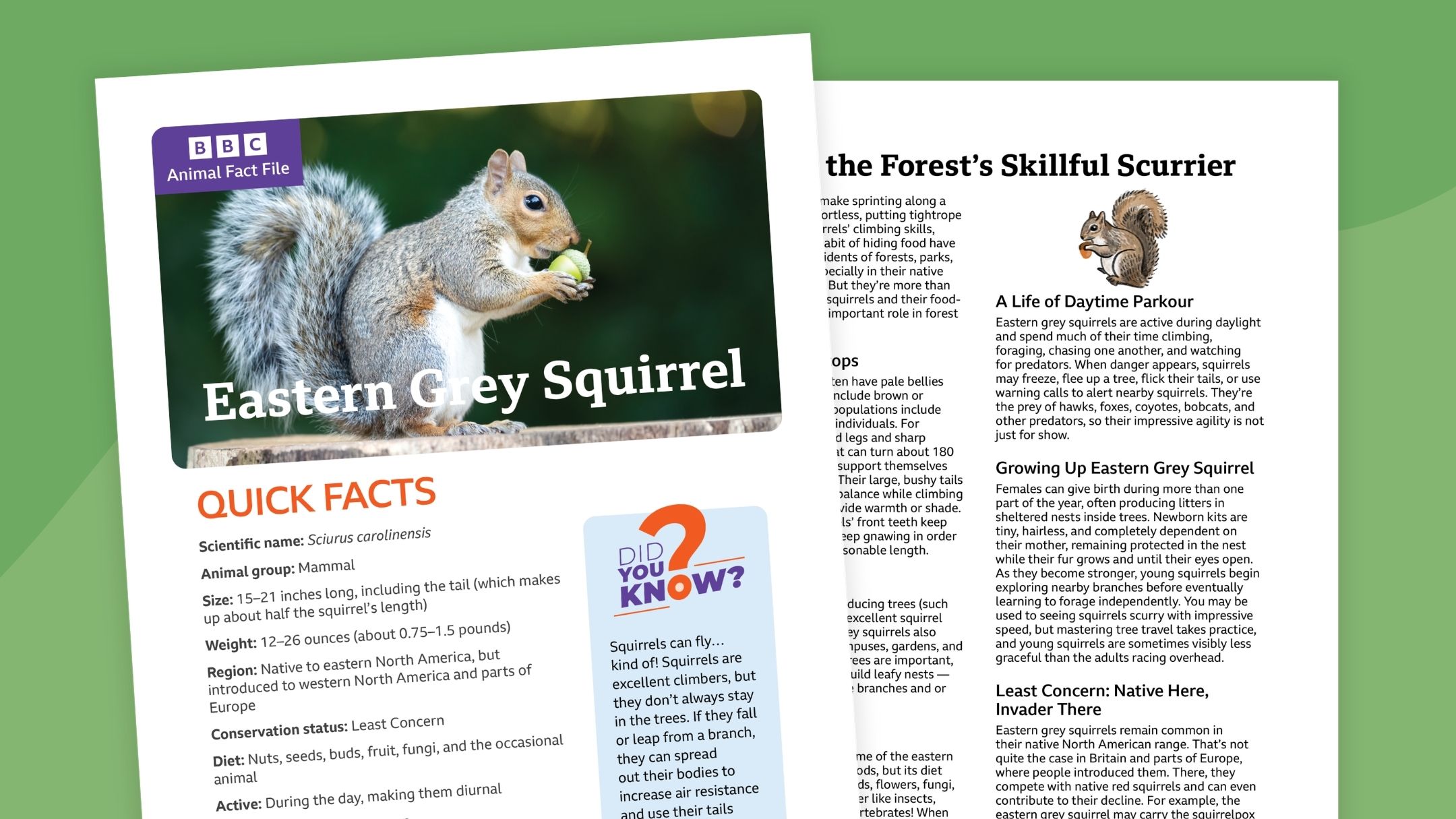
Can a squirrel really fly? Not exactly — but it can leap, fall, and glide through the air with surprising control.
Eastern grey squirrels may be familiar sights in parks and backyards, but there’s a lot going on behind those quick paws and bushy tails. Explore the climbing skills that help them navigate the treetops, the clever way they stash food for later, and the surprising role those forgotten nuts can play in growing new trees. You'll also discover how squirrels communicate, raise their young, and adapt to life in both forests and human neighborhoods.
Teachers and parents, you can use this fact file to:
- Introduce an animal, wildlife, or life science unit
- Support nonfiction reading and vocabulary practice
- Explore animal adaptations, behaviors, and habitats
- Compare animals and the ecosystems they live in
- Practice finding and organizing information from nonfiction texts
- Prepare students for animal research projects or presentations (use our animal report templates!)
- Connect science learning to conservation and environmental issues
- Pair with videos, articles, or other informational texts (see Related Resources below)
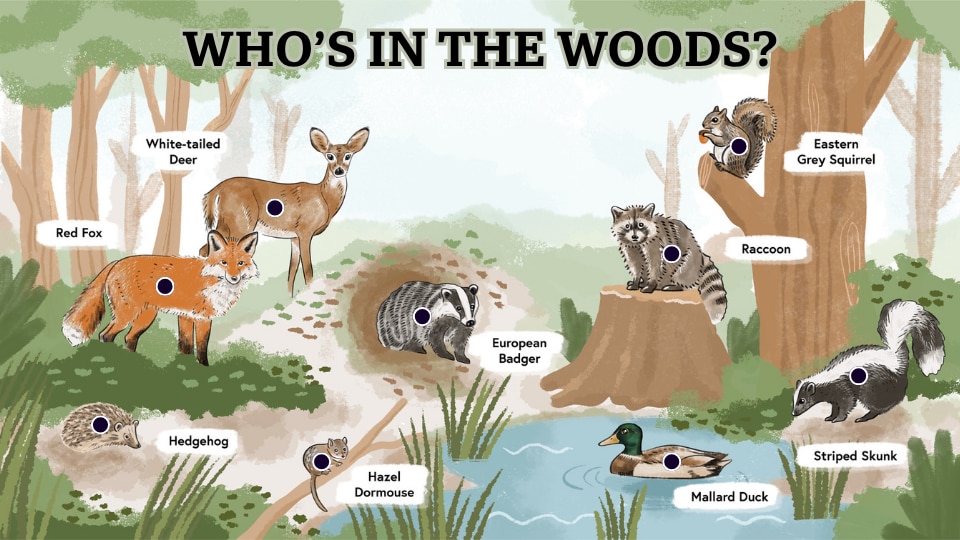
Meet nine wild animals that live in forests, parks, gardens, and neighborhoods: the red fox, white-tailed deer, mallard duck, striped skunk, eastern grey squirrel, raccoon, European badger, hedgehog, and hazel dormouse.
Click on each animal's picture to watch a short video, then click on its name for a fact about what makes it unusual, from its senses and behavior to the ways it has adapted to survive.
Some of these animals may live near you, while others are much harder to spot. Along the way, you'll learn how each one finds food, raises its young, avoids predators, and makes use of the habitat around it.
For Teachers and Parents:
Woodland Animals works well as an introduction to habitats and adaptations or as a self-guided activity for students working on their own or in pairs. Here are a few ways to use it:
- Before exploring: Ask students which of the nine animals they've seen in real life and where. It's a quick way to connect the lesson to their own surroundings.
- While exploring: Have students record one adaptation for each animal, such as a special sense, body feature, or behavior, and how it helps the animal survive.
- After exploring: Ask students to sort the animals by what they eat, when they're active, or how they avoid predators. They can then compare animals that share a habitat but survive in different ways.
- Extension: Some of these animals live in North America, some in Europe, and some in both. Students can research which ones live in their region and why others don't.
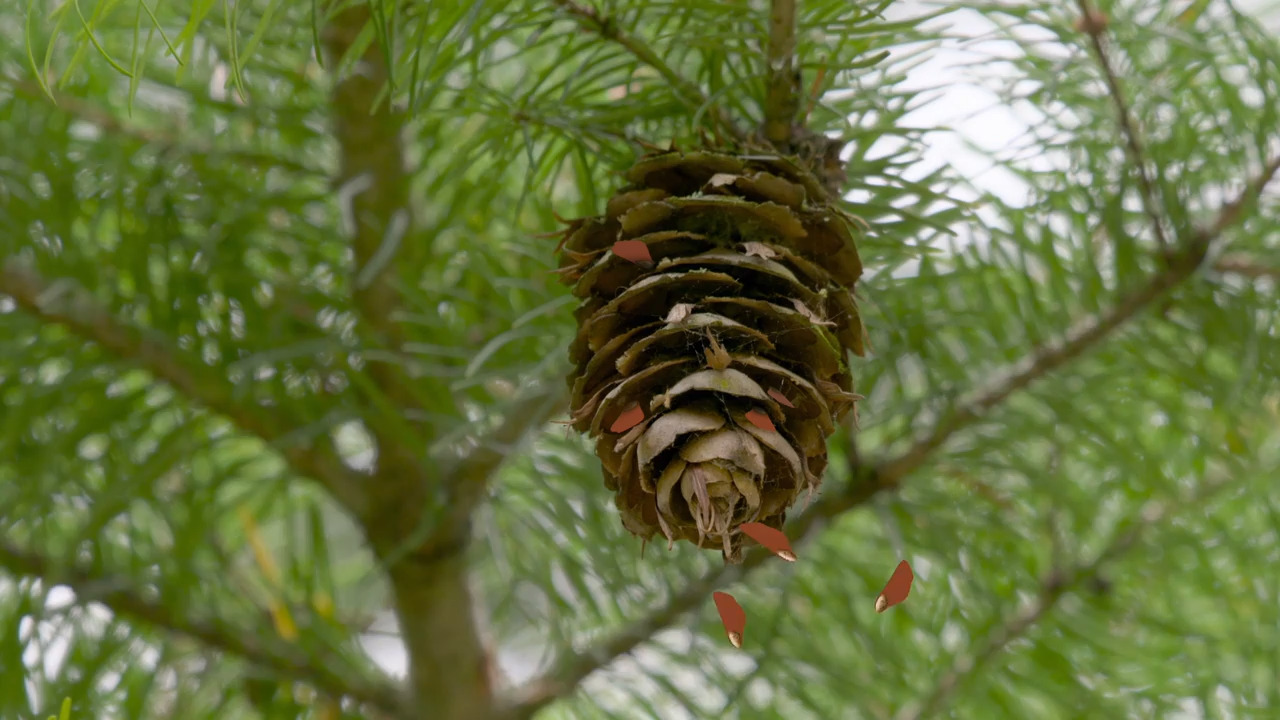
In In Search of Seeds, Ranger Hamza and the Ramblers are in search of seeds! Join them as they investigate pine cones, observe squirrels, and feed ducks, all while learning about the role that seeds play in the environment. This video is excerpted from BBC's Ranger Hamza’s Eco Quest, a nature exploration show in which Ranger Hamza and the Ramblers go on quests to discover nature’s wonders and the important role they play in our environment.
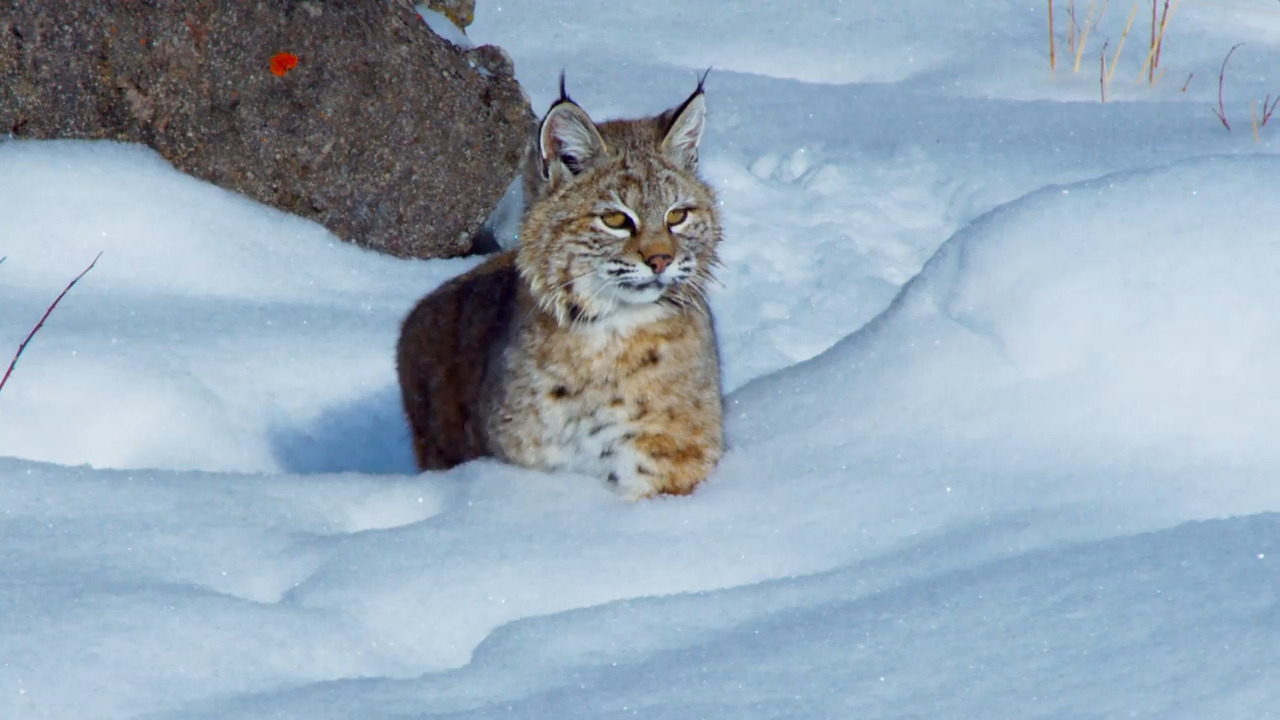
In The Bobcat in the Rockies, narrator Sir David Attenborough explores the extreme cold and snow-covered ground of winter in the Rocky Mountains. He follows a bobcat as it hunts a mouse in the snow. A nearby valley teems with life, thanks to a river fed by a volcanic hot spring. The bobcat hunts ducks in the river and then succeeds in killing a squirrel in a tree. This video is excerpted from BBC’s Planet Earth II, a breathtaking documentary series that highlights the natural wonders of our planet.

How did a small country on a mountainous peninsula become a global leader in technology, entertainment, and culture? Meet South Korea, a country where ancient traditions and modern innovation are woven together.
From the mountains and islands to the busy streets of Seoul, South Korea has much to explore. Learn how Korea’s history shaped the country it is today, discover the traditions and foods that bring people together, and explore South Korea’s government, economy, language, and culture. You’ll also meet native animals —including a flying squirrel — and discover how wildlife survives in a country where people and cities are never far away.
Teachers and parents, you can use this fact file to:
- Introduce a geography or social studies unit
- Support nonfiction reading practice
- Compare countries and cultures
- Complete map and research activities
- Prepare students for projects or presentations (use our country report template!)
- Pair with videos, articles, or other informational texts (see Related Resources below)
Can a squirrel really fly? Not exactly — but it can leap, fall, and glide through the air with surprising control.
Eastern grey squirrels may be familiar sights in parks and backyards, but there’s a lot going on behind those quick paws and bushy tails. Explore the climbing skills that help them navigate the treetops, the clever way they stash food for later, and the surprising role those forgotten nuts can play in growing new trees. You'll also discover how squirrels communicate, raise their young, and adapt to life in both forests and human neighborhoods.
Teachers and parents, you can use this fact file to:
- Introduce an animal, wildlife, or life science unit
- Support nonfiction reading and vocabulary practice
- Explore animal adaptations, behaviors, and habitats
- Compare animals and the ecosystems they live in
- Practice finding and organizing information from nonfiction texts
- Prepare students for animal research projects or presentations (use our animal report templates!)
- Connect science learning to conservation and environmental issues
- Pair with videos, articles, or other informational texts (see Related Resources below)
Meet nine wild animals that live in forests, parks, gardens, and neighborhoods: the red fox, white-tailed deer, mallard duck, striped skunk, eastern grey squirrel, raccoon, European badger, hedgehog, and hazel dormouse.
Click on each animal's picture to watch a short video, then click on its name for a fact about what makes it unusual, from its senses and behavior to the ways it has adapted to survive.
Some of these animals may live near you, while others are much harder to spot. Along the way, you'll learn how each one finds food, raises its young, avoids predators, and makes use of the habitat around it.
For Teachers and Parents:
Woodland Animals works well as an introduction to habitats and adaptations or as a self-guided activity for students working on their own or in pairs. Here are a few ways to use it:
- Before exploring: Ask students which of the nine animals they've seen in real life and where. It's a quick way to connect the lesson to their own surroundings.
- While exploring: Have students record one adaptation for each animal, such as a special sense, body feature, or behavior, and how it helps the animal survive.
- After exploring: Ask students to sort the animals by what they eat, when they're active, or how they avoid predators. They can then compare animals that share a habitat but survive in different ways.
- Extension: Some of these animals live in North America, some in Europe, and some in both. Students can research which ones live in their region and why others don't.
In In Search of Seeds, Ranger Hamza and the Ramblers are in search of seeds! Join them as they investigate pine cones, observe squirrels, and feed ducks, all while learning about the role that seeds play in the environment. This video is excerpted from BBC's Ranger Hamza’s Eco Quest, a nature exploration show in which Ranger Hamza and the Ramblers go on quests to discover nature’s wonders and the important role they play in our environment.
In The Bobcat in the Rockies, narrator Sir David Attenborough explores the extreme cold and snow-covered ground of winter in the Rocky Mountains. He follows a bobcat as it hunts a mouse in the snow. A nearby valley teems with life, thanks to a river fed by a volcanic hot spring. The bobcat hunts ducks in the river and then succeeds in killing a squirrel in a tree. This video is excerpted from BBC’s Planet Earth II, a breathtaking documentary series that highlights the natural wonders of our planet.
How did a small country on a mountainous peninsula become a global leader in technology, entertainment, and culture? Meet South Korea, a country where ancient traditions and modern innovation are woven together.
From the mountains and islands to the busy streets of Seoul, South Korea has much to explore. Learn how Korea’s history shaped the country it is today, discover the traditions and foods that bring people together, and explore South Korea’s government, economy, language, and culture. You’ll also meet native animals —including a flying squirrel — and discover how wildlife survives in a country where people and cities are never far away.
Teachers and parents, you can use this fact file to:
- Introduce a geography or social studies unit
- Support nonfiction reading practice
- Compare countries and cultures
- Complete map and research activities
- Prepare students for projects or presentations (use our country report template!)
- Pair with videos, articles, or other informational texts (see Related Resources below)