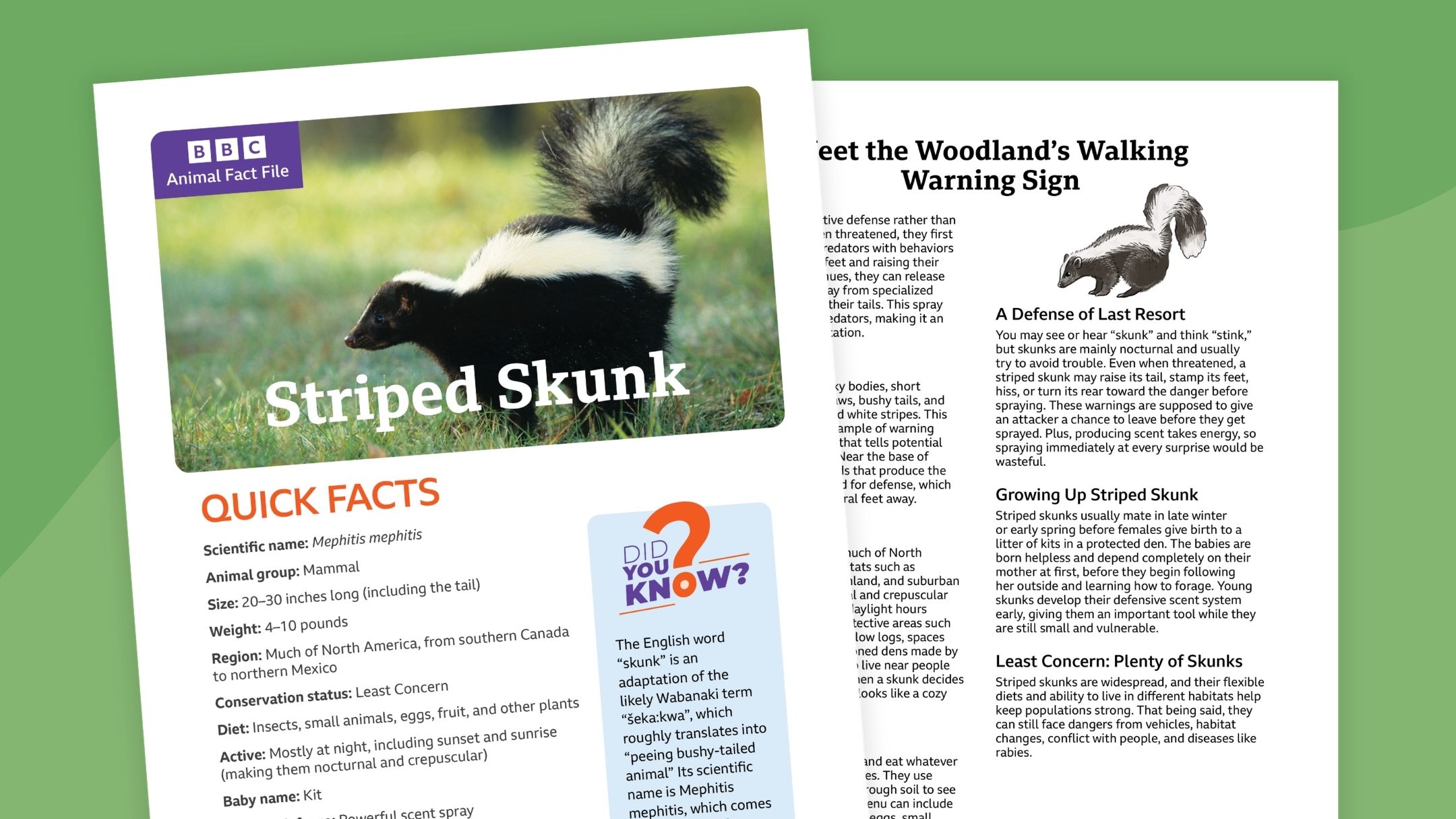
What animal can warn an attacker with stomps, raised fur, and a lifted tail before turning its rear end into a surprisingly powerful defense?
Meet the striped skunk, a small mammal with a big reputation. Find out how its bold black-and-white markings serve as a warning, why spraying is actually a last resort, and how its sharp claws help it dig up dinner. You'll also discover where skunks make their homes, what they eat, and how these mostly nighttime animals manage to live surprisingly close to people.
Teachers and parents, you can use this fact file to:
- Introduce an animal, wildlife, or life science unit
- Support nonfiction reading and vocabulary practice
- Explore animal adaptations, behaviors, and habitats
- Compare animals and the ecosystems they live in
- Practice finding and organizing information from nonfiction texts
- Prepare students for animal research projects or presentations (use our animal report templates!)
- Connect science learning to conservation and environmental issues
- Pair with videos, articles, or other informational texts (see Related Resources below)
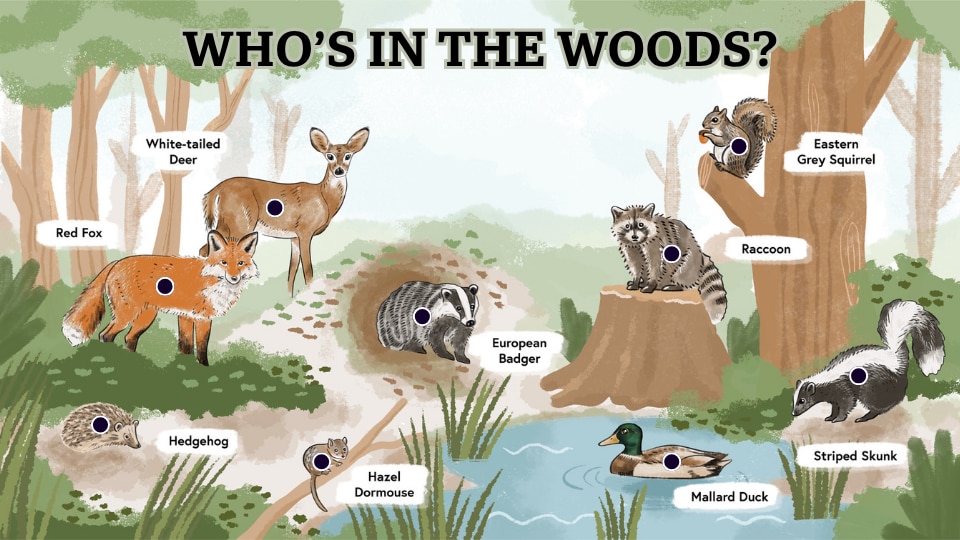
Meet nine wild animals that live in forests, parks, gardens, and neighborhoods: the red fox, white-tailed deer, mallard duck, striped skunk, eastern grey squirrel, raccoon, European badger, hedgehog, and hazel dormouse.
Click on each animal's picture to watch a short video, then click on its name for a fact about what makes it unusual, from its senses and behavior to the ways it has adapted to survive.
Some of these animals may live near you, while others are much harder to spot. Along the way, you'll learn how each one finds food, raises its young, avoids predators, and makes use of the habitat around it.
For Teachers and Parents:
Woodland Animals works well as an introduction to habitats and adaptations or as a self-guided activity for students working on their own or in pairs. Here are a few ways to use it:
- Before exploring: Ask students which of the nine animals they've seen in real life and where. It's a quick way to connect the lesson to their own surroundings.
- While exploring: Have students record one adaptation for each animal, such as a special sense, body feature, or behavior, and how it helps the animal survive.
- After exploring: Ask students to sort the animals by what they eat, when they're active, or how they avoid predators. They can then compare animals that share a habitat but survive in different ways.
- Extension: Some of these animals live in North America, some in Europe, and some in both. Students can research which ones live in their region and why others don't.
What animal can warn an attacker with stomps, raised fur, and a lifted tail before turning its rear end into a surprisingly powerful defense?
Meet the striped skunk, a small mammal with a big reputation. Find out how its bold black-and-white markings serve as a warning, why spraying is actually a last resort, and how its sharp claws help it dig up dinner. You'll also discover where skunks make their homes, what they eat, and how these mostly nighttime animals manage to live surprisingly close to people.
Teachers and parents, you can use this fact file to:
- Introduce an animal, wildlife, or life science unit
- Support nonfiction reading and vocabulary practice
- Explore animal adaptations, behaviors, and habitats
- Compare animals and the ecosystems they live in
- Practice finding and organizing information from nonfiction texts
- Prepare students for animal research projects or presentations (use our animal report templates!)
- Connect science learning to conservation and environmental issues
- Pair with videos, articles, or other informational texts (see Related Resources below)
Meet nine wild animals that live in forests, parks, gardens, and neighborhoods: the red fox, white-tailed deer, mallard duck, striped skunk, eastern grey squirrel, raccoon, European badger, hedgehog, and hazel dormouse.
Click on each animal's picture to watch a short video, then click on its name for a fact about what makes it unusual, from its senses and behavior to the ways it has adapted to survive.
Some of these animals may live near you, while others are much harder to spot. Along the way, you'll learn how each one finds food, raises its young, avoids predators, and makes use of the habitat around it.
For Teachers and Parents:
Woodland Animals works well as an introduction to habitats and adaptations or as a self-guided activity for students working on their own or in pairs. Here are a few ways to use it:
- Before exploring: Ask students which of the nine animals they've seen in real life and where. It's a quick way to connect the lesson to their own surroundings.
- While exploring: Have students record one adaptation for each animal, such as a special sense, body feature, or behavior, and how it helps the animal survive.
- After exploring: Ask students to sort the animals by what they eat, when they're active, or how they avoid predators. They can then compare animals that share a habitat but survive in different ways.
- Extension: Some of these animals live in North America, some in Europe, and some in both. Students can research which ones live in their region and why others don't.