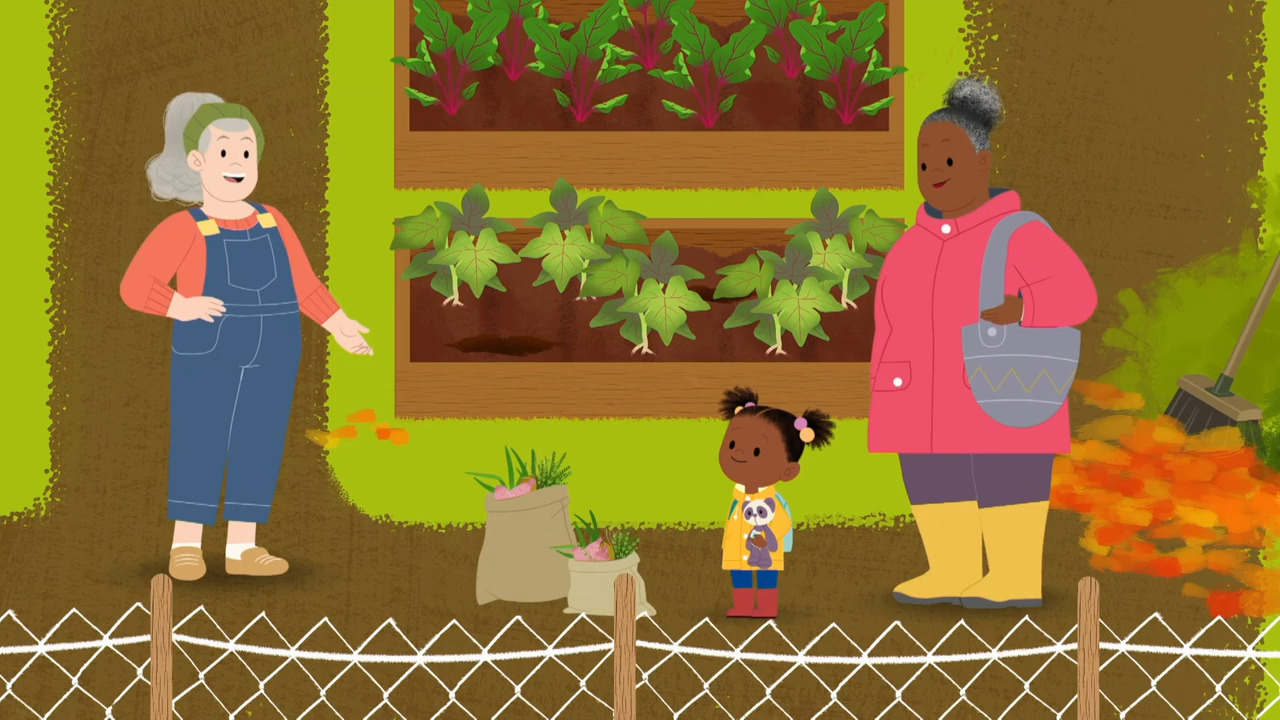
Introducing your new favorite duo! JoJo & Gran Gran is a BBC children's animated television series that follows an inquisitive and cheerful 4-and-a-half-year-old girl and her loving grandmother, who always has something new to teach her. Young learners will love learning alongside the diverse cast of characters as they get to know their community and explore the natural world around them.
This is quick and easy seasonal content — perfect for an intro to a life science (plants, trees, flowers) or social studies (holidays!) lesson. Or watch the video and then try what JoJo and Gran Gran did, whether it's making a fruit crumble or writing a poem.
Gung Hei Fat Choy!
Celebrate Lunar New Year with the BBC Learning Hub’s curated resources for students ages 4–14. Through videos, articles, and printables, students can explore the traditions, symbols, and stories that mark this important holiday. From family gatherings and festive foods to lanterns, lion dances, and the Chinese Zodiac, these resources help students understand how Lunar New Year is celebrated across cultures and communities around the world.
It's tempting to think that seeing is believing, but that's not always the case. When scrolling the internet, it's important to put on your skepticism hat. There's a lot of fake stuff out there, and some of it is convincing.
For example, a Facebook post appeared to come from York Council — the local government office for the city of York, England. It asked people with spare rooms to house asylum seekers (people who have fled their home country and are asking a government for protection). The post wasn't real, but it spread quickly across Facebook, Instagram, TikTok, X, and YouTube. BBC Verify, the BBC's fact-checking team, estimated it could have reached more than a million people.
Misinformation like this can cause real problems, especially when it spreads about sensitive subjects like asylum seekers. Repeated exposure to false information can also make people question what's true at all — damaging trust between people and communities.
So how can you tell what's fake? Even careful readers are finding it harder to spot, while fake content is getting easier to make — a dangerous combination. The fake council post looked convincing: it had an official logo, professional-sounding text, and even a real email address. But a few small details gave it away: the logo was slightly distorted, some words were misspelled, parts of the image looked unnatural, and the AI-generated hands had too many fingers.
Those details are easy to miss when scrolling quickly — but learning to spot them is exactly what makes the difference between falling for a fake and catching one.
Skateboarding made its Olympic debut as an optional sport in 2020, and it'll become a permanent fixture in 2028. But long before the Olympics caught on, skaters had already found their spot.
Back in the 1970s, London's South Bank was known for something other than tourists and river views: skateboarders, drawn to the smooth concrete and sloped walls of the Undercroft Skate Space. Decades later, an exhibit is celebrating that space — a hollowed-out concrete bowl with a cult following — through art, memorabilia, and film.
The Undercroft is where a generation of skaters learned the sport (safety gear very much included). But for years, this free public space faced a real threat: developers tried repeatedly to shut it down or move skaters elsewhere.
The skaters didn't budge. Their persistence paid off — the space was saved, renovated, and eventually celebrated as a landmark. Today, skaters and BMX riders of every age still roll through the Undercroft, part of a community it helped build.
Birdwatching is taking off in a big way among young people. Reports say that around 750,000 people aged 16–29 in the UK and millions in the U.S. now regularly go birdwatching — turning what was once seen as a “quiet” hobby into a fast-growing trend.
Part of the appeal is how simple it is to start. You don’t need expensive gear or special training — just curiosity and a bit of time outdoors. It’s a low-pressure way to take a break from screens, notice what’s around you, and actually tune into sounds and spaces most people scroll past.
Ironically, social media is helping drive the trend. Birdwatching accounts, short videos, and identification apps are making it easier than ever to learn bird calls, spot species, and share discoveries with others. Instead of pulling people away from nature, platforms like TikTok and Instagram are often pushing people back into it.
Conservationists are especially excited because this kind of interest helps more people connect with wildlife and care about protecting it. Birdwatching is becoming less about binoculars and notebooks — and more about curiosity, community, and noticing the world a little differently.
Underwater volcanoes are some of the least visible — but most important — geological features on Earth. Scientist Dr. Isobel Yeo studies these deep-sea volcanoes near the Greek island of Santorini using remotely-operated underwater robots. These robotic tools allow researchers to safely explore volcanic regions and locate hydrothermal vents, where hot gases and fluids escape from cracks in Earth’s crust.
Her team is focused on understanding how underwater eruptions behave differently from those on land. The surrounding water pressure, temperature, and ocean currents can all influence how magma and gases move during an eruption. By studying these systems, scientists can improve predictions of volcanic activity and better understand potential risks.
Although an eruption is not expected soon, this research is important for improving early warning systems and helping nearby coastal communities prepare for future volcanic events.
In JoJo and Gran Gran Visit the Community Garden, JoJo and her grandmother head to the local allotment, or community garden, to harvest some vegetables. Real-life children visit a community garden to see the vegetables that grow there. This video is excerpted from BBC’s JoJo & Gran Gran, a children's animated television series following JoJo, an inquisitive and cheerful 4-and-a-half-year-old girl and her loving Gran Gran, who always has something new to teach her.
In JoJo and Gran Gran Build a Scarecrow, JoJo and her friends are working in the community garden. When pigeons come to eat the vegetables, they build a scarecrow to scare the birds away. Two real-life children make a bird feeder from an apple and seeds. This video is excerpted from BBC’s JoJo & Gran Gran, a children's animated television series following JoJo, an inquisitive and cheerful 4-and-a-half-year-old girl and her loving Gran Gran, who always has something new to teach her.
Tiny but mighty, bees play a huge role in keeping our world alive and blooming. As they travel from flower to flower, they carry pollen that helps plants reproduce — supporting ecosystems and much of the food we eat. Inside their hives, bees work together in highly organized communities, each with a job to do.
From pollination to honey-making, this is the ideal quiz to help students ages 8–14 develop their "hive mind."
In Chhavi Rajawat, Local Leader in India, learn how Rajawat left her corporate career to serve her rural community in India. After new quotas increased opportunities for women leaders, she took on a mayor-like role to help address poverty and challenges faced by villagers, especially women. This video is excerpted from BBC's Her Story: The Female Revolution, which explores the history and impact of women’s rights movements and achievements of women.
Test Your Knowledge of the Civil Rights Movement
The Civil Rights Movement was a pivotal time in American history, when individuals and communities fought for equality, justice, and the basic rights of all people. From the oppressive Jim Crow laws to brave acts of resistance, this movement reshaped the nation.
This quiz will explore key events, influential leaders, and cultural milestones, including Emmett Till, Rosa Parks and the Montgomery bus boycott, the March on Washington, Bloody Sunday, the Voting Rights Act, Martin Luther King Jr., Charlotta Bass, Malcolm X, John Lewis, and Motown.
See how much you know about the struggle, the leaders, and the victories that helped create a more just society.
On February 17, 2026, the Lunar New Year begins and the Year of the Horse gallops in! Introduce this holiday — celebrated in East and Southeast Asia and in Asian communities all around the world — to your primary students with a reading passage that explains Lunar New Year and fun Chinese Zodiac activities.
- Lunar New Year and the Chinese Zodiac (reading passage) invites students to explore the origins of the Chinese Zodiac, learn how the lunar calendar works, and discover the legendary animal race that gave each year its zodiac sign. Along the way, students explore how zodiac animals are believed to connect to personality traits and Lunar New Year traditions.
- Meet Your Chinese Zodiac Animal (student activity) has students to put their learning into action by finding their own zodiac sign, reflecting on its characteristics, drawing their animal, and comparing traits with a classmate. Together, these activities encourage students to read, think, and celebrate the Lunar New Year in a fun and meaningful way.
Introducing your new favorite duo! JoJo & Gran Gran is a BBC children's animated television series that follows an inquisitive and cheerful 4-and-a-half-year-old girl and her loving grandmother, who always has something new to teach her. Young learners will love learning alongside the diverse cast of characters as they get to know their community and explore the natural world around them.
This is quick and easy seasonal content — perfect for an intro to a life science (plants, trees, flowers) or social studies (holidays!) lesson. Or watch the video and then try what JoJo and Gran Gran did, whether it's making a fruit crumble or writing a poem.
Gung Hei Fat Choy!
Celebrate Lunar New Year with the BBC Learning Hub’s curated resources for students ages 4–14. Through videos, articles, and printables, students can explore the traditions, symbols, and stories that mark this important holiday. From family gatherings and festive foods to lanterns, lion dances, and the Chinese Zodiac, these resources help students understand how Lunar New Year is celebrated across cultures and communities around the world.
It's tempting to think that seeing is believing, but that's not always the case. When scrolling the internet, it's important to put on your skepticism hat. There's a lot of fake stuff out there, and some of it is convincing.
For example, a Facebook post appeared to come from York Council — the local government office for the city of York, England. It asked people with spare rooms to house asylum seekers (people who have fled their home country and are asking a government for protection). The post wasn't real, but it spread quickly across Facebook, Instagram, TikTok, X, and YouTube. BBC Verify, the BBC's fact-checking team, estimated it could have reached more than a million people.
Misinformation like this can cause real problems, especially when it spreads about sensitive subjects like asylum seekers. Repeated exposure to false information can also make people question what's true at all — damaging trust between people and communities.
So how can you tell what's fake? Even careful readers are finding it harder to spot, while fake content is getting easier to make — a dangerous combination. The fake council post looked convincing: it had an official logo, professional-sounding text, and even a real email address. But a few small details gave it away: the logo was slightly distorted, some words were misspelled, parts of the image looked unnatural, and the AI-generated hands had too many fingers.
Those details are easy to miss when scrolling quickly — but learning to spot them is exactly what makes the difference between falling for a fake and catching one.
Skateboarding made its Olympic debut as an optional sport in 2020, and it'll become a permanent fixture in 2028. But long before the Olympics caught on, skaters had already found their spot.
Back in the 1970s, London's South Bank was known for something other than tourists and river views: skateboarders, drawn to the smooth concrete and sloped walls of the Undercroft Skate Space. Decades later, an exhibit is celebrating that space — a hollowed-out concrete bowl with a cult following — through art, memorabilia, and film.
The Undercroft is where a generation of skaters learned the sport (safety gear very much included). But for years, this free public space faced a real threat: developers tried repeatedly to shut it down or move skaters elsewhere.
The skaters didn't budge. Their persistence paid off — the space was saved, renovated, and eventually celebrated as a landmark. Today, skaters and BMX riders of every age still roll through the Undercroft, part of a community it helped build.
Birdwatching is taking off in a big way among young people. Reports say that around 750,000 people aged 16–29 in the UK and millions in the U.S. now regularly go birdwatching — turning what was once seen as a “quiet” hobby into a fast-growing trend.
Part of the appeal is how simple it is to start. You don’t need expensive gear or special training — just curiosity and a bit of time outdoors. It’s a low-pressure way to take a break from screens, notice what’s around you, and actually tune into sounds and spaces most people scroll past.
Ironically, social media is helping drive the trend. Birdwatching accounts, short videos, and identification apps are making it easier than ever to learn bird calls, spot species, and share discoveries with others. Instead of pulling people away from nature, platforms like TikTok and Instagram are often pushing people back into it.
Conservationists are especially excited because this kind of interest helps more people connect with wildlife and care about protecting it. Birdwatching is becoming less about binoculars and notebooks — and more about curiosity, community, and noticing the world a little differently.
Underwater volcanoes are some of the least visible — but most important — geological features on Earth. Scientist Dr. Isobel Yeo studies these deep-sea volcanoes near the Greek island of Santorini using remotely-operated underwater robots. These robotic tools allow researchers to safely explore volcanic regions and locate hydrothermal vents, where hot gases and fluids escape from cracks in Earth’s crust.
Her team is focused on understanding how underwater eruptions behave differently from those on land. The surrounding water pressure, temperature, and ocean currents can all influence how magma and gases move during an eruption. By studying these systems, scientists can improve predictions of volcanic activity and better understand potential risks.
Although an eruption is not expected soon, this research is important for improving early warning systems and helping nearby coastal communities prepare for future volcanic events.
In JoJo and Gran Gran Visit the Community Garden, JoJo and her grandmother head to the local allotment, or community garden, to harvest some vegetables. Real-life children visit a community garden to see the vegetables that grow there. This video is excerpted from BBC’s JoJo & Gran Gran, a children's animated television series following JoJo, an inquisitive and cheerful 4-and-a-half-year-old girl and her loving Gran Gran, who always has something new to teach her.
In JoJo and Gran Gran Build a Scarecrow, JoJo and her friends are working in the community garden. When pigeons come to eat the vegetables, they build a scarecrow to scare the birds away. Two real-life children make a bird feeder from an apple and seeds. This video is excerpted from BBC’s JoJo & Gran Gran, a children's animated television series following JoJo, an inquisitive and cheerful 4-and-a-half-year-old girl and her loving Gran Gran, who always has something new to teach her.
Tiny but mighty, bees play a huge role in keeping our world alive and blooming. As they travel from flower to flower, they carry pollen that helps plants reproduce — supporting ecosystems and much of the food we eat. Inside their hives, bees work together in highly organized communities, each with a job to do.
From pollination to honey-making, this is the ideal quiz to help students ages 8–14 develop their "hive mind."
In Chhavi Rajawat, Local Leader in India, learn how Rajawat left her corporate career to serve her rural community in India. After new quotas increased opportunities for women leaders, she took on a mayor-like role to help address poverty and challenges faced by villagers, especially women. This video is excerpted from BBC's Her Story: The Female Revolution, which explores the history and impact of women’s rights movements and achievements of women.
Test Your Knowledge of the Civil Rights Movement
The Civil Rights Movement was a pivotal time in American history, when individuals and communities fought for equality, justice, and the basic rights of all people. From the oppressive Jim Crow laws to brave acts of resistance, this movement reshaped the nation.
This quiz will explore key events, influential leaders, and cultural milestones, including Emmett Till, Rosa Parks and the Montgomery bus boycott, the March on Washington, Bloody Sunday, the Voting Rights Act, Martin Luther King Jr., Charlotta Bass, Malcolm X, John Lewis, and Motown.
See how much you know about the struggle, the leaders, and the victories that helped create a more just society.
On February 17, 2026, the Lunar New Year begins and the Year of the Horse gallops in! Introduce this holiday — celebrated in East and Southeast Asia and in Asian communities all around the world — to your primary students with a reading passage that explains Lunar New Year and fun Chinese Zodiac activities.
- Lunar New Year and the Chinese Zodiac (reading passage) invites students to explore the origins of the Chinese Zodiac, learn how the lunar calendar works, and discover the legendary animal race that gave each year its zodiac sign. Along the way, students explore how zodiac animals are believed to connect to personality traits and Lunar New Year traditions.
- Meet Your Chinese Zodiac Animal (student activity) has students to put their learning into action by finding their own zodiac sign, reflecting on its characteristics, drawing their animal, and comparing traits with a classmate. Together, these activities encourage students to read, think, and celebrate the Lunar New Year in a fun and meaningful way.