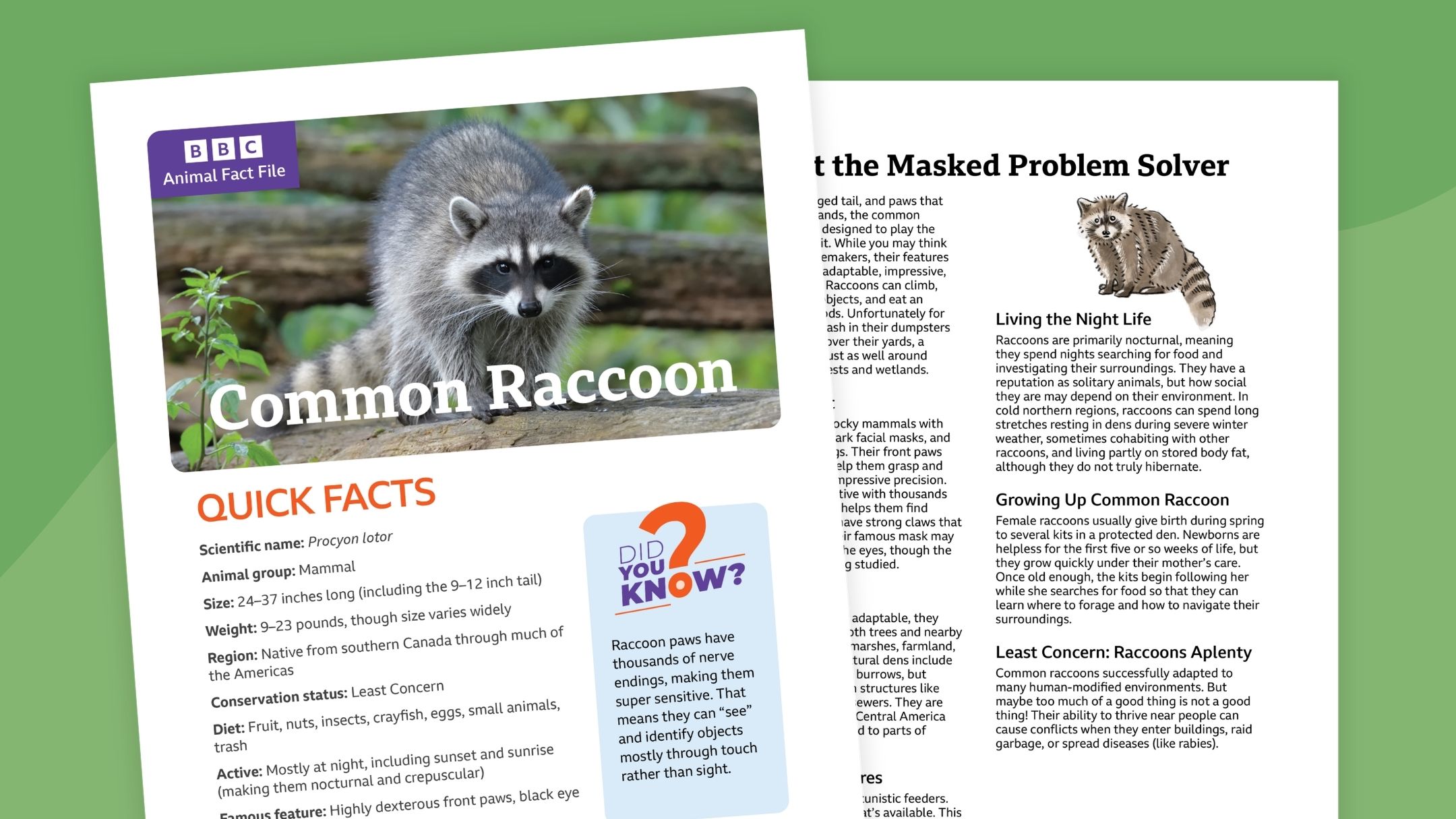
How can an animal identify what it’s holding without even looking at it? For the common raccoon, the answer is all in its paws.
Raccoons are equipped with remarkably sensitive front paws that help them explore, handle food, and investigate their surroundings. Find out how these dexterous mammals use touch, climbing skills, and an anything-goes diet to thrive in forests, wetlands, and neighborhoods. You'll also discover why raccoons sometimes seem to “wash” their food, where they sleep during the day, and how their adaptability can create both opportunities and challenges when they live near people.
Teachers and parents, you can use this fact file to:
- Introduce an animal, wildlife, or life science unit
- Support nonfiction reading and vocabulary practice
- Explore animal adaptations, behaviors, and habitats
- Compare animals and the ecosystems they live in
- Practice finding and organizing information from nonfiction texts
- Prepare students for animal research projects or presentations (use our animal report templates!)
- Connect science learning to conservation and environmental issues
- Pair with videos, articles, or other informational texts (see Related Resources below)
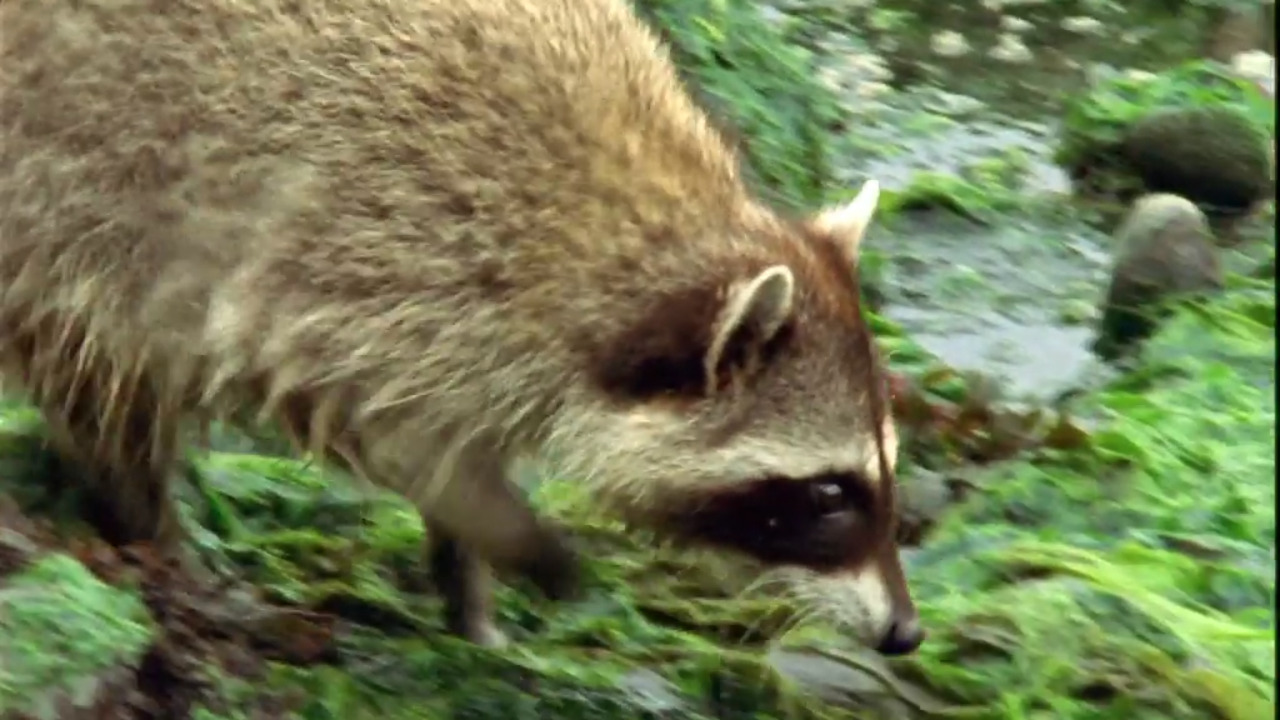
In Raccoons at Low Tide, narrator Sir David Attenborough describes what happens during the powerful spring tides. Learn how the pull of the Moon and the Sun impact the tides and how animals, like raccoons, take advantage of low tide. This video is excerpted from BBC’s Blue Planet, a definitive documentary series diving into the mysterious depths of the sea to discover the natural history of the world’s oceans and the rarely seen marine life that reside there.
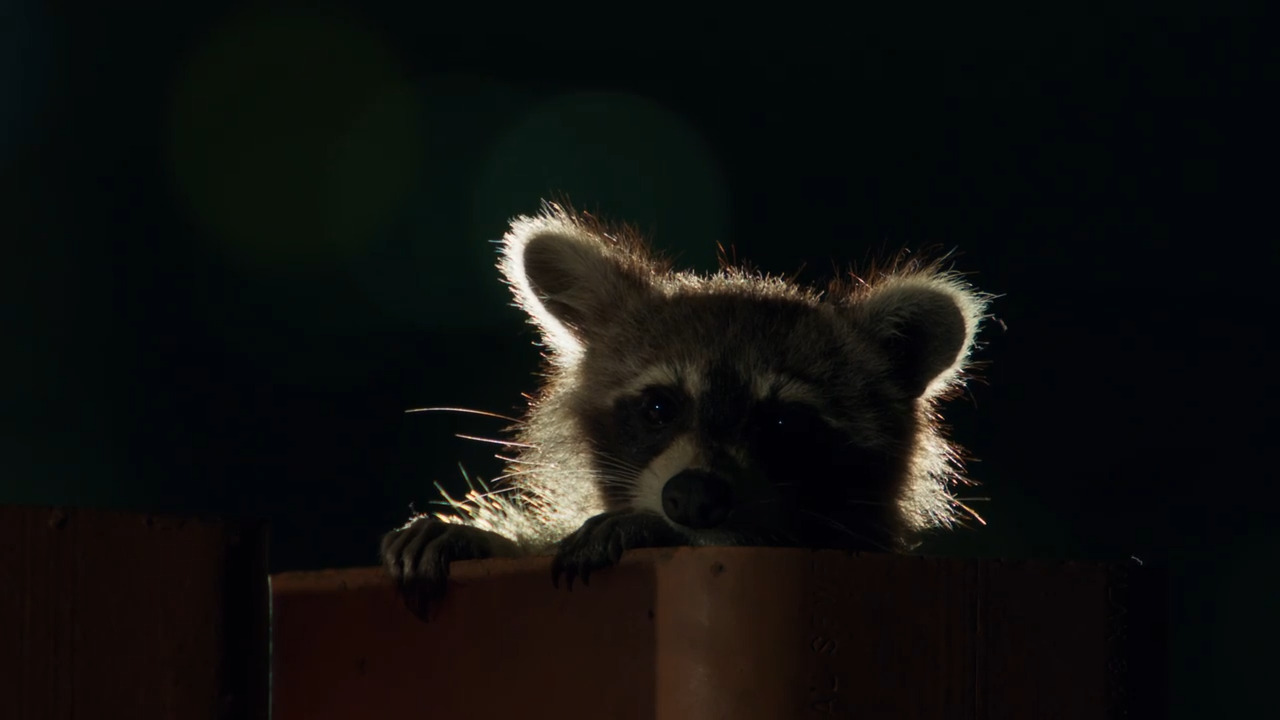
In Raccoons and Monkeys in the Urban Jungle, narrator Sir David Attenborough explores how female raccoons raise their young in the busy urban environment of Toronto and how rhesus macaques adapt to city life by raiding markets in Jaipur. Learn how these clever animals use their intelligence and adaptability to survive and thrive in the urban jungle. This video is excerpted from BBC’s Planet Earth II, a breathtaking documentary series that highlights the natural wonders of our planet.
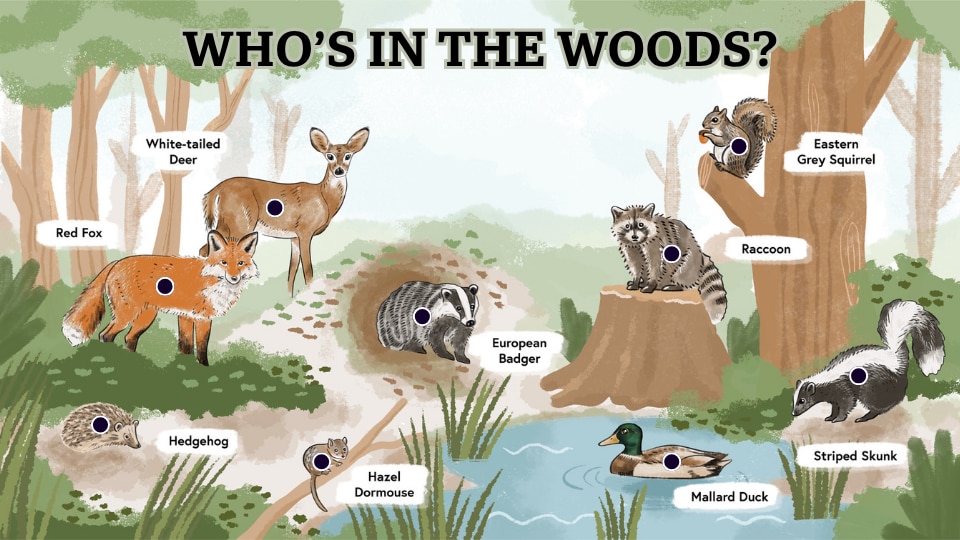
Meet nine wild animals that live in forests, parks, gardens, and neighborhoods: the red fox, white-tailed deer, mallard duck, striped skunk, eastern grey squirrel, raccoon, European badger, hedgehog, and hazel dormouse.
Click on each animal's picture to watch a short video, then click on its name for a fact about what makes it unusual, from its senses and behavior to the ways it has adapted to survive.
Some of these animals may live near you, while others are much harder to spot. Along the way, you'll learn how each one finds food, raises its young, avoids predators, and makes use of the habitat around it.
For Teachers and Parents:
Woodland Animals works well as an introduction to habitats and adaptations or as a self-guided activity for students working on their own or in pairs. Here are a few ways to use it:
- Before exploring: Ask students which of the nine animals they've seen in real life and where. It's a quick way to connect the lesson to their own surroundings.
- While exploring: Have students record one adaptation for each animal, such as a special sense, body feature, or behavior, and how it helps the animal survive.
- After exploring: Ask students to sort the animals by what they eat, when they're active, or how they avoid predators. They can then compare animals that share a habitat but survive in different ways.
- Extension: Some of these animals live in North America, some in Europe, and some in both. Students can research which ones live in their region and why others don't.
How can an animal identify what it’s holding without even looking at it? For the common raccoon, the answer is all in its paws.
Raccoons are equipped with remarkably sensitive front paws that help them explore, handle food, and investigate their surroundings. Find out how these dexterous mammals use touch, climbing skills, and an anything-goes diet to thrive in forests, wetlands, and neighborhoods. You'll also discover why raccoons sometimes seem to “wash” their food, where they sleep during the day, and how their adaptability can create both opportunities and challenges when they live near people.
Teachers and parents, you can use this fact file to:
- Introduce an animal, wildlife, or life science unit
- Support nonfiction reading and vocabulary practice
- Explore animal adaptations, behaviors, and habitats
- Compare animals and the ecosystems they live in
- Practice finding and organizing information from nonfiction texts
- Prepare students for animal research projects or presentations (use our animal report templates!)
- Connect science learning to conservation and environmental issues
- Pair with videos, articles, or other informational texts (see Related Resources below)
In Raccoons at Low Tide, narrator Sir David Attenborough describes what happens during the powerful spring tides. Learn how the pull of the Moon and the Sun impact the tides and how animals, like raccoons, take advantage of low tide. This video is excerpted from BBC’s Blue Planet, a definitive documentary series diving into the mysterious depths of the sea to discover the natural history of the world’s oceans and the rarely seen marine life that reside there.
In Raccoons and Monkeys in the Urban Jungle, narrator Sir David Attenborough explores how female raccoons raise their young in the busy urban environment of Toronto and how rhesus macaques adapt to city life by raiding markets in Jaipur. Learn how these clever animals use their intelligence and adaptability to survive and thrive in the urban jungle. This video is excerpted from BBC’s Planet Earth II, a breathtaking documentary series that highlights the natural wonders of our planet.
Meet nine wild animals that live in forests, parks, gardens, and neighborhoods: the red fox, white-tailed deer, mallard duck, striped skunk, eastern grey squirrel, raccoon, European badger, hedgehog, and hazel dormouse.
Click on each animal's picture to watch a short video, then click on its name for a fact about what makes it unusual, from its senses and behavior to the ways it has adapted to survive.
Some of these animals may live near you, while others are much harder to spot. Along the way, you'll learn how each one finds food, raises its young, avoids predators, and makes use of the habitat around it.
For Teachers and Parents:
Woodland Animals works well as an introduction to habitats and adaptations or as a self-guided activity for students working on their own or in pairs. Here are a few ways to use it:
- Before exploring: Ask students which of the nine animals they've seen in real life and where. It's a quick way to connect the lesson to their own surroundings.
- While exploring: Have students record one adaptation for each animal, such as a special sense, body feature, or behavior, and how it helps the animal survive.
- After exploring: Ask students to sort the animals by what they eat, when they're active, or how they avoid predators. They can then compare animals that share a habitat but survive in different ways.
- Extension: Some of these animals live in North America, some in Europe, and some in both. Students can research which ones live in their region and why others don't.