
The article "Polar Bears Are Suffering From Painful Ice Blocks on Their Paws Due to Climate Change" from BBC's Discover Wildlife explains how polar bears are experiencing painful ice blocks on their paws, some as large as 12 inches in diameter. Researchers from the University of Washington found that these ice blocks are causing deep injuries, and climate change is to blame for the freeze-thaw cycles that cause the blocks.
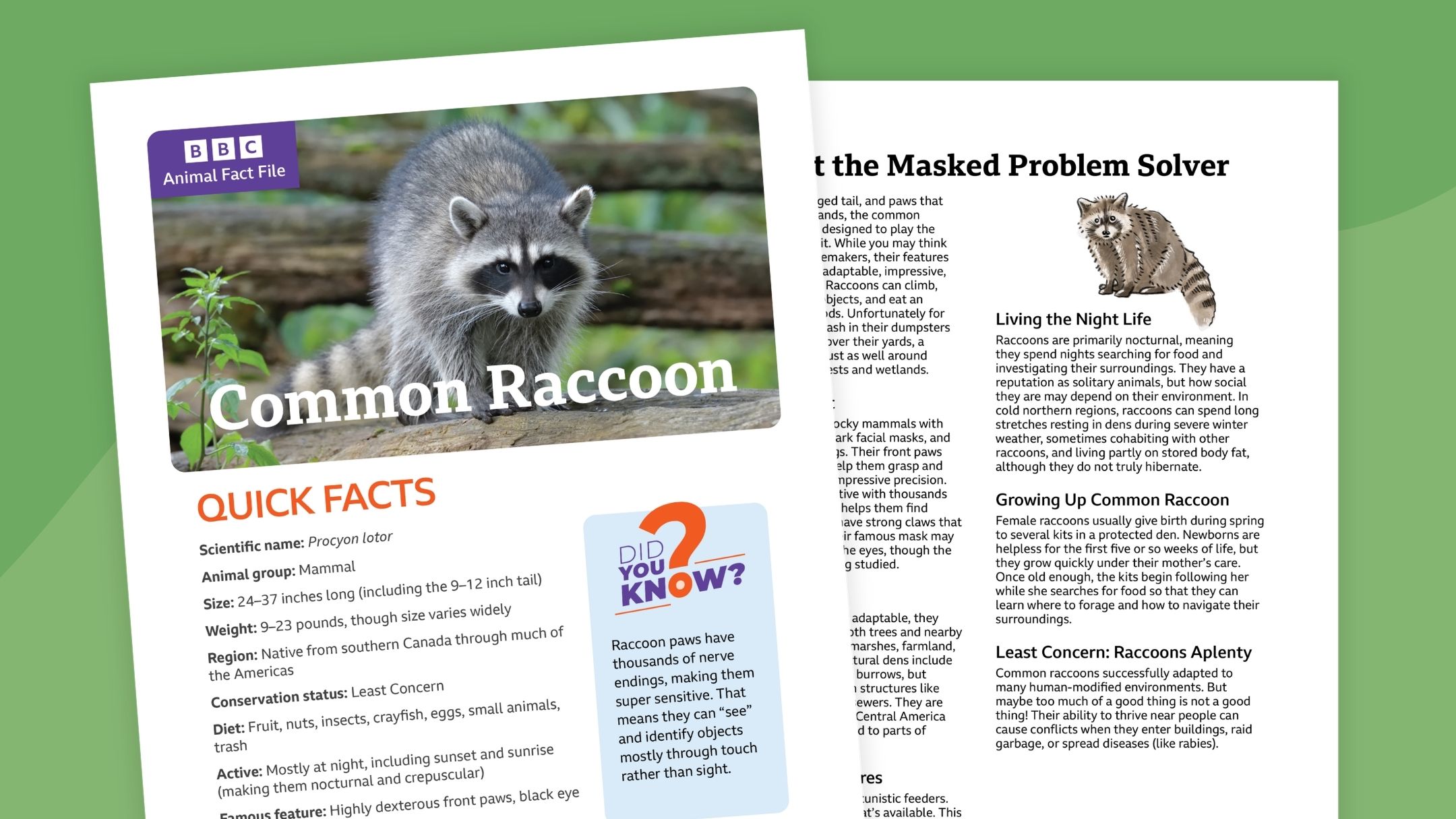
How can an animal identify what it’s holding without even looking at it? For the common raccoon, the answer is all in its paws.
Raccoons are equipped with remarkably sensitive front paws that help them explore, handle food, and investigate their surroundings. Find out how these dexterous mammals use touch, climbing skills, and an anything-goes diet to thrive in forests, wetlands, and neighborhoods. You'll also discover why raccoons sometimes seem to “wash” their food, where they sleep during the day, and how their adaptability can create both opportunities and challenges when they live near people.
Teachers and parents, you can use this fact file to:
- Introduce an animal, wildlife, or life science unit
- Support nonfiction reading and vocabulary practice
- Explore animal adaptations, behaviors, and habitats
- Compare animals and the ecosystems they live in
- Practice finding and organizing information from nonfiction texts
- Prepare students for animal research projects or presentations (use our animal report templates!)
- Connect science learning to conservation and environmental issues
- Pair with videos, articles, or other informational texts (see Related Resources below)

The UK wants to see more hedgehogs, and it’s not because hedgehogs are incredibly cute. Well, not just because of that. The UK’s hedgehog population is in dangerous decline, but part of the solution could be an AI tool called Tessera that uses satellite images to help build a map of hedgehog habitats.
Before Tessera can work its magic, it needs some input. Researchers need to find and learn hedgehogs’ preferred environments by identifying the habitat’s fingerprint. A fingerprint, in this case, is a pattern or collection of characteristics generally found in hedgehog habitats. Maybe your habitat fingerprint would include a freezer full of ice cream and trampoline floors! It has nothing to do with actual fingers, even though that would be a great excuse to spend all day looking at hedgehog paws.
Researchers do their field work in small areas, then input their findings into the software that can extrapolate, show where the other similar habitats are, and record changes over time. The project will hopefully help us learn about where hedgehogs live, how we can help them survive, and how we can set up our homes to comfortably accommodate a hedgehog houseguest.
The article "Polar Bears Are Suffering From Painful Ice Blocks on Their Paws Due to Climate Change" from BBC's Discover Wildlife explains how polar bears are experiencing painful ice blocks on their paws, some as large as 12 inches in diameter. Researchers from the University of Washington found that these ice blocks are causing deep injuries, and climate change is to blame for the freeze-thaw cycles that cause the blocks.
How can an animal identify what it’s holding without even looking at it? For the common raccoon, the answer is all in its paws.
Raccoons are equipped with remarkably sensitive front paws that help them explore, handle food, and investigate their surroundings. Find out how these dexterous mammals use touch, climbing skills, and an anything-goes diet to thrive in forests, wetlands, and neighborhoods. You'll also discover why raccoons sometimes seem to “wash” their food, where they sleep during the day, and how their adaptability can create both opportunities and challenges when they live near people.
Teachers and parents, you can use this fact file to:
- Introduce an animal, wildlife, or life science unit
- Support nonfiction reading and vocabulary practice
- Explore animal adaptations, behaviors, and habitats
- Compare animals and the ecosystems they live in
- Practice finding and organizing information from nonfiction texts
- Prepare students for animal research projects or presentations (use our animal report templates!)
- Connect science learning to conservation and environmental issues
- Pair with videos, articles, or other informational texts (see Related Resources below)
The UK wants to see more hedgehogs, and it’s not because hedgehogs are incredibly cute. Well, not just because of that. The UK’s hedgehog population is in dangerous decline, but part of the solution could be an AI tool called Tessera that uses satellite images to help build a map of hedgehog habitats.
Before Tessera can work its magic, it needs some input. Researchers need to find and learn hedgehogs’ preferred environments by identifying the habitat’s fingerprint. A fingerprint, in this case, is a pattern or collection of characteristics generally found in hedgehog habitats. Maybe your habitat fingerprint would include a freezer full of ice cream and trampoline floors! It has nothing to do with actual fingers, even though that would be a great excuse to spend all day looking at hedgehog paws.
Researchers do their field work in small areas, then input their findings into the software that can extrapolate, show where the other similar habitats are, and record changes over time. The project will hopefully help us learn about where hedgehogs live, how we can help them survive, and how we can set up our homes to comfortably accommodate a hedgehog houseguest.