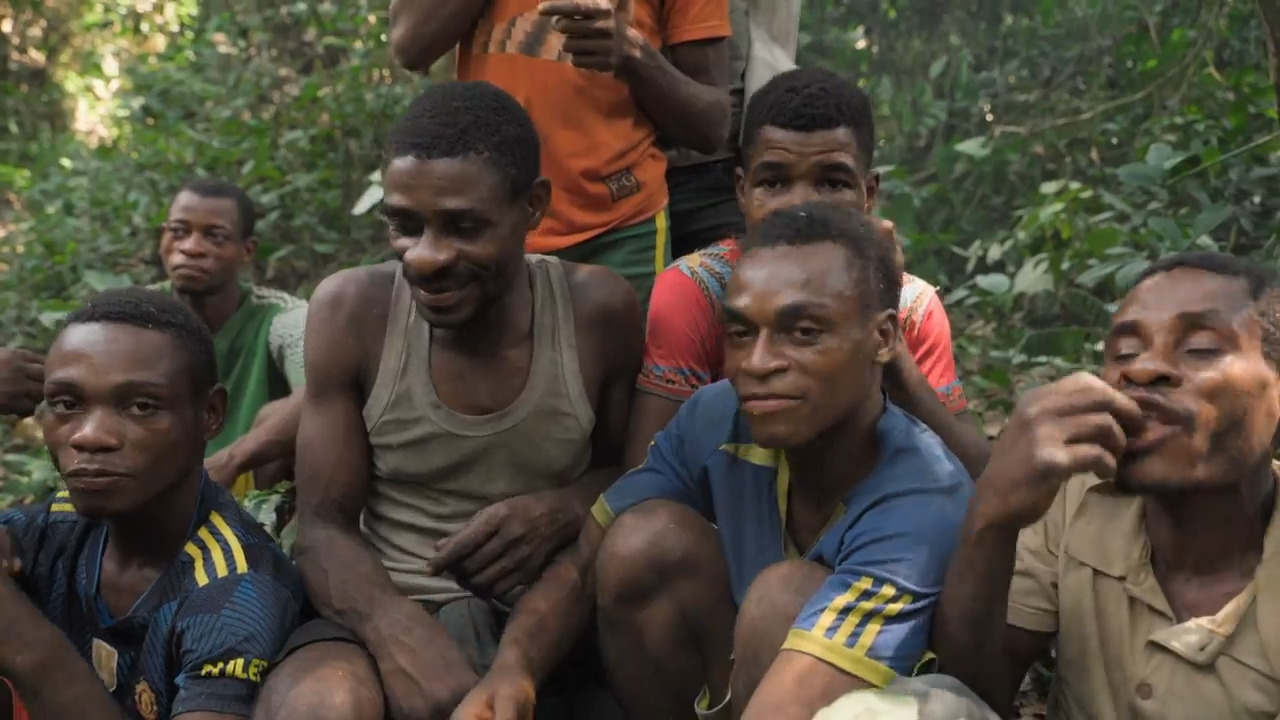
In Honey Hunters of the Congo, host Simon Reeve spends time with the Baka community in the Congo, learning their way of life. He joins the men on a hunt through the rainforest, where they collect fruits, nuts, and fresh honeycomb from a towering tree using a smoker. Back in the village, the Baka share everything they gather, showing unity as a community. Simon gets a taste of the honey and a glimpse of how deeply connected the Baka people are to each other and the rainforest. This video is excerpted from BBC’s Wilderness With Simon Reeve, an epic adventure into the heart of Earth’s last great wild areas, where nature is at its most beautiful and fragile.
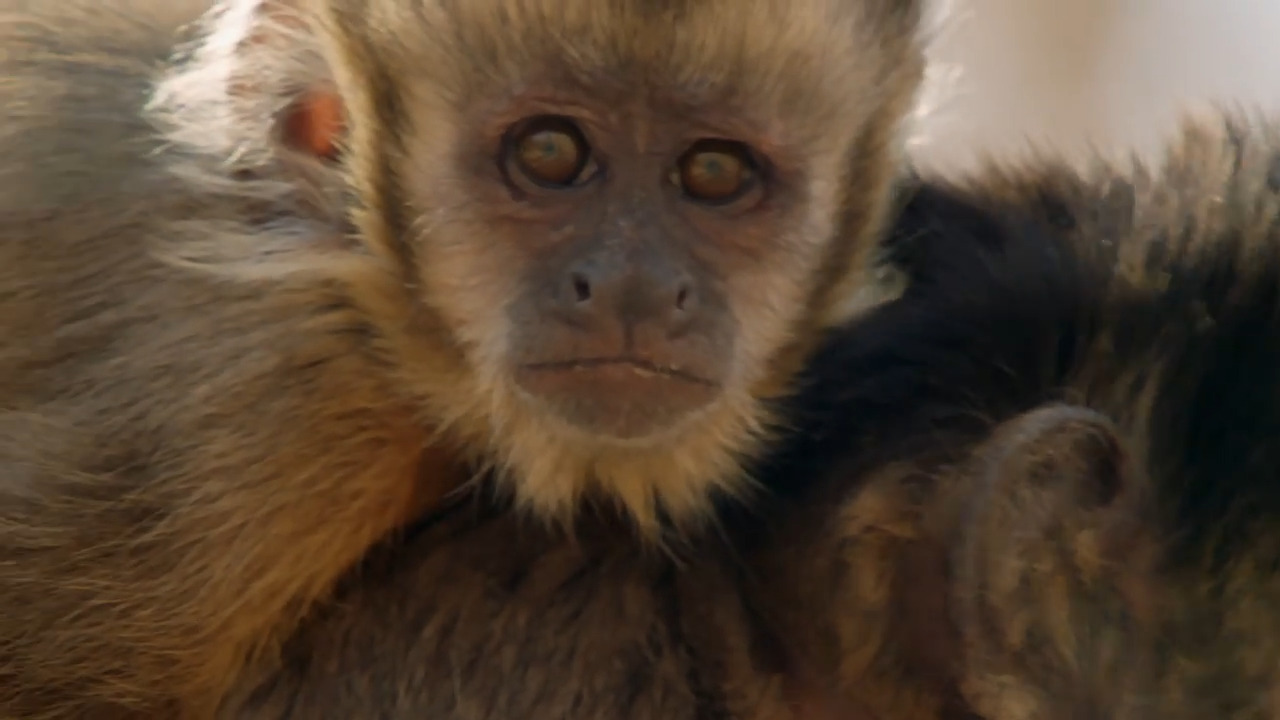
In Tufted Capuchin Babysitters, narrator Gordon Buchanan describes how a tufted capuchin mother discovers there’s honey in a bee’s nest at the top of a canyon. In order to climb to the top, she enlists the help of another capuchin to watch her baby while she makes the climb for the honey. However, the babysitter abandons the young capuchin after she gives in to the temptation to join in on the search for honey. The young capuchin finds itself alone and vulnerable, however after a call to its mother for help, it is quickly reunited with her and out of danger. This video is excerpted from BBC's Animal Babies, a heartwarming show that follows the first breaths, first steps, and first feeds of some adorable baby animals, revealing the challenges they face to survive in some of the toughest but most beautiful places on the planet.
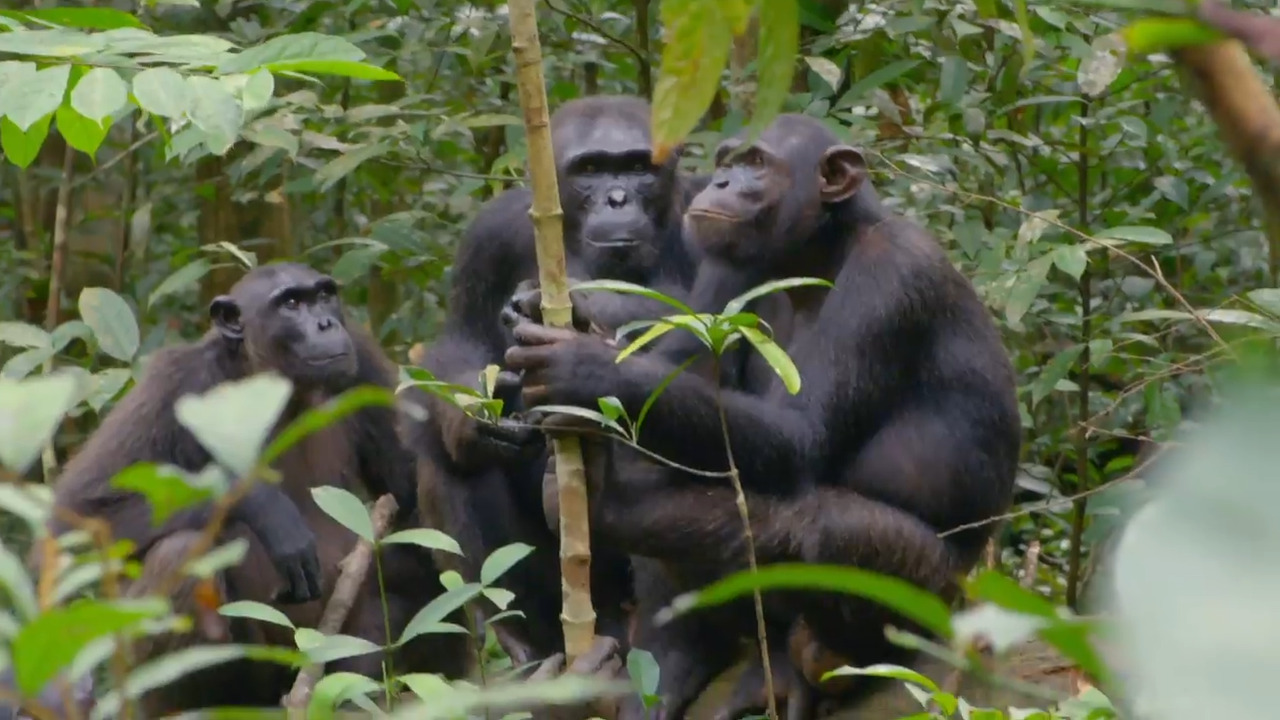
In Clever Chimpanzees, naturalist Steve Backshall comes across chimps in the Loango National Park in Gabon. He watches them engage in behaviors he has never seen before, including working together to get honey. This video is excerpted from BBC's Deadly 60, an award-winning nature and adventure show for kids in which narrator Steve Backshall has one mission: to travel the globe in search of 60 of the world's deadliest animals.
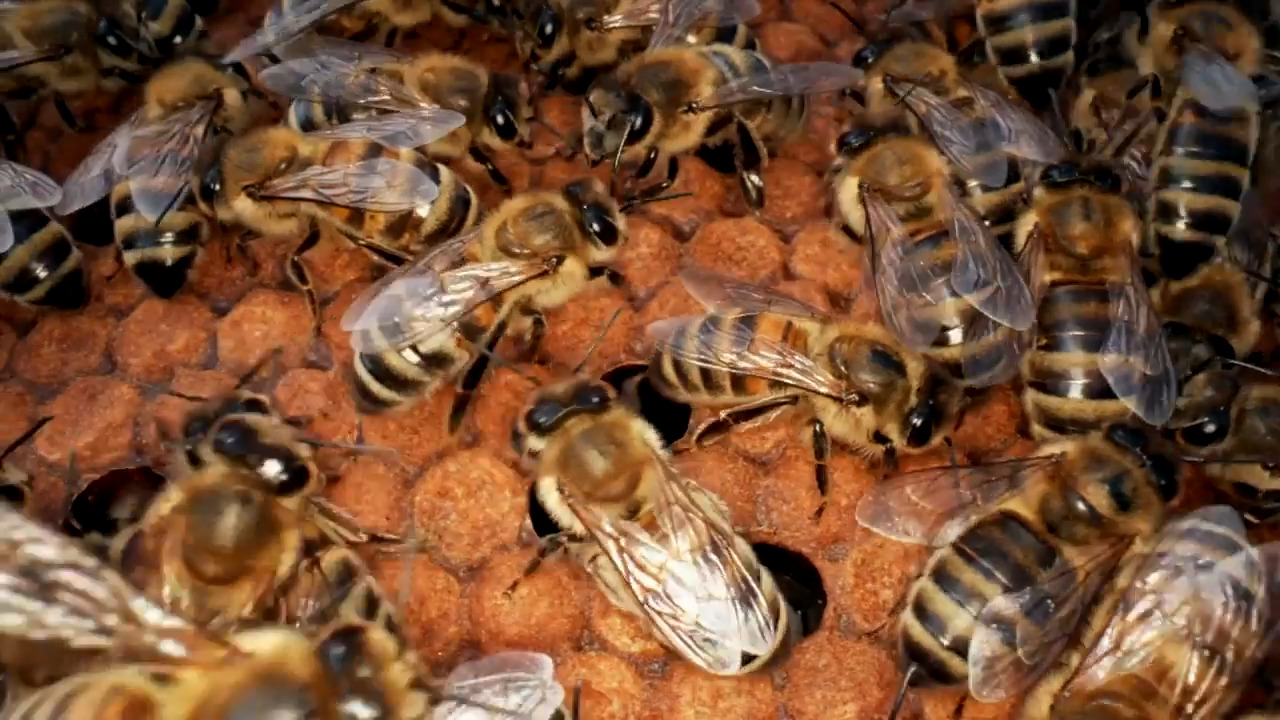
Beekeeper Nick was confused when his bees kept dying off. He kept his hives being stocked with food, so why did he still lose around 75% of the colony? The answer was in what was (or wasn’t) in his bees’ food.
In the wild, bees take what they need from flowers to make honey, and then feed off this honey in the winter. When we take this honey for ourselves, beekeepers replace it with supplementary food in the form of sugar and water, and scientists now say that bees can’t subsist off of just sugar and water, as the simple combination was missing key nutrients. Your parents probably said the same thing about why you can’t just have cake for dinner!
After years of testing different foods for bees, scientists have finally discovered how to make the core ingredient, called “sterole.” Oxford scientists have been developing the best foods for bees, and have found that the bees who consumed the food with sterole were healthier, and had up to 15 times more baby bees! This breakthrough is incredibly important — it means bees can still thrive without floral pollen, which would also help our food security, since bees are so important for pollinating crops.
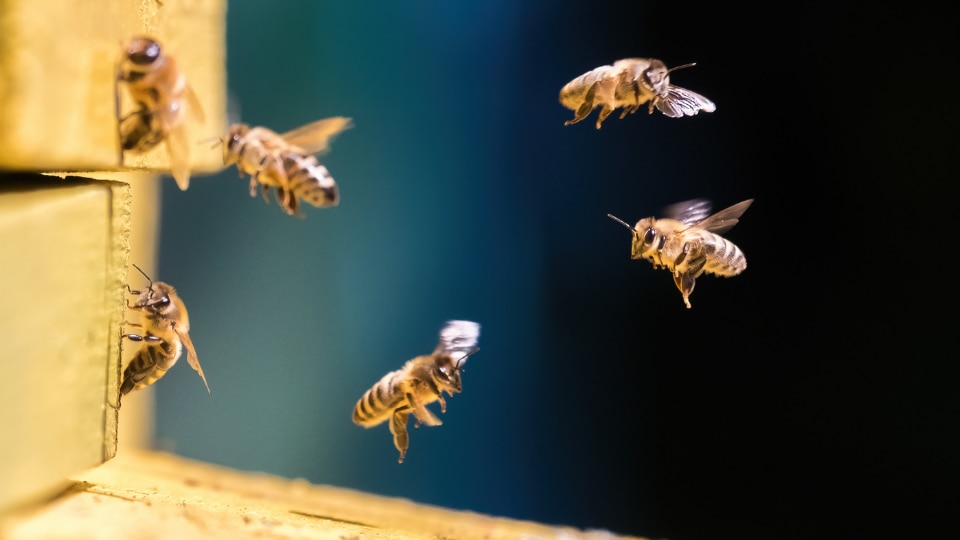
Tiny but mighty, bees play a huge role in keeping our world alive and blooming. As they travel from flower to flower, they carry pollen that helps plants reproduce — supporting ecosystems and much of the food we eat. Inside their hives, bees work together in highly organized communities, each with a job to do.
From pollination to honey-making, this is the ideal quiz to help students ages 8–14 develop their "hive mind."
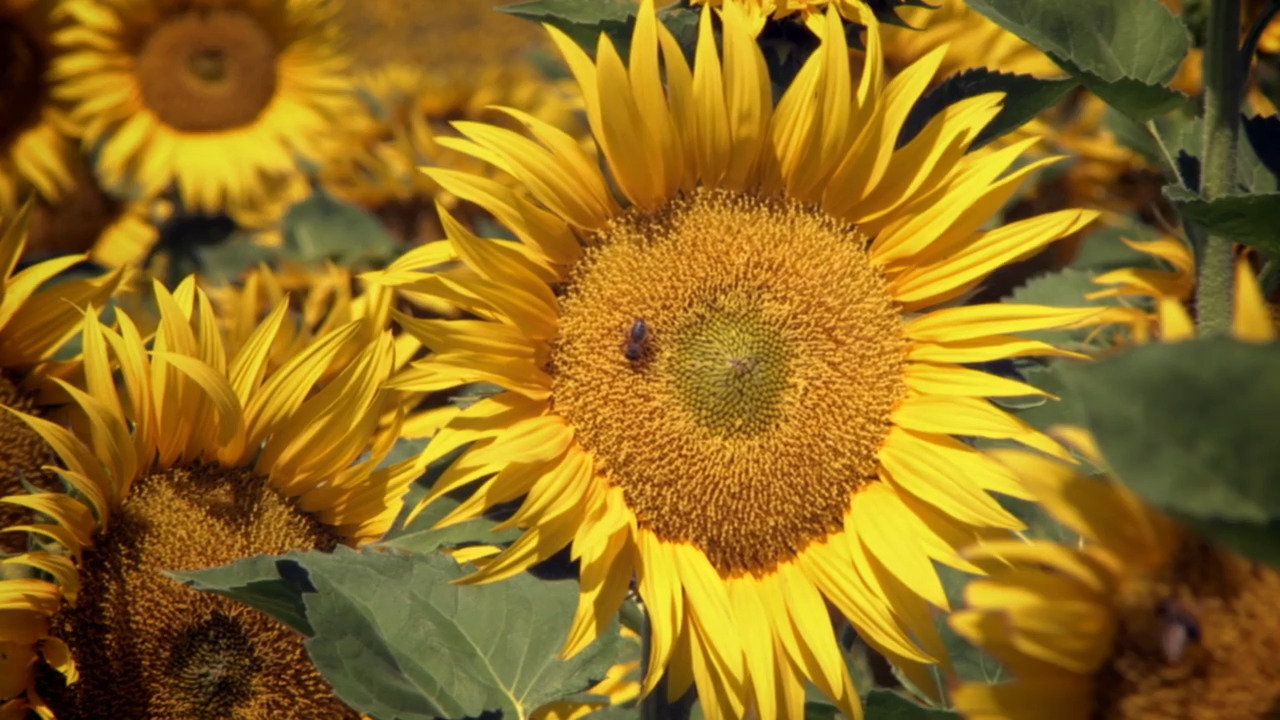
In Clever Ways Plants Reproduce, narrator Sir David Attenborough explains how flowers are amazing problem-solvers when it comes to pollination! In sunny fields of France, sunflowers use nectar to lure insects, which help spread pollen from flower to flower. But in the icy winds of Cradle Mountain, the honey bush protects its delicate parts by fusing its petals, leaving only strong birds to break through and help with pollination. Depending on its environment, flowers are problem-solvers when it comes to reproducing! This video is excerpted from BBC's Life, a show that explores the remarkable strategies animals and plants use to ensure their survival.
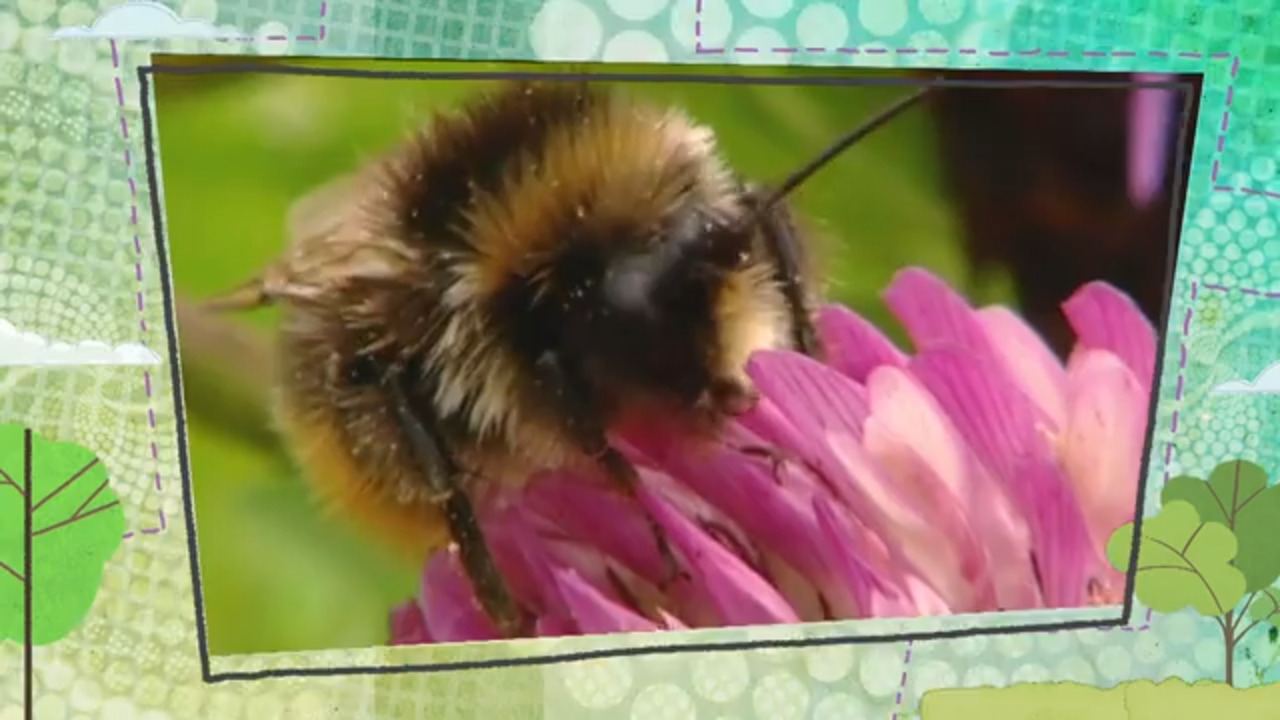
In The Life of a Honeybee!, host Rory Crawford is about to buzz into the exciting world of honeybees! These social creatures live in hives filled with worker bees and one big queen bee who lays all the eggs. Learn how to care for these busy pollinators safely, including using a smoker and wearing a bee suit, while discovering the sweet treasures of honey and beeswax found in their hives! This video is excerpted from BBC’s My Pet and Me, a children’s show that introduces kids to the rewards and responsibilities involved when having a pet.
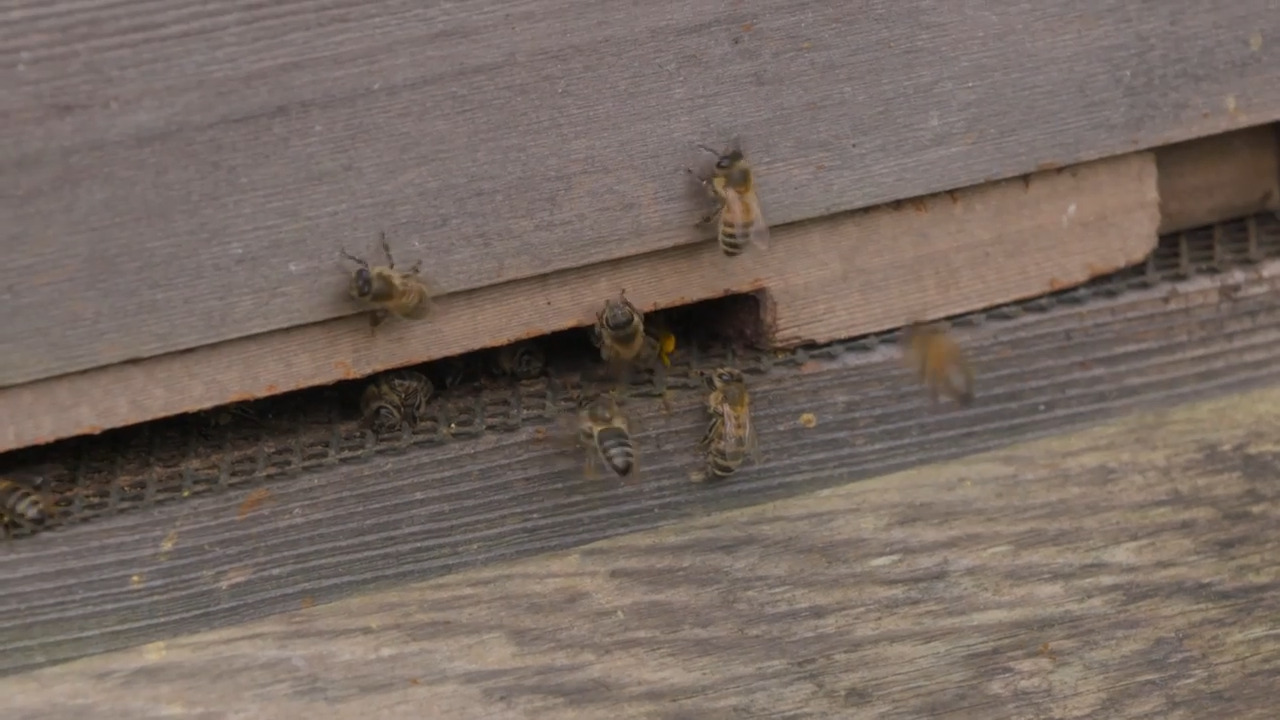
In Life Inside a Beehive, Ranger Hamza and the Ramblers come across a beehive. They look at honeycomb and learn how bees make honey to feed their babies. Join them as they buzz and dance like bees. This video is excerpted from BBC's Ranger Hamza’s Eco Quest, a nature exploration show in which Ranger Hamza and the Ramblers go on quests to discover nature’s wonders and the important role they play in our environment.

Help Doctor Bluey through the maze to her patient, collecting her doctor thingymajigs along the way!
Top Tip: Recycle some old boxes and decorate them to make a doctor surgery for your teddies. Use the bits and bobs from your doctor set too!
Inspired by Season 1 Episode 18 "The Doctor": Honey is stuck in the waiting room with receptionist Bluey as Dr. Bingo prioritises patients with more exciting injuries, until Honey demonstrates how her tail can wag her body.
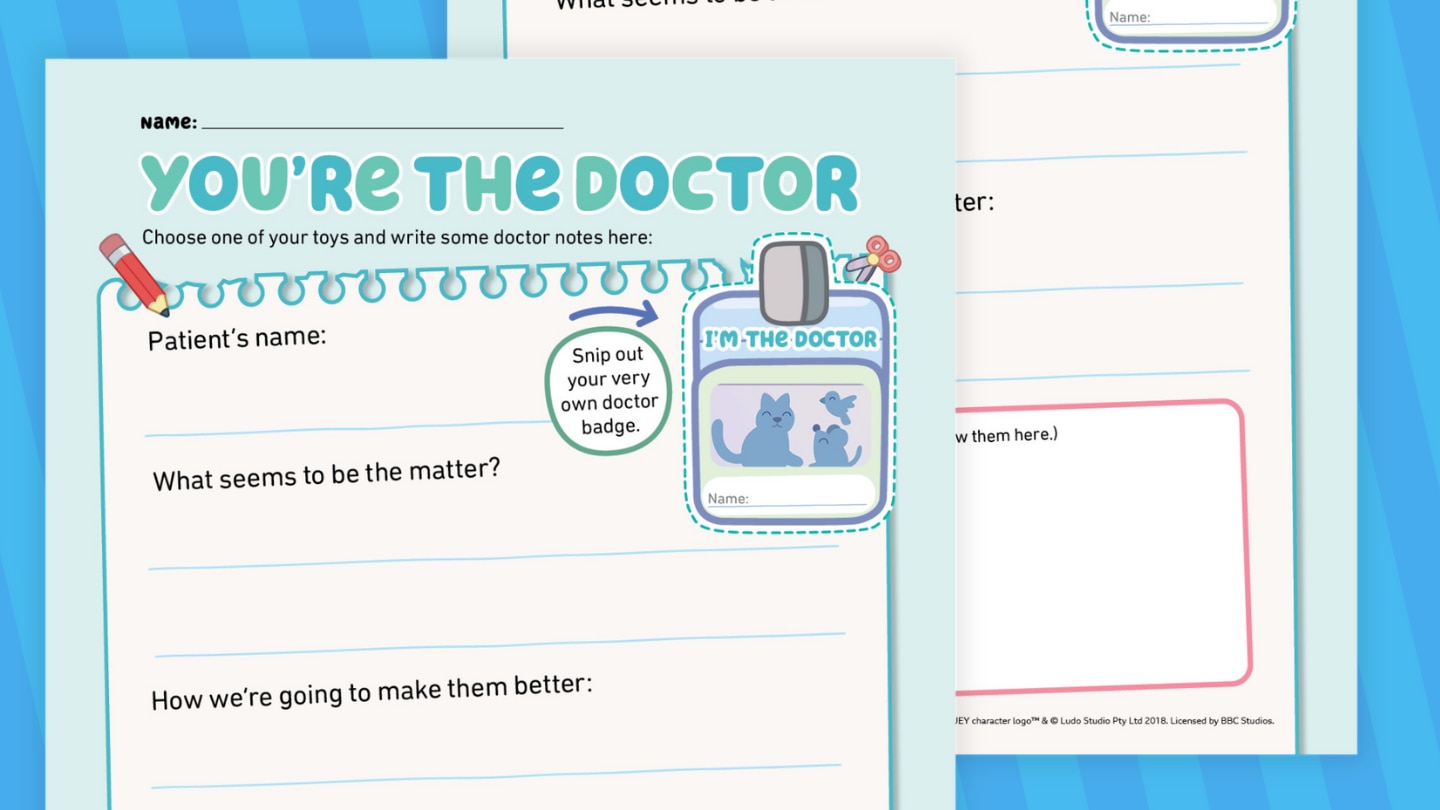
Choose one of your toys and write some doctor notes. Think about:
- What seems to be the matter?
- How we're going to make them better
Plus, get your very own doctor badge!
Inspired by Season 1, Episode 18: Honey is stuck in the waiting room with receptionist Bluey as Dr. Bingo prioritises patients with more exciting injuries, until Honey demonstrates how her tail can wag her body.

Hey, kiddos! Doctor Bingo's office is full of patients in a pickle. She needs your help to fix 'em up. Start by filling out a patient form for Honey... or anyone else. Doctor Bingo will see you know! Next, help the rest of the patients:
- Snickers has cuddled a cactus! Ouch! Color band-aids on him
- Indy's arms fell off when she hung out the washing! Draw some new ones for her
- Lucky has a croc on his head! What will help?
- Rusty is burping hippos! How many are there?
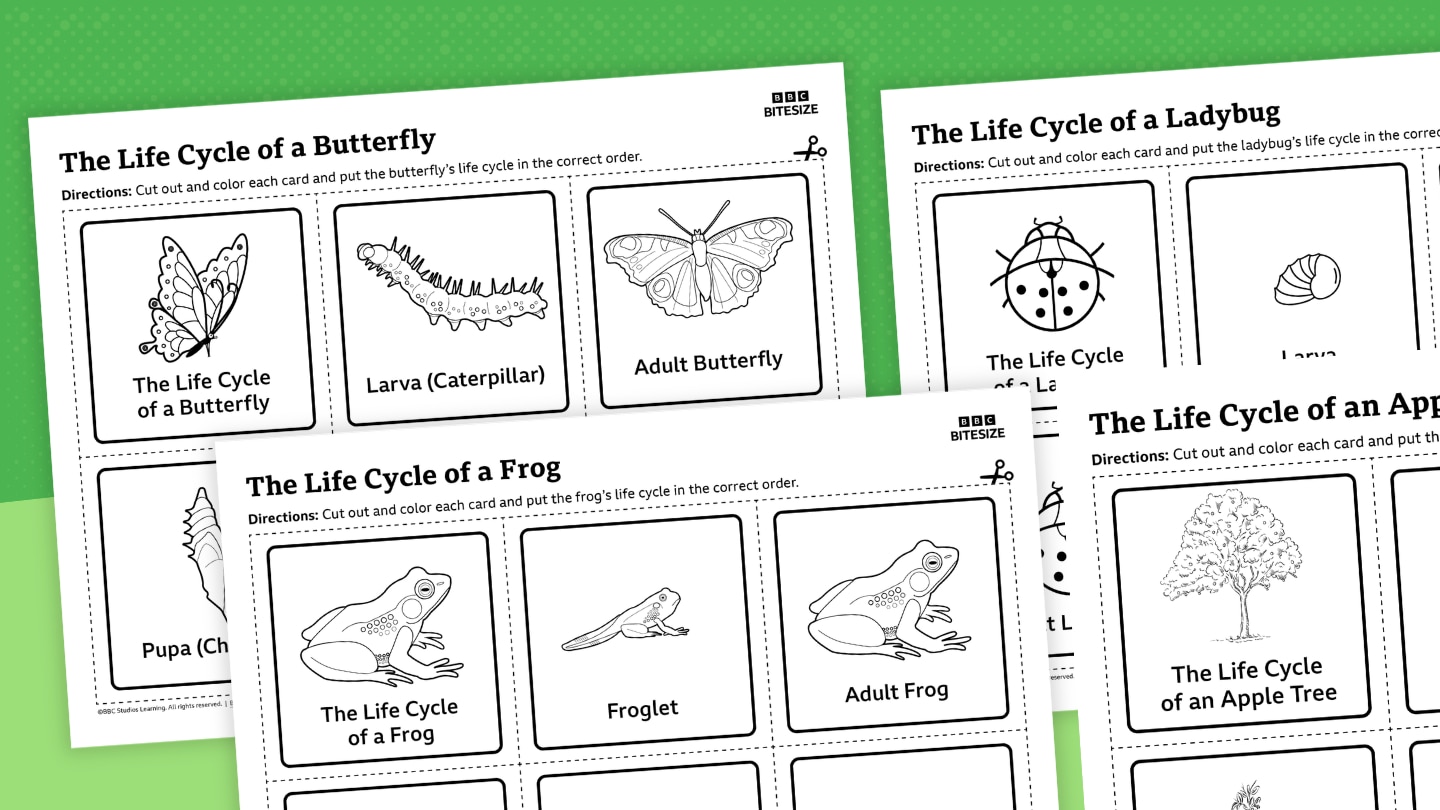
Invite your students to explore the life cycles of common organisms with these life cycle sequencing cards. The cards cover the bean plant, butterfly, birch tree, apple tree, honeybee, ladybug, and frog. They come already mixed up, so kids can color, cut, and put them in order. Use as an introductory task, check for understanding, center activity, or study guide!
As you introduce life cycles, focus on key concepts such as stages of growth, changes in form and function, and the idea that all living things follow a pattern from beginning to end. Encourage students to ask questions, make predictions, and notice patterns across plants and animals.
Teaching life cycles in elementary school is not only standards-based, it's also a great way to help students understand how living things grow and change over time. At this level, students are ready to explore clear, observable stages — like seed to plant or egg to adult—and begin comparing similarities and differences across species.
In Honey Hunters of the Congo, host Simon Reeve spends time with the Baka community in the Congo, learning their way of life. He joins the men on a hunt through the rainforest, where they collect fruits, nuts, and fresh honeycomb from a towering tree using a smoker. Back in the village, the Baka share everything they gather, showing unity as a community. Simon gets a taste of the honey and a glimpse of how deeply connected the Baka people are to each other and the rainforest. This video is excerpted from BBC’s Wilderness With Simon Reeve, an epic adventure into the heart of Earth’s last great wild areas, where nature is at its most beautiful and fragile.
In Tufted Capuchin Babysitters, narrator Gordon Buchanan describes how a tufted capuchin mother discovers there’s honey in a bee’s nest at the top of a canyon. In order to climb to the top, she enlists the help of another capuchin to watch her baby while she makes the climb for the honey. However, the babysitter abandons the young capuchin after she gives in to the temptation to join in on the search for honey. The young capuchin finds itself alone and vulnerable, however after a call to its mother for help, it is quickly reunited with her and out of danger. This video is excerpted from BBC's Animal Babies, a heartwarming show that follows the first breaths, first steps, and first feeds of some adorable baby animals, revealing the challenges they face to survive in some of the toughest but most beautiful places on the planet.
In Clever Chimpanzees, naturalist Steve Backshall comes across chimps in the Loango National Park in Gabon. He watches them engage in behaviors he has never seen before, including working together to get honey. This video is excerpted from BBC's Deadly 60, an award-winning nature and adventure show for kids in which narrator Steve Backshall has one mission: to travel the globe in search of 60 of the world's deadliest animals.
Beekeeper Nick was confused when his bees kept dying off. He kept his hives being stocked with food, so why did he still lose around 75% of the colony? The answer was in what was (or wasn’t) in his bees’ food.
In the wild, bees take what they need from flowers to make honey, and then feed off this honey in the winter. When we take this honey for ourselves, beekeepers replace it with supplementary food in the form of sugar and water, and scientists now say that bees can’t subsist off of just sugar and water, as the simple combination was missing key nutrients. Your parents probably said the same thing about why you can’t just have cake for dinner!
After years of testing different foods for bees, scientists have finally discovered how to make the core ingredient, called “sterole.” Oxford scientists have been developing the best foods for bees, and have found that the bees who consumed the food with sterole were healthier, and had up to 15 times more baby bees! This breakthrough is incredibly important — it means bees can still thrive without floral pollen, which would also help our food security, since bees are so important for pollinating crops.
Tiny but mighty, bees play a huge role in keeping our world alive and blooming. As they travel from flower to flower, they carry pollen that helps plants reproduce — supporting ecosystems and much of the food we eat. Inside their hives, bees work together in highly organized communities, each with a job to do.
From pollination to honey-making, this is the ideal quiz to help students ages 8–14 develop their "hive mind."
In Clever Ways Plants Reproduce, narrator Sir David Attenborough explains how flowers are amazing problem-solvers when it comes to pollination! In sunny fields of France, sunflowers use nectar to lure insects, which help spread pollen from flower to flower. But in the icy winds of Cradle Mountain, the honey bush protects its delicate parts by fusing its petals, leaving only strong birds to break through and help with pollination. Depending on its environment, flowers are problem-solvers when it comes to reproducing! This video is excerpted from BBC's Life, a show that explores the remarkable strategies animals and plants use to ensure their survival.
In The Life of a Honeybee!, host Rory Crawford is about to buzz into the exciting world of honeybees! These social creatures live in hives filled with worker bees and one big queen bee who lays all the eggs. Learn how to care for these busy pollinators safely, including using a smoker and wearing a bee suit, while discovering the sweet treasures of honey and beeswax found in their hives! This video is excerpted from BBC’s My Pet and Me, a children’s show that introduces kids to the rewards and responsibilities involved when having a pet.
In Life Inside a Beehive, Ranger Hamza and the Ramblers come across a beehive. They look at honeycomb and learn how bees make honey to feed their babies. Join them as they buzz and dance like bees. This video is excerpted from BBC's Ranger Hamza’s Eco Quest, a nature exploration show in which Ranger Hamza and the Ramblers go on quests to discover nature’s wonders and the important role they play in our environment.
Help Doctor Bluey through the maze to her patient, collecting her doctor thingymajigs along the way!
Top Tip: Recycle some old boxes and decorate them to make a doctor surgery for your teddies. Use the bits and bobs from your doctor set too!
Inspired by Season 1 Episode 18 "The Doctor": Honey is stuck in the waiting room with receptionist Bluey as Dr. Bingo prioritises patients with more exciting injuries, until Honey demonstrates how her tail can wag her body.
Choose one of your toys and write some doctor notes. Think about:
- What seems to be the matter?
- How we're going to make them better
Plus, get your very own doctor badge!
Inspired by Season 1, Episode 18: Honey is stuck in the waiting room with receptionist Bluey as Dr. Bingo prioritises patients with more exciting injuries, until Honey demonstrates how her tail can wag her body.
Hey, kiddos! Doctor Bingo's office is full of patients in a pickle. She needs your help to fix 'em up. Start by filling out a patient form for Honey... or anyone else. Doctor Bingo will see you know! Next, help the rest of the patients:
- Snickers has cuddled a cactus! Ouch! Color band-aids on him
- Indy's arms fell off when she hung out the washing! Draw some new ones for her
- Lucky has a croc on his head! What will help?
- Rusty is burping hippos! How many are there?
Invite your students to explore the life cycles of common organisms with these life cycle sequencing cards. The cards cover the bean plant, butterfly, birch tree, apple tree, honeybee, ladybug, and frog. They come already mixed up, so kids can color, cut, and put them in order. Use as an introductory task, check for understanding, center activity, or study guide!
As you introduce life cycles, focus on key concepts such as stages of growth, changes in form and function, and the idea that all living things follow a pattern from beginning to end. Encourage students to ask questions, make predictions, and notice patterns across plants and animals.
Teaching life cycles in elementary school is not only standards-based, it's also a great way to help students understand how living things grow and change over time. At this level, students are ready to explore clear, observable stages — like seed to plant or egg to adult—and begin comparing similarities and differences across species.