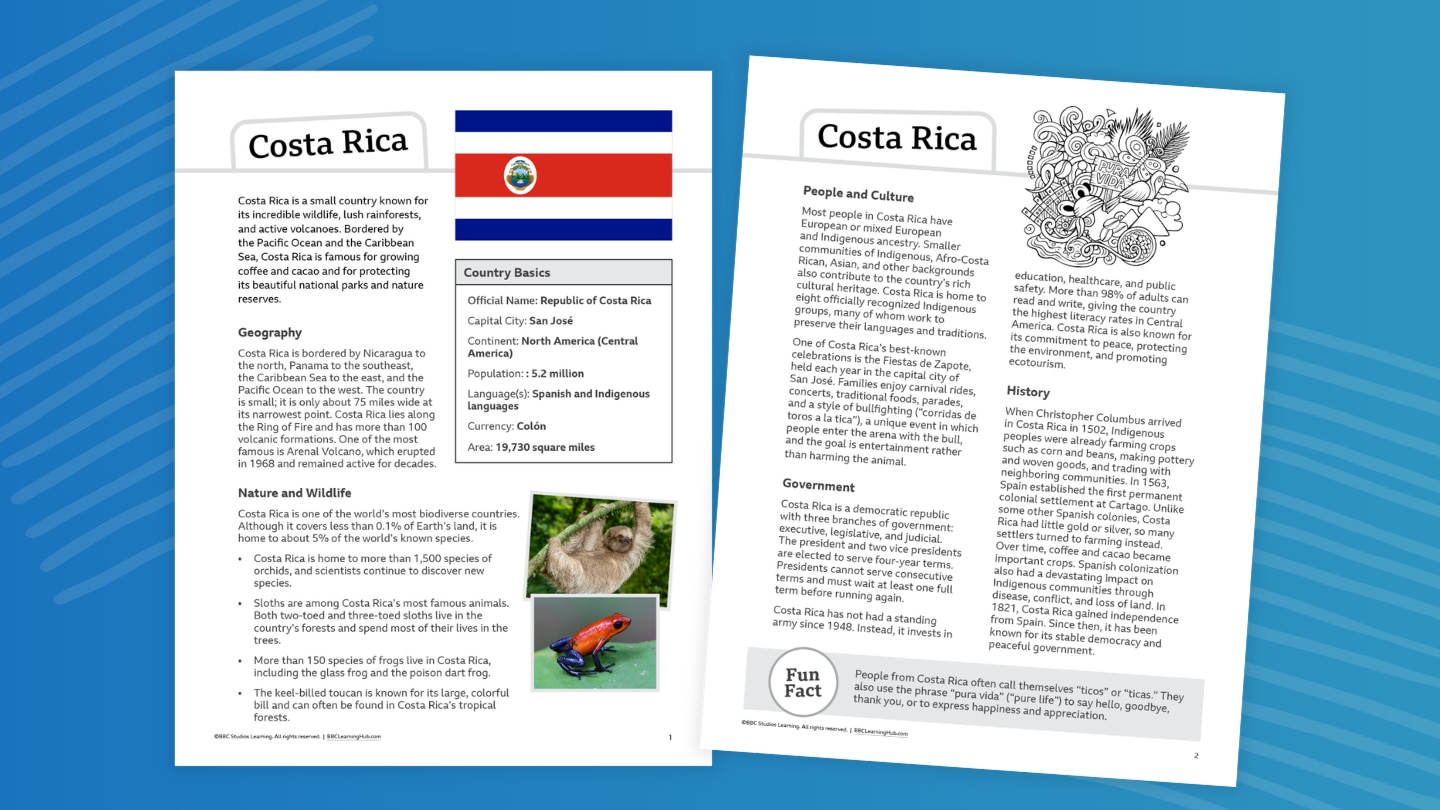
What small country is home to an astonishing variety of plants and animals, hundreds of volcanoes, and tropical forests stretching from coast to coast? Meet Costa Rica, a Central American country known for its incredible biodiversity and commitment to protecting nature.
From sloths and glass frogs to colorful toucans and thousands of orchids, Costa Rica is packed with wildlife. Discover how Indigenous peoples and Spanish colonization shaped the country, learn about its government and culture, and explore traditions such as the Fiestas de Zapote and "pura vida." You’ll also find out why Costa Rica has become a leader in protecting forests, wildlife, and other natural resources.
Teachers and parents, you can use this fact file to:
- Introduce a geography or social studies unit
- Support nonfiction reading practice
- Compare countries and cultures
- Complete map and research activities
- Prepare students for projects or presentations (use our country report template!)
- Pair with videos, articles, or other informational texts (see Related Resources below)
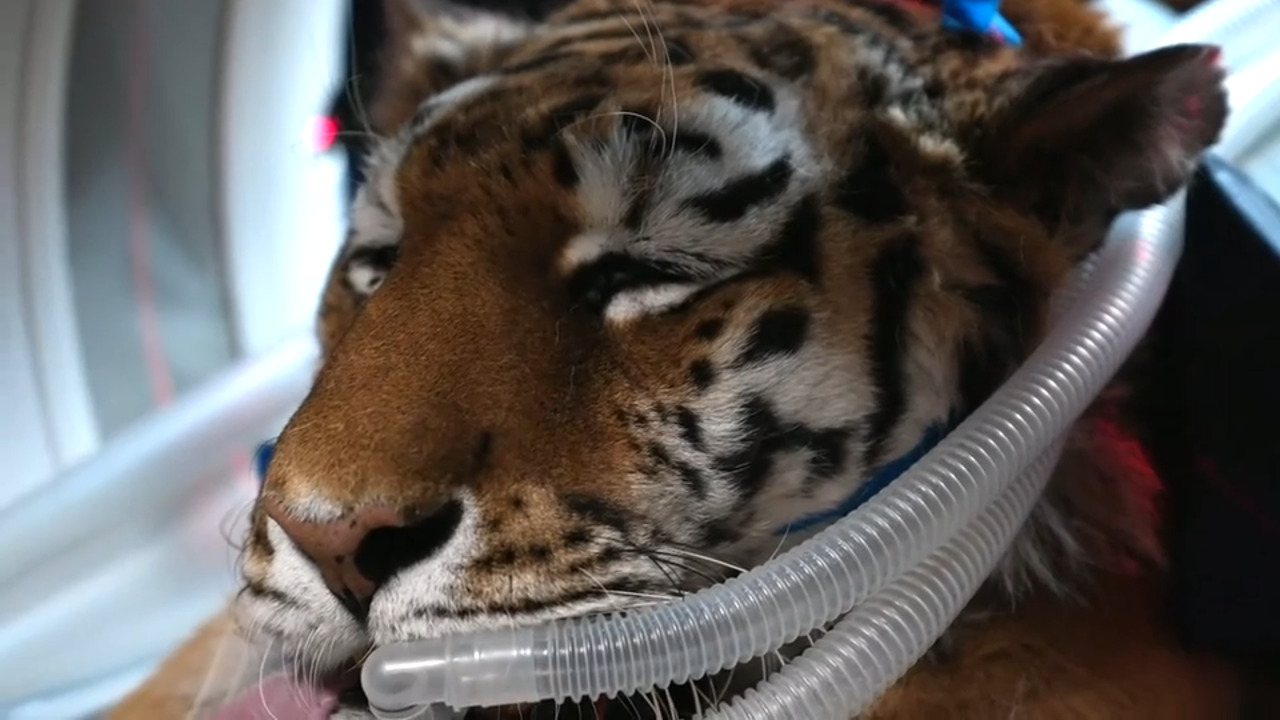
Did somebody say CAT scan? The Norfolk Zoo is doubling down on the idea of a big CAT scan by giving a big cat a scan! A tiger named Mishka is one of many animal patients that the zoo is sending through a CAT, or CT, scan. Short for “computerized axial tomography” or “computed tomography,” depending on how much time you have and how much you want to impress your friends, CT scans use a combination of X-rays and computer technology to help see inside bodies, produced detailed images of bones, organs, and soft tissue.
To the untrained eye, the scan’s grey and white blobs may look like, well, blobs. But, skilled professionals will be able to see if they show any abnormalities in bones or soft tissues. In addition to Mishka, the zoo also checked out other animals like a vulture, penguin, and sloth.
Their scans will not only help animals at the zoo, but in the wild, too. The findings will be added to the base knowledge on a species or animal, which can be shared with experts and vet colleagues globally.

The article "Exploring Costa Rica’s Rich Wildlife: Which Animals Can You See?" from BBC's Discover Wildlife explores the incredible range of animals that live in Costa Rica. From howler monkeys whose calls can be heard over long distances, to the rare jaguar, the country is home to some of the most unique species in the world. It also highlights vibrant creatures like the resplendent quetzal and endangered sea turtles.
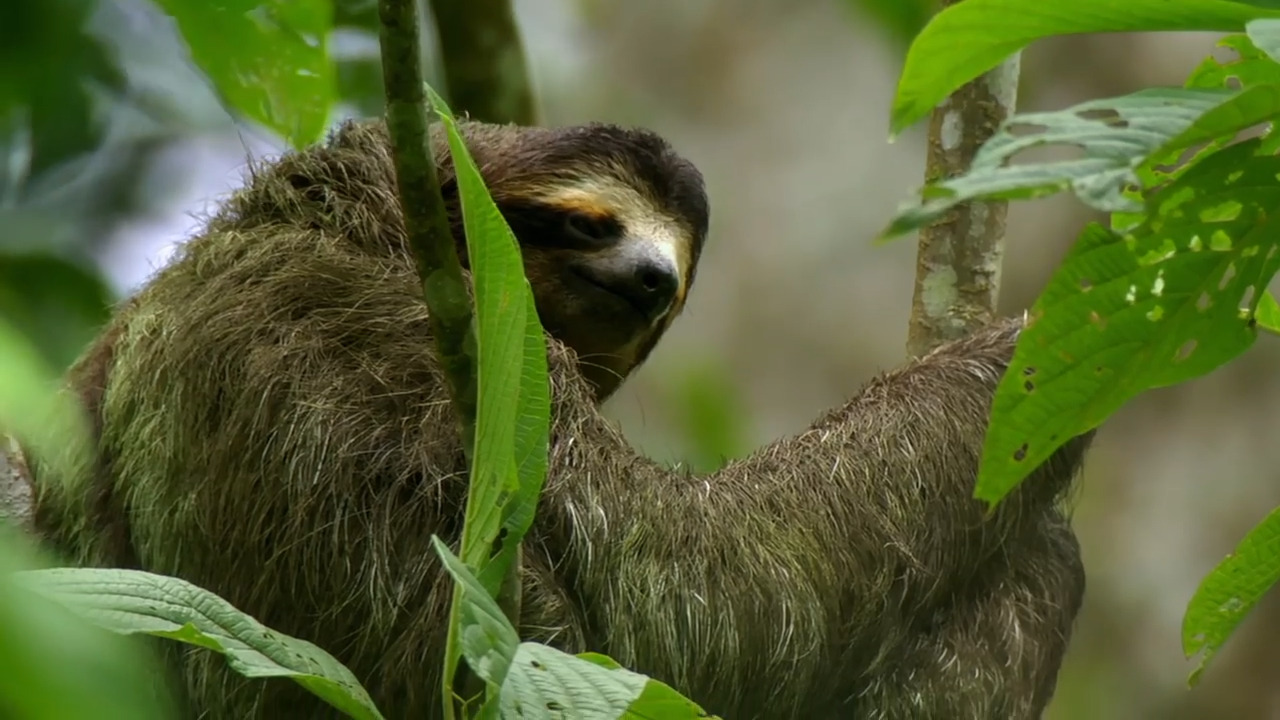
In Sloths, Masters of Slow and Steady, evolutionary biologist Ben Garrod describes how a sloth's skin provides unique camouflage, helping it blend into its environment for protection. Discover the symbiotic relationship between sloths and algae, which grows on their fur and gives them a greenish tint. This algae offers camouflage while also supporting moths that help fertilize the algae. Through this fascinating example of nature’s design, see how animals and plants can depend on each other in unexpected ways. This video is excerpted from Secrets of Skin, a documentary series exploring the natural history of the body’s largest organ.
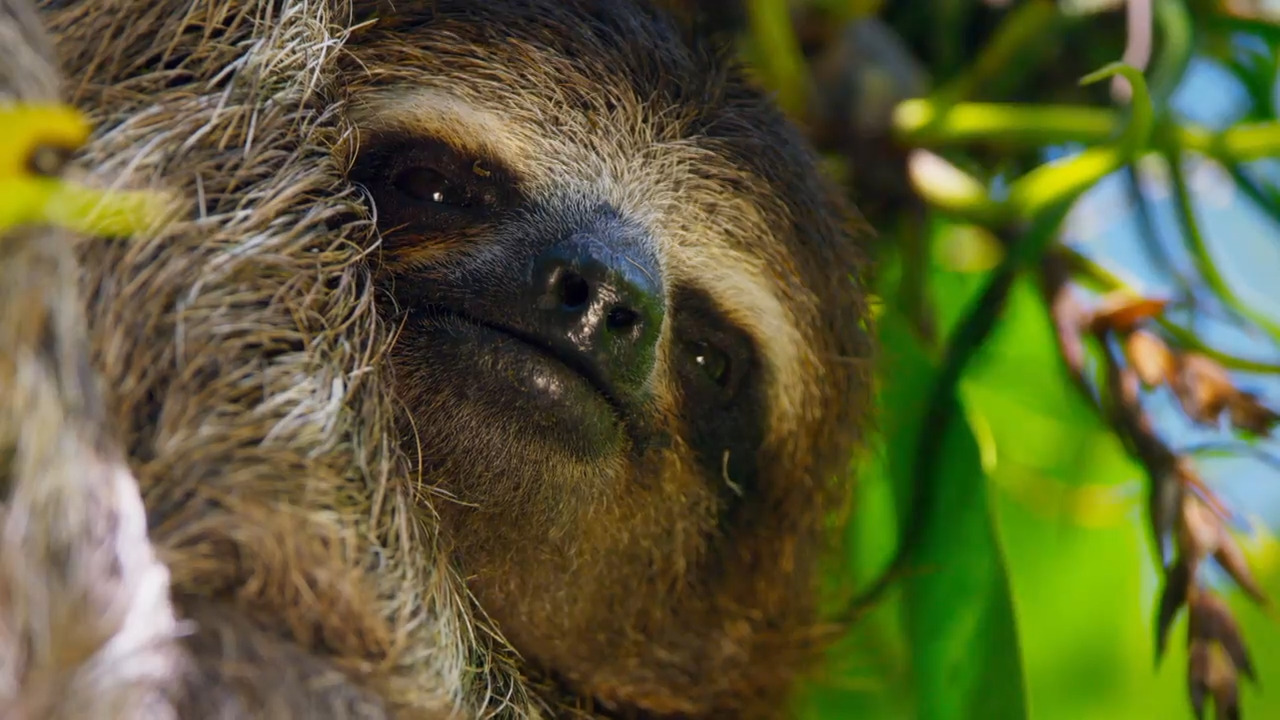
In The Pygmy Sloth's Search for a Mate, narrator Sir David Attenborough explains the unique challenges faced by pygmy sloths on Escudo de Veraguas Island. Although the island offers food and safety, it also creates isolation that makes it difficult for male pygmy sloths to find a mate. This video is excerpted from BBC’s Planet Earth II, a breathtaking documentary series that highlights the natural wonders of our planet.
What small country is home to an astonishing variety of plants and animals, hundreds of volcanoes, and tropical forests stretching from coast to coast? Meet Costa Rica, a Central American country known for its incredible biodiversity and commitment to protecting nature.
From sloths and glass frogs to colorful toucans and thousands of orchids, Costa Rica is packed with wildlife. Discover how Indigenous peoples and Spanish colonization shaped the country, learn about its government and culture, and explore traditions such as the Fiestas de Zapote and "pura vida." You’ll also find out why Costa Rica has become a leader in protecting forests, wildlife, and other natural resources.
Teachers and parents, you can use this fact file to:
- Introduce a geography or social studies unit
- Support nonfiction reading practice
- Compare countries and cultures
- Complete map and research activities
- Prepare students for projects or presentations (use our country report template!)
- Pair with videos, articles, or other informational texts (see Related Resources below)
Did somebody say CAT scan? The Norfolk Zoo is doubling down on the idea of a big CAT scan by giving a big cat a scan! A tiger named Mishka is one of many animal patients that the zoo is sending through a CAT, or CT, scan. Short for “computerized axial tomography” or “computed tomography,” depending on how much time you have and how much you want to impress your friends, CT scans use a combination of X-rays and computer technology to help see inside bodies, produced detailed images of bones, organs, and soft tissue.
To the untrained eye, the scan’s grey and white blobs may look like, well, blobs. But, skilled professionals will be able to see if they show any abnormalities in bones or soft tissues. In addition to Mishka, the zoo also checked out other animals like a vulture, penguin, and sloth.
Their scans will not only help animals at the zoo, but in the wild, too. The findings will be added to the base knowledge on a species or animal, which can be shared with experts and vet colleagues globally.
The article "Exploring Costa Rica’s Rich Wildlife: Which Animals Can You See?" from BBC's Discover Wildlife explores the incredible range of animals that live in Costa Rica. From howler monkeys whose calls can be heard over long distances, to the rare jaguar, the country is home to some of the most unique species in the world. It also highlights vibrant creatures like the resplendent quetzal and endangered sea turtles.
In Sloths, Masters of Slow and Steady, evolutionary biologist Ben Garrod describes how a sloth's skin provides unique camouflage, helping it blend into its environment for protection. Discover the symbiotic relationship between sloths and algae, which grows on their fur and gives them a greenish tint. This algae offers camouflage while also supporting moths that help fertilize the algae. Through this fascinating example of nature’s design, see how animals and plants can depend on each other in unexpected ways. This video is excerpted from Secrets of Skin, a documentary series exploring the natural history of the body’s largest organ.
In The Pygmy Sloth's Search for a Mate, narrator Sir David Attenborough explains the unique challenges faced by pygmy sloths on Escudo de Veraguas Island. Although the island offers food and safety, it also creates isolation that makes it difficult for male pygmy sloths to find a mate. This video is excerpted from BBC’s Planet Earth II, a breathtaking documentary series that highlights the natural wonders of our planet.