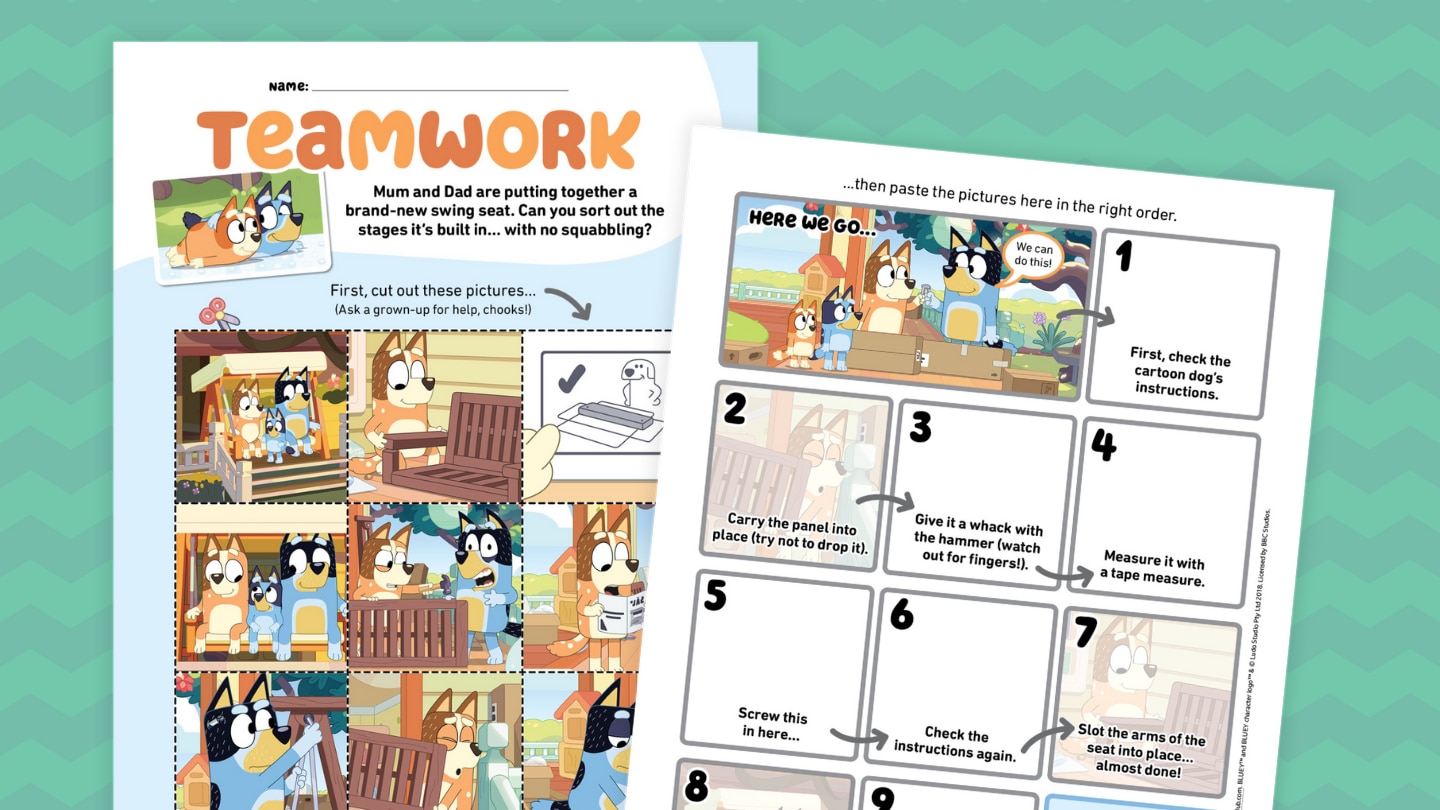
Teamwork makes the swing work! Mum and Dad are putting together a brand-new swing seat. Can you sort out the stages it’s built in... with no squabbling? First, cut out the pictures and then paste them in the right order (use the words in the boxes to help you!).
Inspired by Season 2, Episode 24 "Flatpack": With Mum and Dad assembling the flatpack furniture, the kids improvise games with the discarded wrapping materials. As the flatpack swing-seat takes shape, so does Bluey and Bingo’s mini-world.
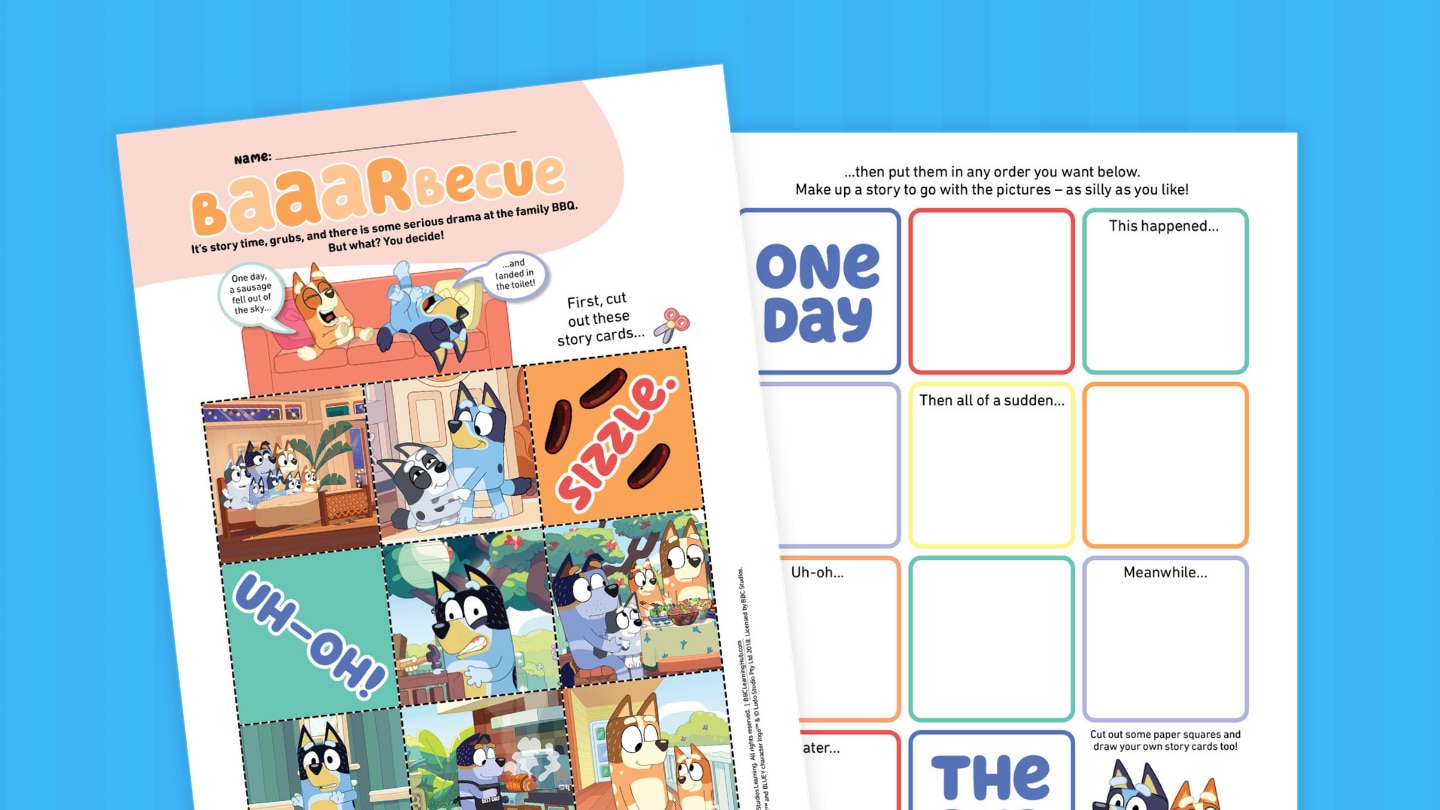
It's story time, grubs, and there is some serious drama at the family BBQ. But what? You decide. First, cut out the story cards and then put them in any order you want. Make up a story to go with the pictures — as silly as you like! Cut out some paper squares and draw your own story cards too!
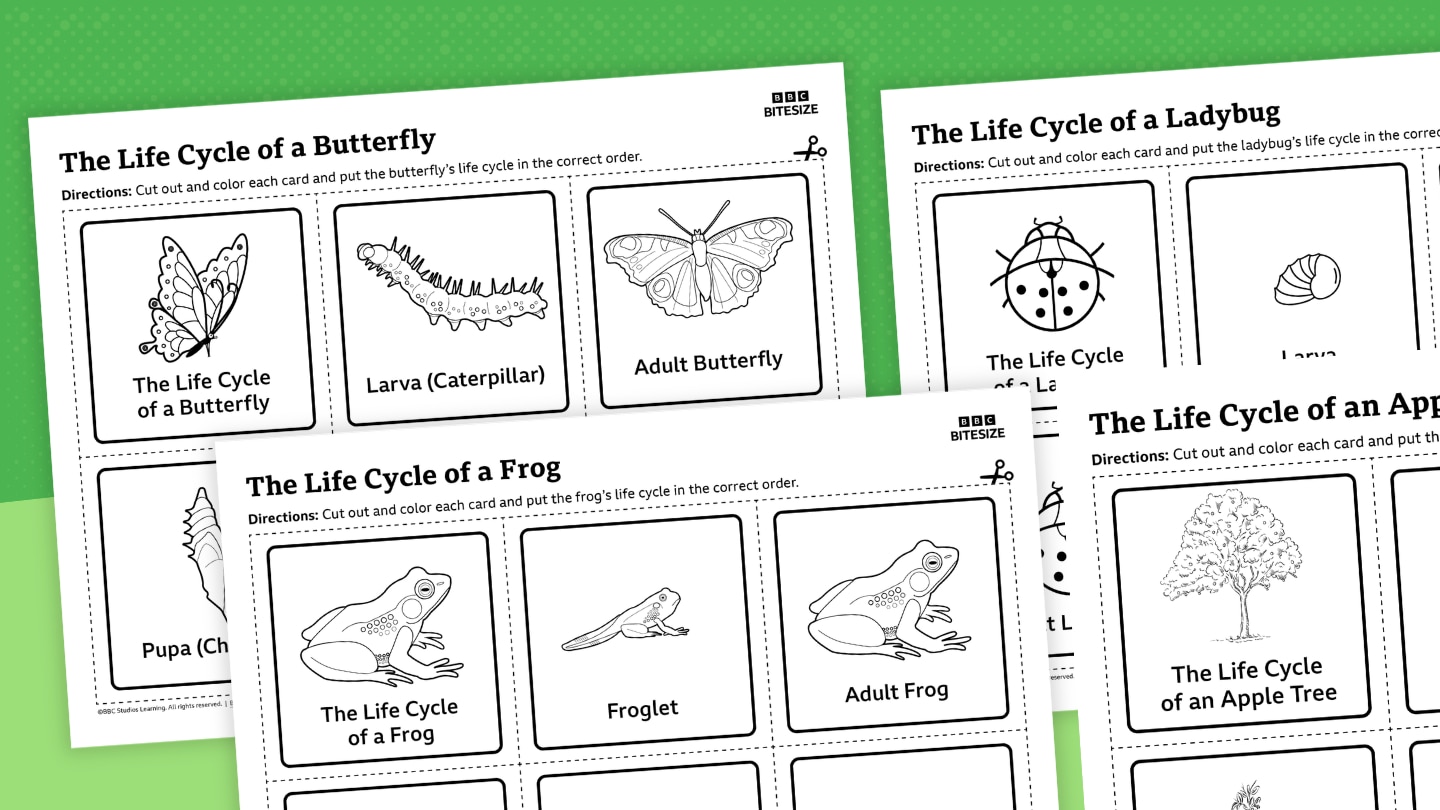
Invite your students to explore the life cycles of common organisms with these life cycle sequencing cards. The cards cover the bean plant, butterfly, birch tree, apple tree, honeybee, ladybug, and frog. They come already mixed up, so kids can color, cut, and put them in order. Use as an introductory task, check for understanding, center activity, or study guide!
As you introduce life cycles, focus on key concepts such as stages of growth, changes in form and function, and the idea that all living things follow a pattern from beginning to end. Encourage students to ask questions, make predictions, and notice patterns across plants and animals.
Teaching life cycles in elementary school is not only standards-based, it's also a great way to help students understand how living things grow and change over time. At this level, students are ready to explore clear, observable stages — like seed to plant or egg to adult—and begin comparing similarities and differences across species.
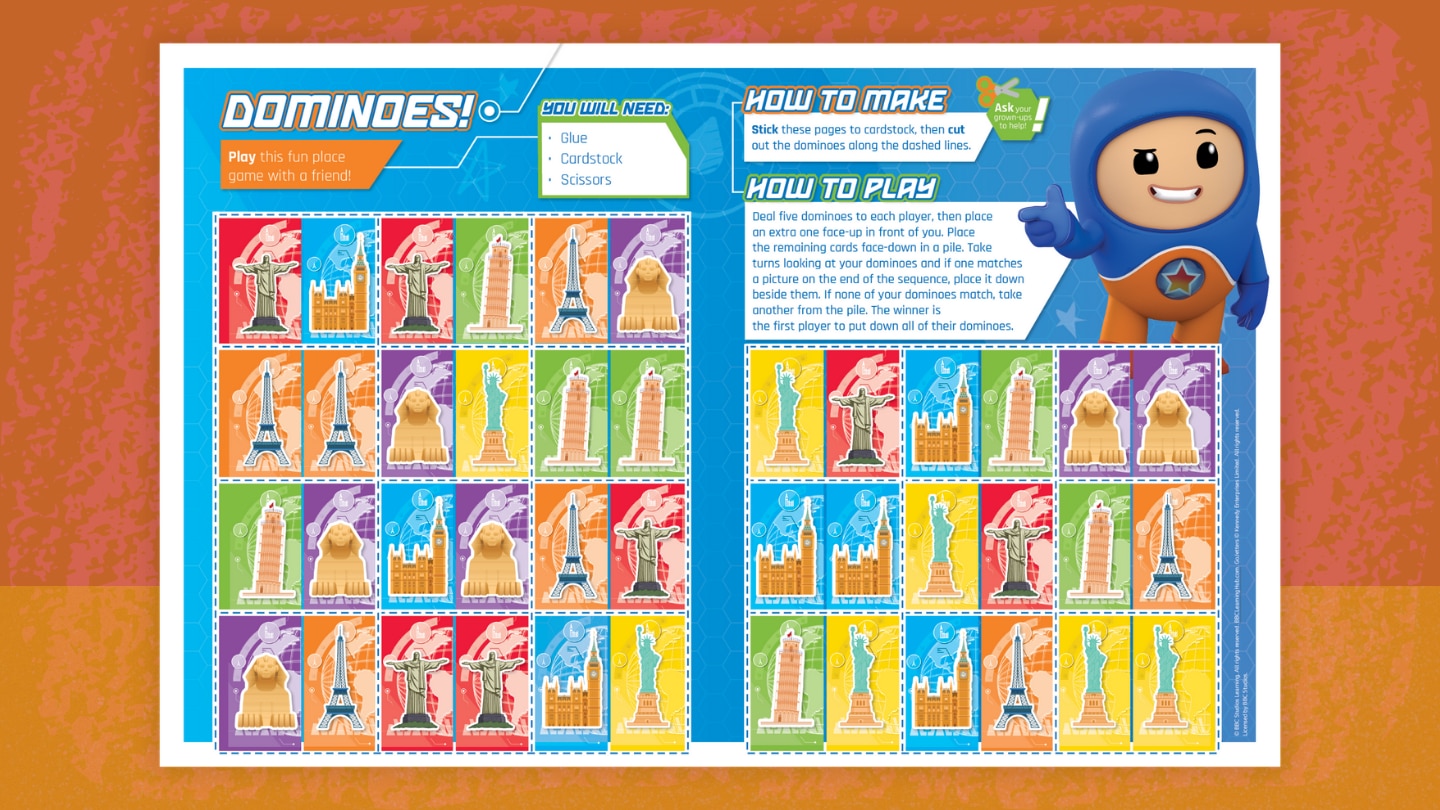
Play this fun Go Jetters dominoes game (featuring famous world landmarks) with a friend! Here's how to play:
- Deal five dominoes to each player, then place an extra one face-up in front of you.
- Place the remaining cards face-down in a pile.
- Take turns looking at your dominoes and if one matches a picture on the end of the sequence, place it down beside them. If none of your dominoes match, take another from the pile.
- The winner is the first player to put down all of their dominoes.
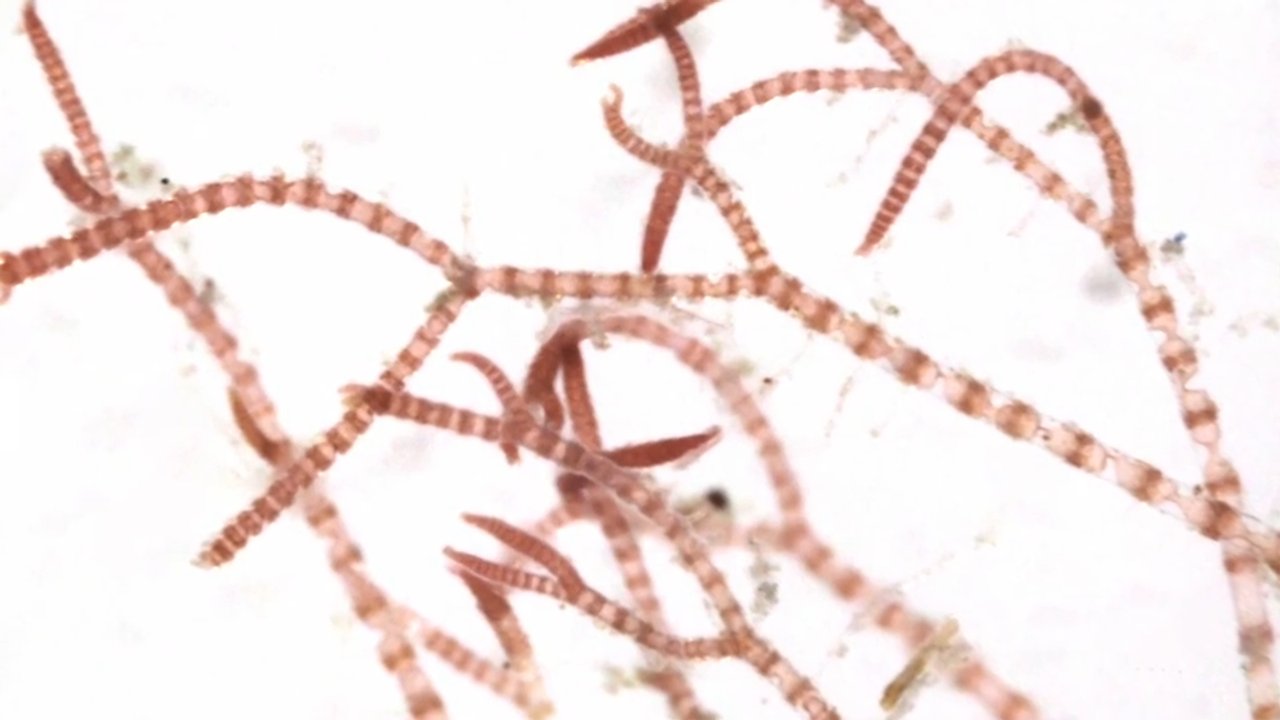
It's not often you see people really excited about seaweed (unless it's wrapped around all-you-can-eat sushi), but a tiny seaweed growing off the coast of Cornwall — a rugged coastal region in southwest England — has got scientists buzzing.
Divers found a new type of seaweed growing on a larger, coral-like seaweed called maerl. Well, it's not really "new" in the sense of just appearing — Professor Christine Maggs had been using it to try to solve a scientific puzzle for about 40 years. Four decades! It took so long because the seaweed was so small that it was difficult to collect a large enough sample to gather molecular data and sequence its DNA, which was necessary to confirm exactly what it was.
Once the DNA work was finally complete, the seaweed was accepted into the collection at London's Natural History Museum — one of the world's leading scientific institutions, similar in scale to the Smithsonian in the U.S. — and officially recognized in scientific literature as an entirely new species. Professor Maggs probably took a long overdue celebratory nap.
But the discovery is about more than naming one tiny organism. Researchers say maerl beds support a lot of biodiversity, and seaweeds can provide nursery habitats for economically important fish. That means protecting these underwater ecosystems could also help protect the other species that depend on them. The best kind of two-for-one deal.
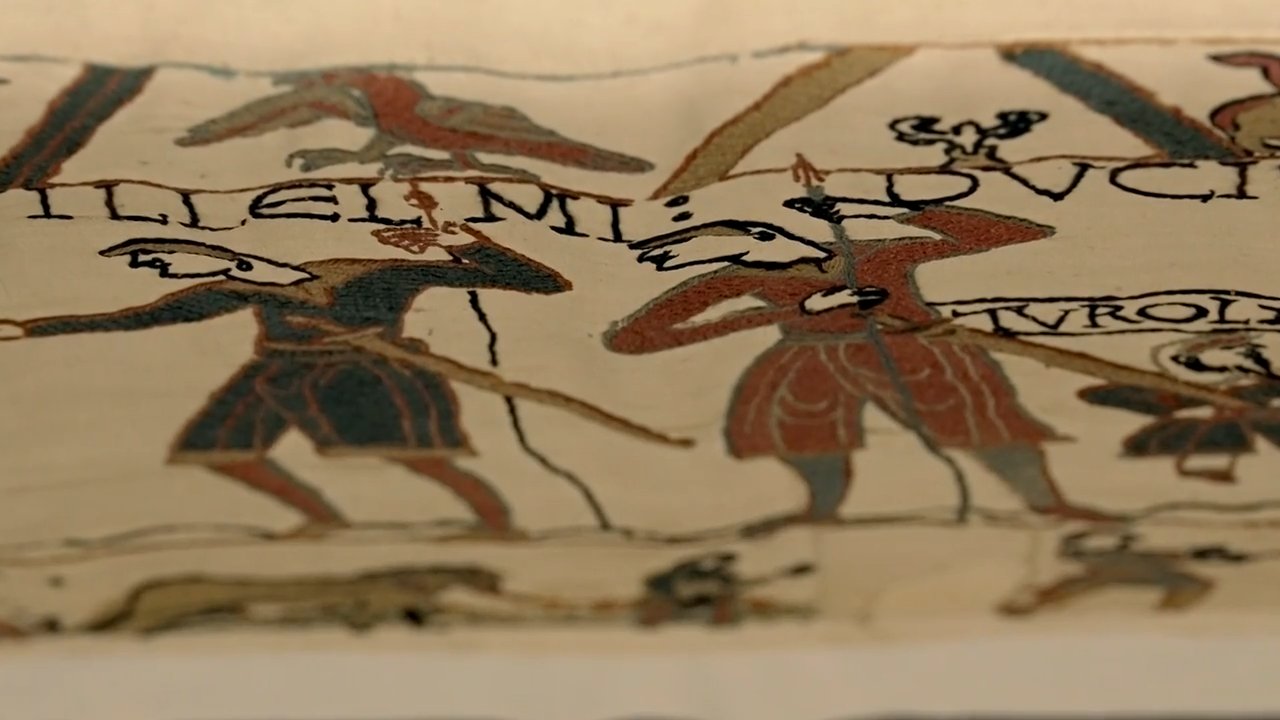
After almost 1,000 years, the historic Bayeux Tapestry is back where it began.
The 11th Century artwork is thought to have been made in Britain, and it's now on display at the British Museum — one of the UK's largest national museums, located in London — while on loan from France until summer 2027. Think of it as the original comic strip: instead of panels, it uses a continuous, nearly 70-meter-long strip of embroidered fabric (about the length of a football field) to tell the story frame by frame, image after image, all the way across.
The story it tells is the Norman Conquest of 1066: the year William the Conqueror, a duke from Normandy in modern-day France, invaded England and took the throne. Like a comic laid end to end, the tapestry shows the buildup, the battle, and the aftermath — soldiers, ships, horses, and even Halley's Comet all stitched into the sequence. That invasion permanently changed England's ruling family, language, and culture, and is often seen as the starting point of the modern British monarchy.
Moving the tapestry took hours of extremely careful work, since it's so old and delicate. Even people standing near it had to wear protective clothing so stray fibers wouldn't end up on the fabric. It's now displayed flat, inside a protective glass case. Safe to say, it may look like a large piece of fabric, but it's definitely not something you'd want to wipe your hands on if you're missing a napkin.
The loan is also part of a bigger cultural exchange between France and Britain — two neighboring countries separated by the narrow English Channel, with a long and sometimes tense shared history. In exchange for the tapestry, Britain is lending important historical objects of its own back to France.
Teamwork makes the swing work! Mum and Dad are putting together a brand-new swing seat. Can you sort out the stages it’s built in... with no squabbling? First, cut out the pictures and then paste them in the right order (use the words in the boxes to help you!).
Inspired by Season 2, Episode 24 "Flatpack": With Mum and Dad assembling the flatpack furniture, the kids improvise games with the discarded wrapping materials. As the flatpack swing-seat takes shape, so does Bluey and Bingo’s mini-world.
It's story time, grubs, and there is some serious drama at the family BBQ. But what? You decide. First, cut out the story cards and then put them in any order you want. Make up a story to go with the pictures — as silly as you like! Cut out some paper squares and draw your own story cards too!
Invite your students to explore the life cycles of common organisms with these life cycle sequencing cards. The cards cover the bean plant, butterfly, birch tree, apple tree, honeybee, ladybug, and frog. They come already mixed up, so kids can color, cut, and put them in order. Use as an introductory task, check for understanding, center activity, or study guide!
As you introduce life cycles, focus on key concepts such as stages of growth, changes in form and function, and the idea that all living things follow a pattern from beginning to end. Encourage students to ask questions, make predictions, and notice patterns across plants and animals.
Teaching life cycles in elementary school is not only standards-based, it's also a great way to help students understand how living things grow and change over time. At this level, students are ready to explore clear, observable stages — like seed to plant or egg to adult—and begin comparing similarities and differences across species.
Play this fun Go Jetters dominoes game (featuring famous world landmarks) with a friend! Here's how to play:
- Deal five dominoes to each player, then place an extra one face-up in front of you.
- Place the remaining cards face-down in a pile.
- Take turns looking at your dominoes and if one matches a picture on the end of the sequence, place it down beside them. If none of your dominoes match, take another from the pile.
- The winner is the first player to put down all of their dominoes.
It's not often you see people really excited about seaweed (unless it's wrapped around all-you-can-eat sushi), but a tiny seaweed growing off the coast of Cornwall — a rugged coastal region in southwest England — has got scientists buzzing.
Divers found a new type of seaweed growing on a larger, coral-like seaweed called maerl. Well, it's not really "new" in the sense of just appearing — Professor Christine Maggs had been using it to try to solve a scientific puzzle for about 40 years. Four decades! It took so long because the seaweed was so small that it was difficult to collect a large enough sample to gather molecular data and sequence its DNA, which was necessary to confirm exactly what it was.
Once the DNA work was finally complete, the seaweed was accepted into the collection at London's Natural History Museum — one of the world's leading scientific institutions, similar in scale to the Smithsonian in the U.S. — and officially recognized in scientific literature as an entirely new species. Professor Maggs probably took a long overdue celebratory nap.
But the discovery is about more than naming one tiny organism. Researchers say maerl beds support a lot of biodiversity, and seaweeds can provide nursery habitats for economically important fish. That means protecting these underwater ecosystems could also help protect the other species that depend on them. The best kind of two-for-one deal.
After almost 1,000 years, the historic Bayeux Tapestry is back where it began.
The 11th Century artwork is thought to have been made in Britain, and it's now on display at the British Museum — one of the UK's largest national museums, located in London — while on loan from France until summer 2027. Think of it as the original comic strip: instead of panels, it uses a continuous, nearly 70-meter-long strip of embroidered fabric (about the length of a football field) to tell the story frame by frame, image after image, all the way across.
The story it tells is the Norman Conquest of 1066: the year William the Conqueror, a duke from Normandy in modern-day France, invaded England and took the throne. Like a comic laid end to end, the tapestry shows the buildup, the battle, and the aftermath — soldiers, ships, horses, and even Halley's Comet all stitched into the sequence. That invasion permanently changed England's ruling family, language, and culture, and is often seen as the starting point of the modern British monarchy.
Moving the tapestry took hours of extremely careful work, since it's so old and delicate. Even people standing near it had to wear protective clothing so stray fibers wouldn't end up on the fabric. It's now displayed flat, inside a protective glass case. Safe to say, it may look like a large piece of fabric, but it's definitely not something you'd want to wipe your hands on if you're missing a napkin.
The loan is also part of a bigger cultural exchange between France and Britain — two neighboring countries separated by the narrow English Channel, with a long and sometimes tense shared history. In exchange for the tapestry, Britain is lending important historical objects of its own back to France.