
The ancestors of dolphins lived in a very different world, when Pangea was hot and dry and giant reptiles dominated the land. This clip from BBC’s Evolution episode "The Dolphin" follows the small cynodonts that survived by burrowing and becoming active at night, escaping competition with larger predators while their senses adapted to a darker world.
As smell and touch became increasingly important, the cynodont brain grew larger and more complex, eventually giving rise to the neocortex — a defining feature of mammalian brains. The video explores how this folded layer of the brain provides space for vast networks of neurons involved in processing information, memory, problem-solving, and other complex behaviors.
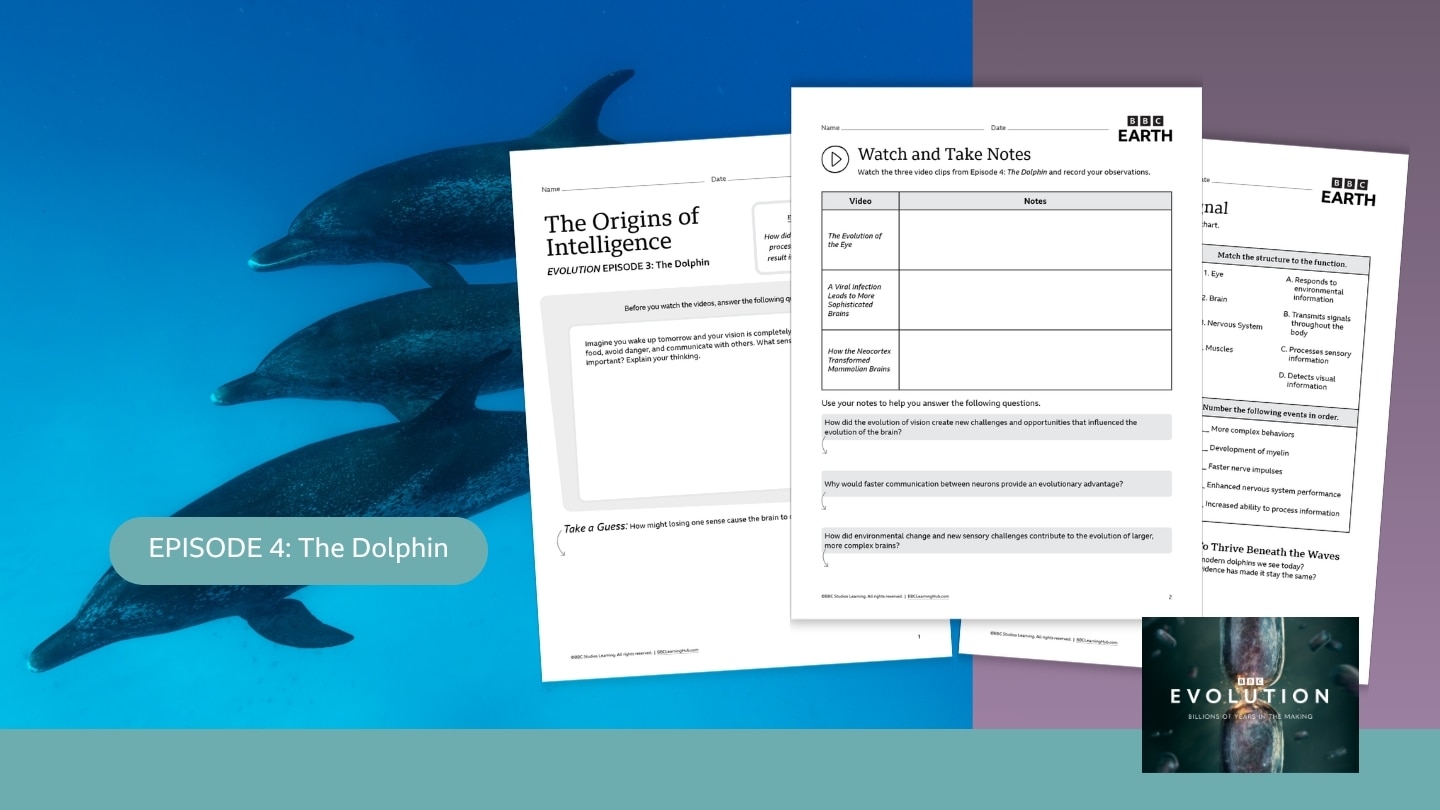
How does an animal make sense of its surroundings — and what happens when that world changes? This lesson for ages 11–18 examines the evolution of sensory systems and the increasingly sophisticated brains that allow animals to gather, process, and respond to information.
In the BBC video clips from Evolution Episode 4: "The Dolphin," explore the evolution of the eye, changes that made communication between neurons faster, and the development of the mammalian neocortex. Along the way, consider how better ways of detecting and processing information created new opportunities for behavior and survival.
The worksheet activities ask you to connect environmental information to nervous system responses, compare the advantages of vision for predators and prey, and trace the relationship between myelin, faster nerve impulses, information processing, and complex behavior. At the end, you'll return to your initial prediction and use evidence from the lesson to reflect on how sensory challenges and environmental change shaped the evolution of increasingly complex brains.
The ancestors of dolphins lived in a very different world, when Pangea was hot and dry and giant reptiles dominated the land. This clip from BBC’s Evolution episode "The Dolphin" follows the small cynodonts that survived by burrowing and becoming active at night, escaping competition with larger predators while their senses adapted to a darker world.
As smell and touch became increasingly important, the cynodont brain grew larger and more complex, eventually giving rise to the neocortex — a defining feature of mammalian brains. The video explores how this folded layer of the brain provides space for vast networks of neurons involved in processing information, memory, problem-solving, and other complex behaviors.
How does an animal make sense of its surroundings — and what happens when that world changes? This lesson for ages 11–18 examines the evolution of sensory systems and the increasingly sophisticated brains that allow animals to gather, process, and respond to information.
In the BBC video clips from Evolution Episode 4: "The Dolphin," explore the evolution of the eye, changes that made communication between neurons faster, and the development of the mammalian neocortex. Along the way, consider how better ways of detecting and processing information created new opportunities for behavior and survival.
The worksheet activities ask you to connect environmental information to nervous system responses, compare the advantages of vision for predators and prey, and trace the relationship between myelin, faster nerve impulses, information processing, and complex behavior. At the end, you'll return to your initial prediction and use evidence from the lesson to reflect on how sensory challenges and environmental change shaped the evolution of increasingly complex brains.