

Skateboarding made its Olympic debut as an optional sport in 2020, and it'll become a permanent fixture in 2028. But long before the Olympics caught on, skaters had already found their spot.
Back in the 1970s, London's South Bank was known for something other than tourists and river views: skateboarders, drawn to the smooth concrete and sloped walls of the Undercroft Skate Space. Decades later, an exhibit is celebrating that space — a hollowed-out concrete bowl with a cult following — through art, memorabilia, and film.
The Undercroft is where a generation of skaters learned the sport (safety gear very much included). But for years, this free public space faced a real threat: developers tried repeatedly to shut it down or move skaters elsewhere.
The skaters didn't budge. Their persistence paid off — the space was saved, renovated, and eventually celebrated as a landmark. Today, skaters and BMX riders of every age still roll through the Undercroft, part of a community it helped build.
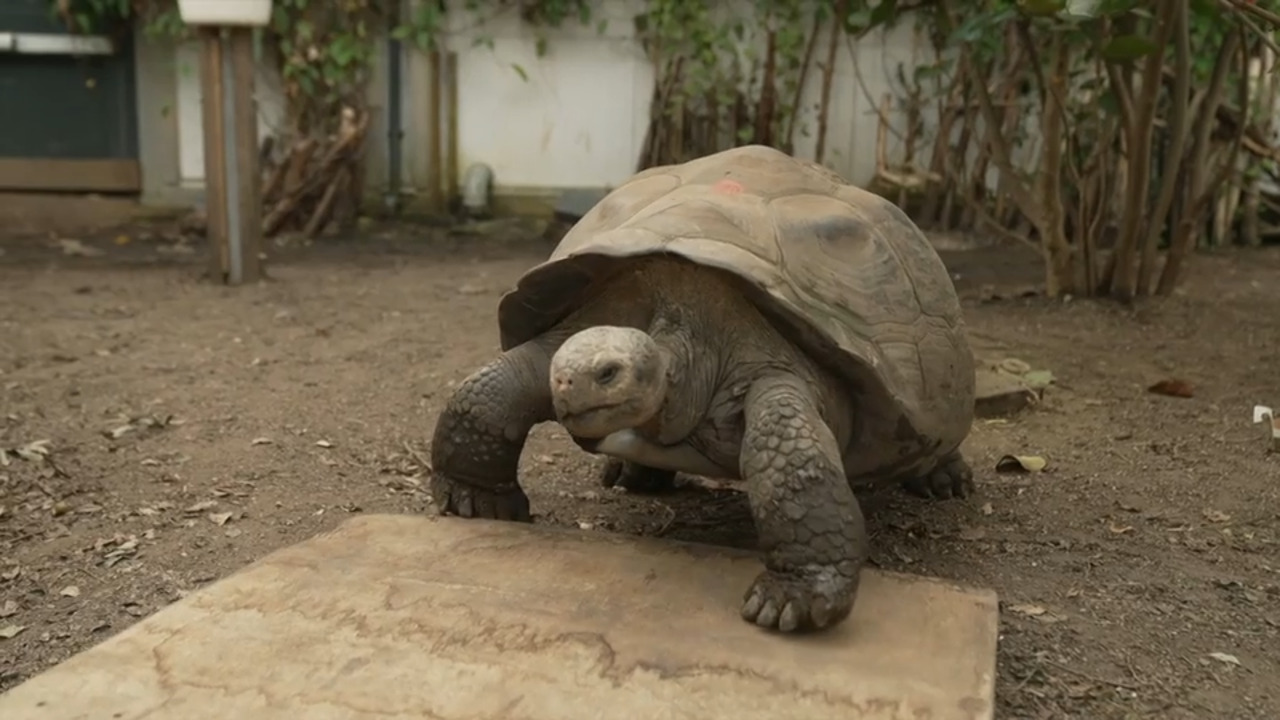
What happens when a zoo animal gets sick? For most of the history of zoos, that question had an answer most visitors never saw. Now, one of the world's oldest zoological societies is building a facility designed to change that — and what they're planning goes well beyond routine checkups.
The Zoological Society of London is constructing a new wildlife health center that will allow visitors to observe animals receiving medical care firsthand. Some of what they'll see will be routine — weight checks, dental exams, the kind of maintenance that keeps zoo populations healthy. But onlookers may also get a window into surgical procedures, and in some cases, postmortems. It's an unusually transparent approach for an institution that has traditionally kept its medical operations behind closed doors.
Not everyone is convinced. Critics argue the center is more about capitalizing on public curiosity than genuinely benefiting the animals in its care — that making medicine into a spectator sport serves the zoo's revenue more than its residents.
ZSL pushes back on that framing. The center is designed to be more than an exhibit. It's intended to function as a global training resource for wildlife vets, a hub where expertise in animal medicine can be developed and shared across institutions worldwide. The argument is that visibility and conservation aren't in conflict — that showing people what it actually takes to keep wild animals healthy is exactly the kind of thing that builds the public understanding zoos increasingly depend on to justify their existence.
The deeper question the center raises isn't really about one zoo or one building. It's about what zoos are actually for — and whether letting people watch is a compromise of that mission or an extension of it.
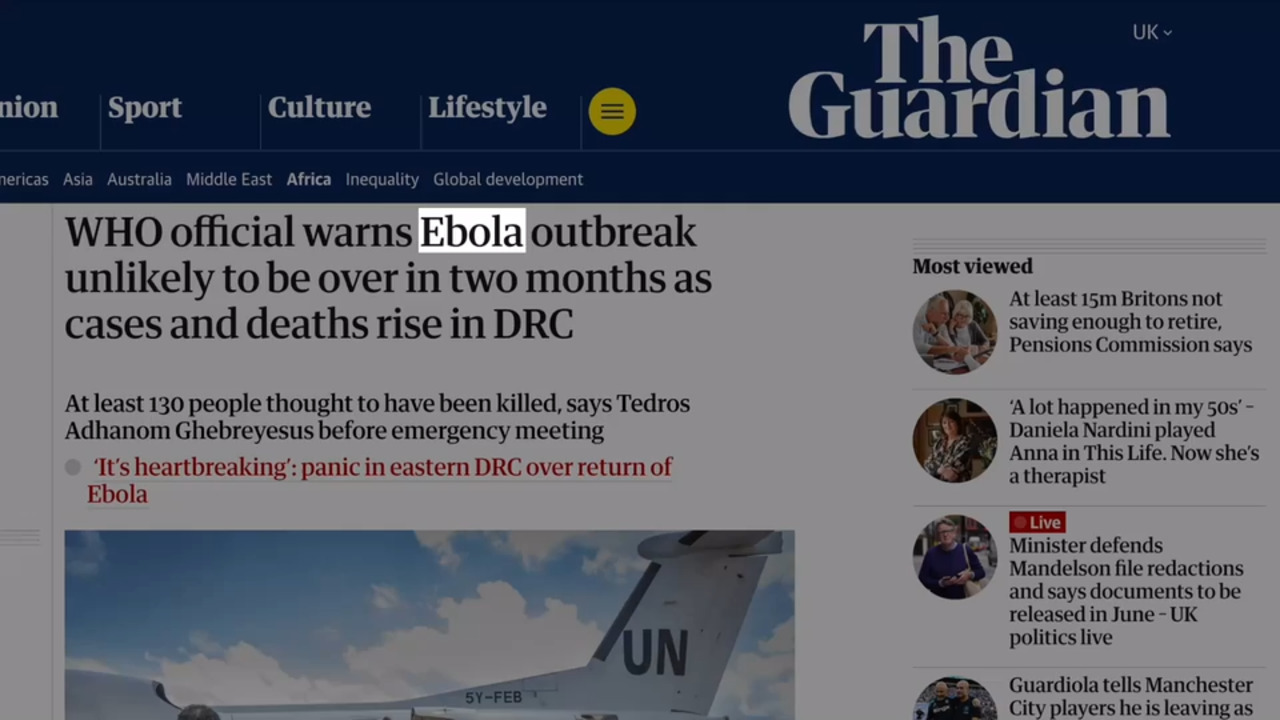
The DRC (Democratic Republic of the Congo) is a large central African country now facing an Ebola outbreak along with neighboring Uganda. Ebola is a serious virus spread through contact with infected blood or body fluids, causing fever, vomiting, and bleeding. This outbreak's strain has no approved vaccine or treatment.
This isn't the DRC's first health crisis — and it's not bad luck. Three main factors are at play: the DRC borders nine countries with heavy cross-border movement and conflict-driven displacement, making disease spread easy; its health system is stretched thin, so early symptoms (which mimic other illnesses) often go unnoticed; and close contact with wildlife in its vast forests — including hunting and eating bushmeat — raises the risk of animal-to-human disease jumps.
Together, these factors explain why outbreaks keep happening — and why this one deserves close attention.
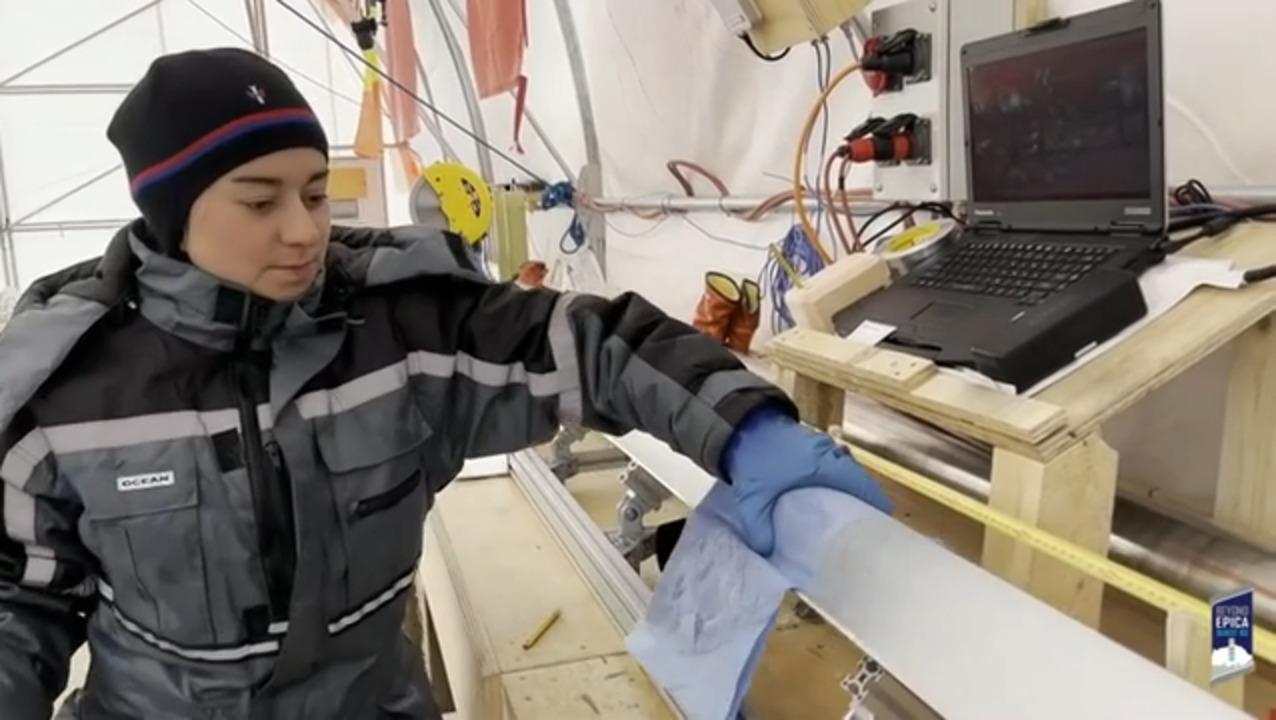
Scientists have found some very old ice. No, it’s not bag of frozen peas that have been in your freezer for three years (which means someone’s not eating their vegetables). It’s actually cores of Antarctic ice, the oldest that have ever been collected, that go back over a million years.
Researchers are keeping almost 200 pieces of meter-long ice cores that were drilled from a depth of almost 3 km over the course of four years. After careful preservation, the ice now needs to be melted in order to reveal the rich environmental history that the ice has to offer. When melted carefully and incredibly slowly, scientists can see how the Earth changed over time, including variations in temperature, snowfall, and wind, because the tiny bubbles give a snapshot of carbon dioxide levels.
Studying this old ice will help scientists understand our environment today. For example, the concentration of greenhouse gasses we see today is higher than they have been in the past 800,000 years. To understand how the climate might change in the future, we need to learn about how it’s changed in the past.

Mars may be cold and barren, but it might have supported life! At least, that’s what scientists think, after finding rocks with some very interesting spots. These markings, nicknamed “leopard spots” and “poppyseeds,” are minerals that could have been made by Martian microbes, early in the planet’s history. They were discovered by the Perseverance Rover, which has been exploring Mars since its 2021 landing.
The rover has been focused on Mars’s Jezero Crater, which used to be a huge lake with a river running into it before drying up billions of years ago. Now, Perseverance collects samples to analyze in its onboard lab! Car Bluetooth is cool but c’mon, it’s no analysis lab…
These rocks aren’t exactly the video diary of an alien’s day in the life on Mars, but they could be the clearest sign of life ever found on Mars, which is thought to be one of the most promising places in our Solar System to look for life outside of Earth. The only way to confirm if the minerals were made by microbes is to get them back to Earth, so NASA and the European Space Agency have proposed a mission to collect them. It’ll be expensive, but this could be the answer to if there was life on other planets!
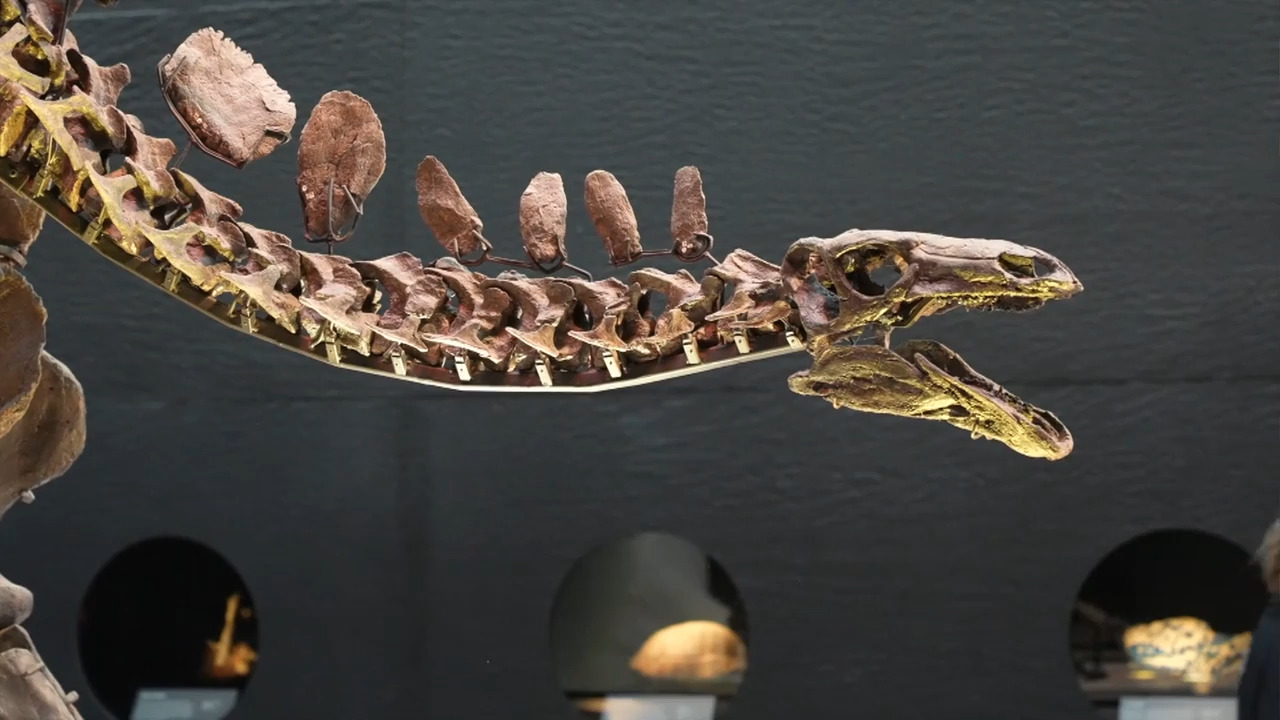
Did you know we’re still finding new dinosaurs?! You’d think the 66 million years they’ve been extinct would have been enough time for research, but the Natural History Museum is getting ready to welcome yet another new addition — a small dinosaur that they had previously mistaken for a Nanosaurus. It’s a two-legged, herbivorous dinosaur with big feet and a long tail, about the height of a labrador. Scientists have renamed it “Enigmacursor,” which means “puzzling runner,” and would also be a very cool name for the next Nike sneaker.
To determine if a dinosaur (or any creature) is new, researchers try to find unique features, like parts, proportions, and shapes. The Enigmacursor will be displayed at the Natural History Museum and will be an important tool for learning how its bigger relatives evolved, since dinosaurs started their evolution as small animals and became much, much bigger over a long, long time.

In Myths and Discoveries About Blood, Dr. Michael Mosley introduces the science, history, and mystery behind blood and its life-giving role in the human body. Learn how blood has inspired myths about immortality and healing, while modern science begins to uncover its true functions and potential. This video is excerpted from BBC’s The Wonderful World of Blood, in which Dr. Michael Mosley carries out six experiments on his own blood, from starving it of oxygen to injecting it with snake venom.
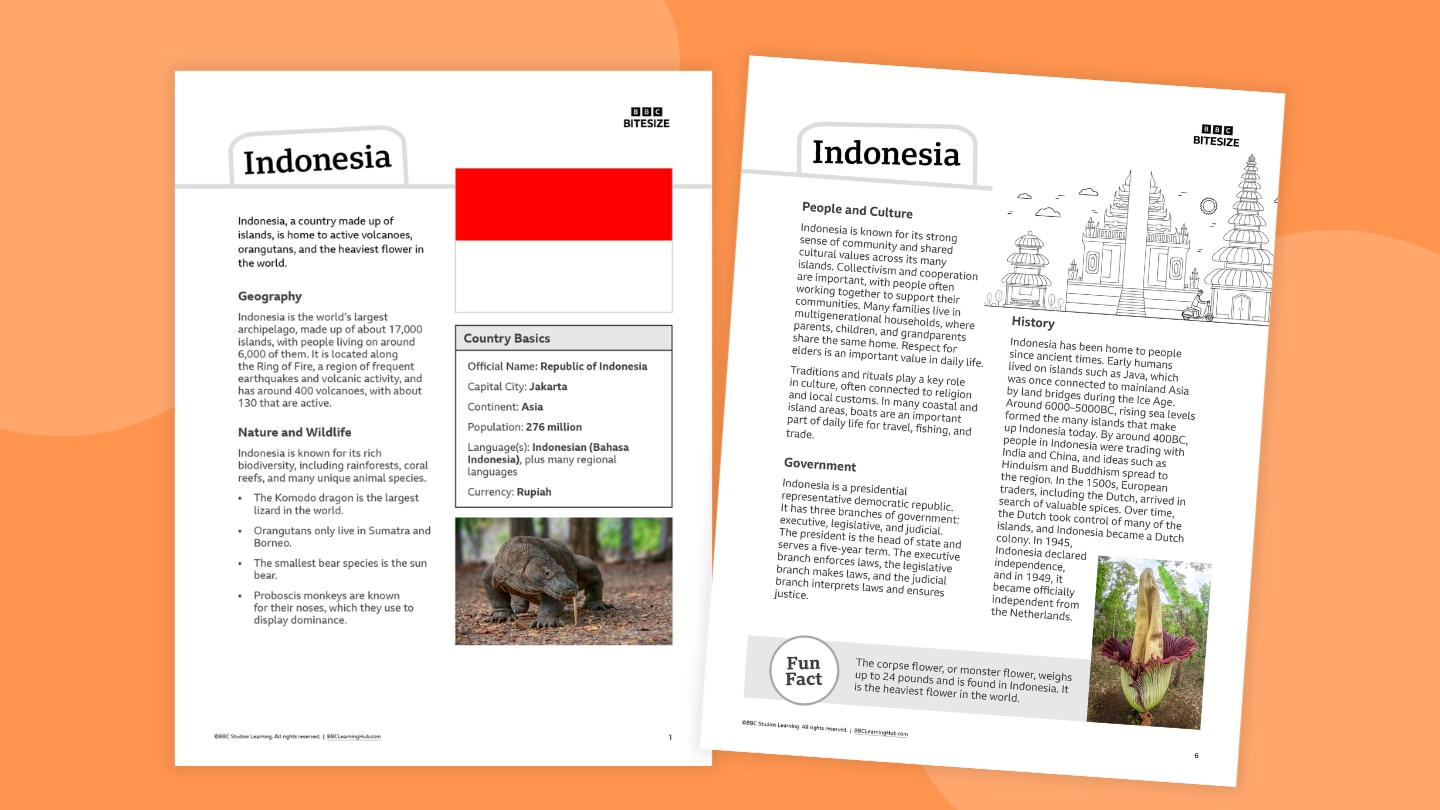
Travel across the islands of Indonesia with this colorful one-page fact file for Grades 3–8. Students will explore Indonesia’s geography, history, culture, wildlife, and government while learning about thousands of islands, volcanoes and coral reefs, tropical rainforests, unique animals such as Komodo dragons and orangutans, and the traditions of Indonesia’s many cultures.
You can use this fact file to:
- Introduce a geography or social studies unit
- Support nonfiction reading practice
- Compare countries and cultures
- Complete map and research activities
- Prepare students for projects or presentations (use our country report template!)
- Pair with videos, articles, or other informational texts (see Related Resources below)
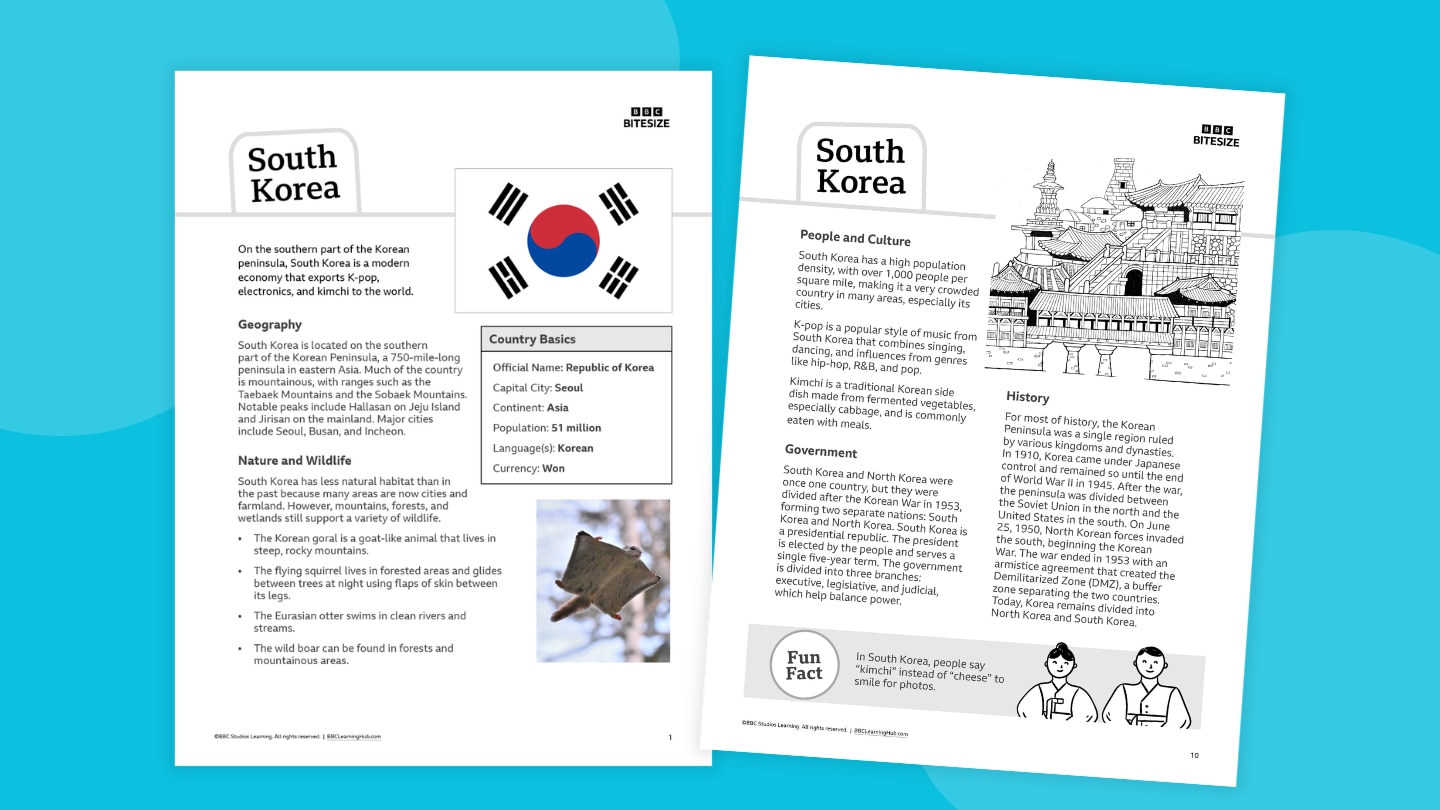
Explore the culture, history, and modern life of South Korea with this student-friendly fact file for Grades 3–8. Students will explore South Korea’s geography, history, culture, wildlife, and government while learning about mountain landscapes, Korean traditions, K-pop, kimchi, important events in Korean history, and the country’s modern economy and technology.
You can use this fact file to:
- Introduce a geography or social studies unit
- Support nonfiction reading practice
- Compare countries and cultures
- Complete map and research activities
- Prepare students for projects or presentations (use our country report template!)
- Pair with videos, articles, or other informational texts (see Related Resources below)
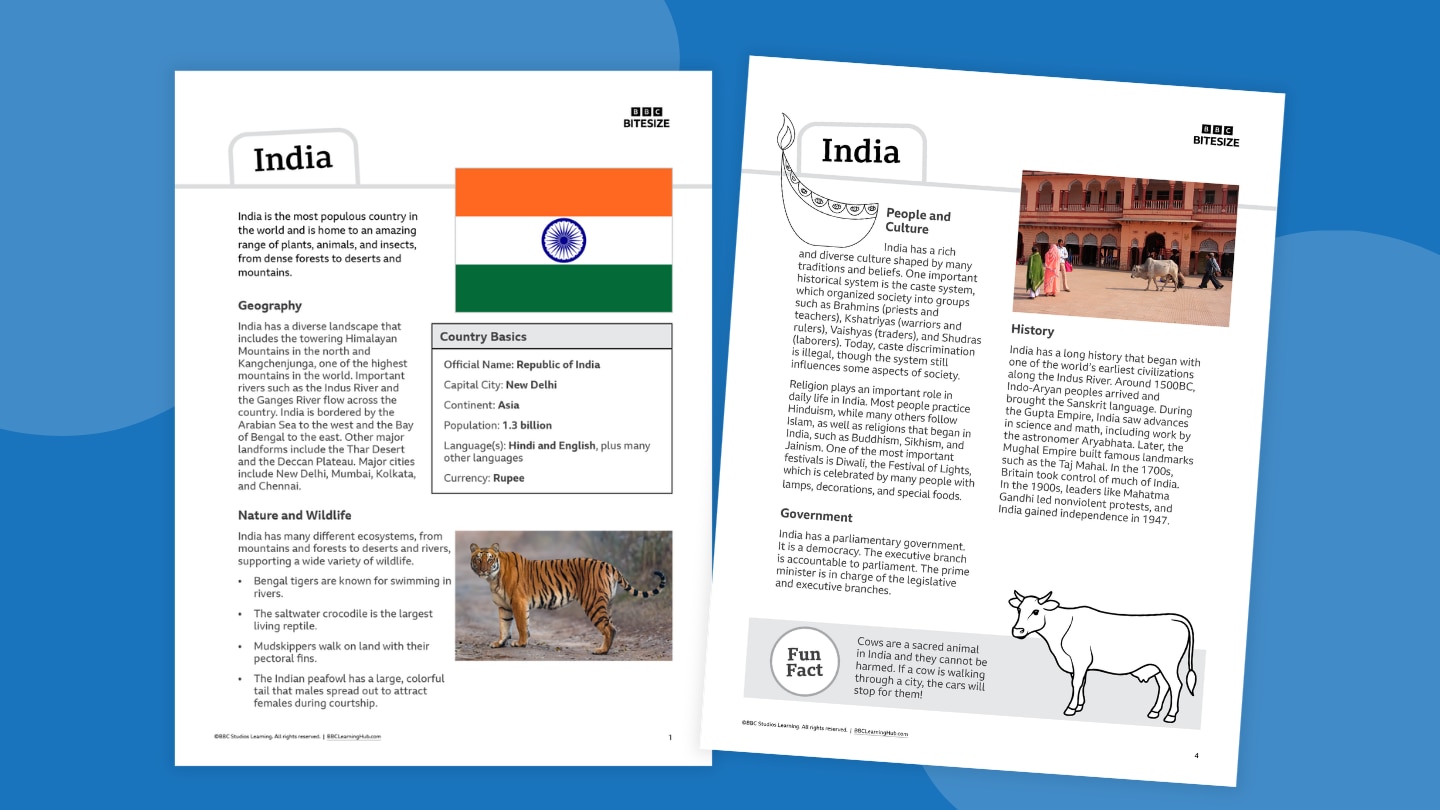
Introduce students to the rich cultures, landscapes, and history of India with this classroom-ready fact file for Grades 3–8. Students will explore India’s geography, history, culture, wildlife, and government while learning about the Himalayan Mountains, major rivers, diverse religions and traditions, colorful festivals, and animals such as Bengal tigers and Indian peafowl.
You can use this fact file to:
- Introduce a geography or social studies unit
- Support nonfiction reading practice
- Compare countries and cultures
- Complete map and research activities
- Prepare students for projects or presentations (use our country report template!)
- Pair with videos, articles, or other informational texts (see Related Resources below)
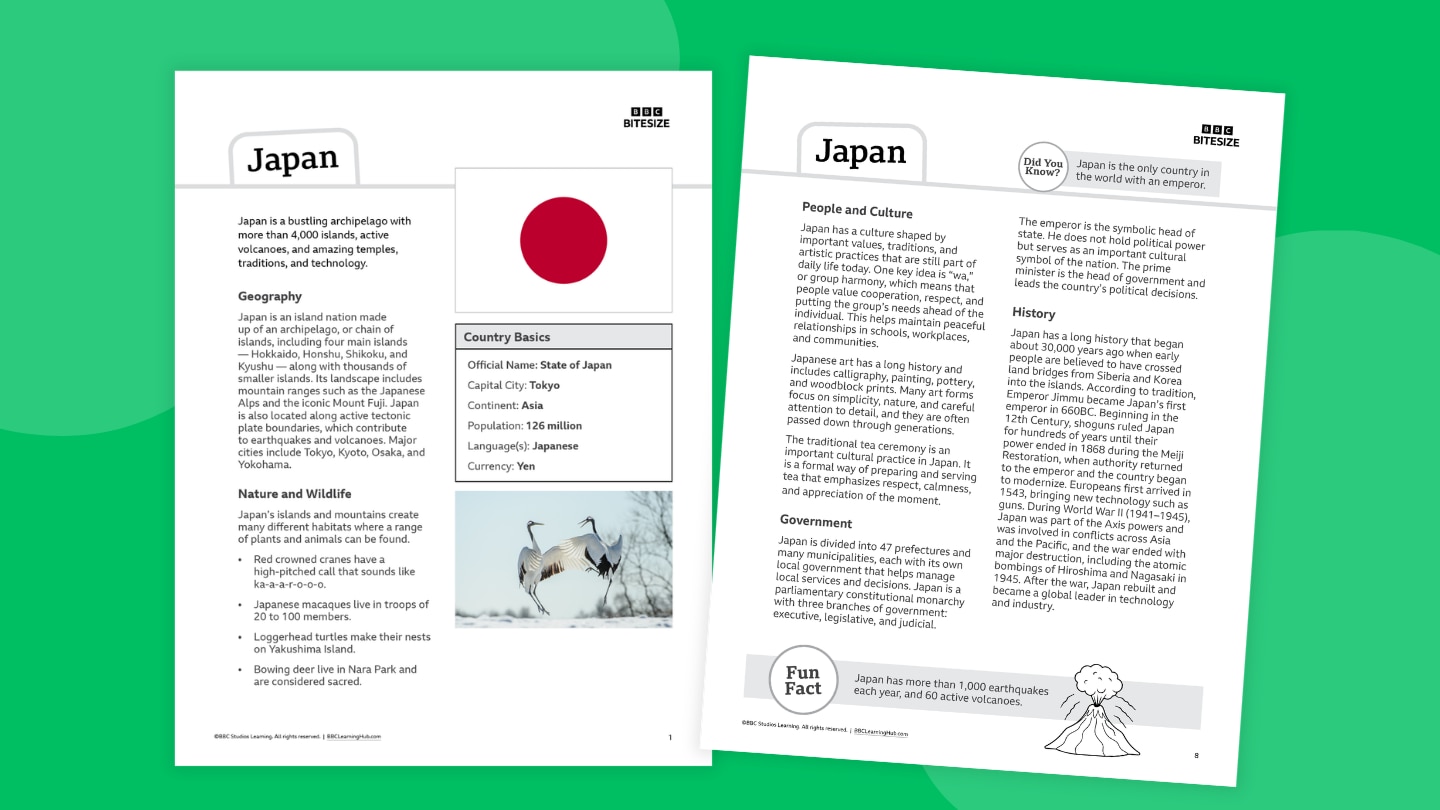
Discover the islands, traditions, and history of Japan with this one-page fact file for Grades 3–8. Students will explore Japan’s geography, history, culture, wildlife, and government while learning about volcanic islands, mountain landscapes, traditional customs, unique wildlife, modern cities, and important moments from Japan’s past and present.
You can use this fact file to:
- Introduce a geography or social studies unit
- Support nonfiction reading practice
- Compare countries and cultures
- Complete map and research activities
- Prepare students for projects or presentations (use our country report template!)
- Pair with videos, articles, or other informational texts (see Related Resources below)
Skateboarding made its Olympic debut as an optional sport in 2020, and it'll become a permanent fixture in 2028. But long before the Olympics caught on, skaters had already found their spot.
Back in the 1970s, London's South Bank was known for something other than tourists and river views: skateboarders, drawn to the smooth concrete and sloped walls of the Undercroft Skate Space. Decades later, an exhibit is celebrating that space — a hollowed-out concrete bowl with a cult following — through art, memorabilia, and film.
The Undercroft is where a generation of skaters learned the sport (safety gear very much included). But for years, this free public space faced a real threat: developers tried repeatedly to shut it down or move skaters elsewhere.
The skaters didn't budge. Their persistence paid off — the space was saved, renovated, and eventually celebrated as a landmark. Today, skaters and BMX riders of every age still roll through the Undercroft, part of a community it helped build.
What happens when a zoo animal gets sick? For most of the history of zoos, that question had an answer most visitors never saw. Now, one of the world's oldest zoological societies is building a facility designed to change that — and what they're planning goes well beyond routine checkups.
The Zoological Society of London is constructing a new wildlife health center that will allow visitors to observe animals receiving medical care firsthand. Some of what they'll see will be routine — weight checks, dental exams, the kind of maintenance that keeps zoo populations healthy. But onlookers may also get a window into surgical procedures, and in some cases, postmortems. It's an unusually transparent approach for an institution that has traditionally kept its medical operations behind closed doors.
Not everyone is convinced. Critics argue the center is more about capitalizing on public curiosity than genuinely benefiting the animals in its care — that making medicine into a spectator sport serves the zoo's revenue more than its residents.
ZSL pushes back on that framing. The center is designed to be more than an exhibit. It's intended to function as a global training resource for wildlife vets, a hub where expertise in animal medicine can be developed and shared across institutions worldwide. The argument is that visibility and conservation aren't in conflict — that showing people what it actually takes to keep wild animals healthy is exactly the kind of thing that builds the public understanding zoos increasingly depend on to justify their existence.
The deeper question the center raises isn't really about one zoo or one building. It's about what zoos are actually for — and whether letting people watch is a compromise of that mission or an extension of it.
The DRC (Democratic Republic of the Congo) is a large central African country now facing an Ebola outbreak along with neighboring Uganda. Ebola is a serious virus spread through contact with infected blood or body fluids, causing fever, vomiting, and bleeding. This outbreak's strain has no approved vaccine or treatment.
This isn't the DRC's first health crisis — and it's not bad luck. Three main factors are at play: the DRC borders nine countries with heavy cross-border movement and conflict-driven displacement, making disease spread easy; its health system is stretched thin, so early symptoms (which mimic other illnesses) often go unnoticed; and close contact with wildlife in its vast forests — including hunting and eating bushmeat — raises the risk of animal-to-human disease jumps.
Together, these factors explain why outbreaks keep happening — and why this one deserves close attention.
Scientists have found some very old ice. No, it’s not bag of frozen peas that have been in your freezer for three years (which means someone’s not eating their vegetables). It’s actually cores of Antarctic ice, the oldest that have ever been collected, that go back over a million years.
Researchers are keeping almost 200 pieces of meter-long ice cores that were drilled from a depth of almost 3 km over the course of four years. After careful preservation, the ice now needs to be melted in order to reveal the rich environmental history that the ice has to offer. When melted carefully and incredibly slowly, scientists can see how the Earth changed over time, including variations in temperature, snowfall, and wind, because the tiny bubbles give a snapshot of carbon dioxide levels.
Studying this old ice will help scientists understand our environment today. For example, the concentration of greenhouse gasses we see today is higher than they have been in the past 800,000 years. To understand how the climate might change in the future, we need to learn about how it’s changed in the past.
Mars may be cold and barren, but it might have supported life! At least, that’s what scientists think, after finding rocks with some very interesting spots. These markings, nicknamed “leopard spots” and “poppyseeds,” are minerals that could have been made by Martian microbes, early in the planet’s history. They were discovered by the Perseverance Rover, which has been exploring Mars since its 2021 landing.
The rover has been focused on Mars’s Jezero Crater, which used to be a huge lake with a river running into it before drying up billions of years ago. Now, Perseverance collects samples to analyze in its onboard lab! Car Bluetooth is cool but c’mon, it’s no analysis lab…
These rocks aren’t exactly the video diary of an alien’s day in the life on Mars, but they could be the clearest sign of life ever found on Mars, which is thought to be one of the most promising places in our Solar System to look for life outside of Earth. The only way to confirm if the minerals were made by microbes is to get them back to Earth, so NASA and the European Space Agency have proposed a mission to collect them. It’ll be expensive, but this could be the answer to if there was life on other planets!
Did you know we’re still finding new dinosaurs?! You’d think the 66 million years they’ve been extinct would have been enough time for research, but the Natural History Museum is getting ready to welcome yet another new addition — a small dinosaur that they had previously mistaken for a Nanosaurus. It’s a two-legged, herbivorous dinosaur with big feet and a long tail, about the height of a labrador. Scientists have renamed it “Enigmacursor,” which means “puzzling runner,” and would also be a very cool name for the next Nike sneaker.
To determine if a dinosaur (or any creature) is new, researchers try to find unique features, like parts, proportions, and shapes. The Enigmacursor will be displayed at the Natural History Museum and will be an important tool for learning how its bigger relatives evolved, since dinosaurs started their evolution as small animals and became much, much bigger over a long, long time.
In Myths and Discoveries About Blood, Dr. Michael Mosley introduces the science, history, and mystery behind blood and its life-giving role in the human body. Learn how blood has inspired myths about immortality and healing, while modern science begins to uncover its true functions and potential. This video is excerpted from BBC’s The Wonderful World of Blood, in which Dr. Michael Mosley carries out six experiments on his own blood, from starving it of oxygen to injecting it with snake venom.
Travel across the islands of Indonesia with this colorful one-page fact file for Grades 3–8. Students will explore Indonesia’s geography, history, culture, wildlife, and government while learning about thousands of islands, volcanoes and coral reefs, tropical rainforests, unique animals such as Komodo dragons and orangutans, and the traditions of Indonesia’s many cultures.
You can use this fact file to:
- Introduce a geography or social studies unit
- Support nonfiction reading practice
- Compare countries and cultures
- Complete map and research activities
- Prepare students for projects or presentations (use our country report template!)
- Pair with videos, articles, or other informational texts (see Related Resources below)
Explore the culture, history, and modern life of South Korea with this student-friendly fact file for Grades 3–8. Students will explore South Korea’s geography, history, culture, wildlife, and government while learning about mountain landscapes, Korean traditions, K-pop, kimchi, important events in Korean history, and the country’s modern economy and technology.
You can use this fact file to:
- Introduce a geography or social studies unit
- Support nonfiction reading practice
- Compare countries and cultures
- Complete map and research activities
- Prepare students for projects or presentations (use our country report template!)
- Pair with videos, articles, or other informational texts (see Related Resources below)
Introduce students to the rich cultures, landscapes, and history of India with this classroom-ready fact file for Grades 3–8. Students will explore India’s geography, history, culture, wildlife, and government while learning about the Himalayan Mountains, major rivers, diverse religions and traditions, colorful festivals, and animals such as Bengal tigers and Indian peafowl.
You can use this fact file to:
- Introduce a geography or social studies unit
- Support nonfiction reading practice
- Compare countries and cultures
- Complete map and research activities
- Prepare students for projects or presentations (use our country report template!)
- Pair with videos, articles, or other informational texts (see Related Resources below)
Discover the islands, traditions, and history of Japan with this one-page fact file for Grades 3–8. Students will explore Japan’s geography, history, culture, wildlife, and government while learning about volcanic islands, mountain landscapes, traditional customs, unique wildlife, modern cities, and important moments from Japan’s past and present.
You can use this fact file to:
- Introduce a geography or social studies unit
- Support nonfiction reading practice
- Compare countries and cultures
- Complete map and research activities
- Prepare students for projects or presentations (use our country report template!)
- Pair with videos, articles, or other informational texts (see Related Resources below)