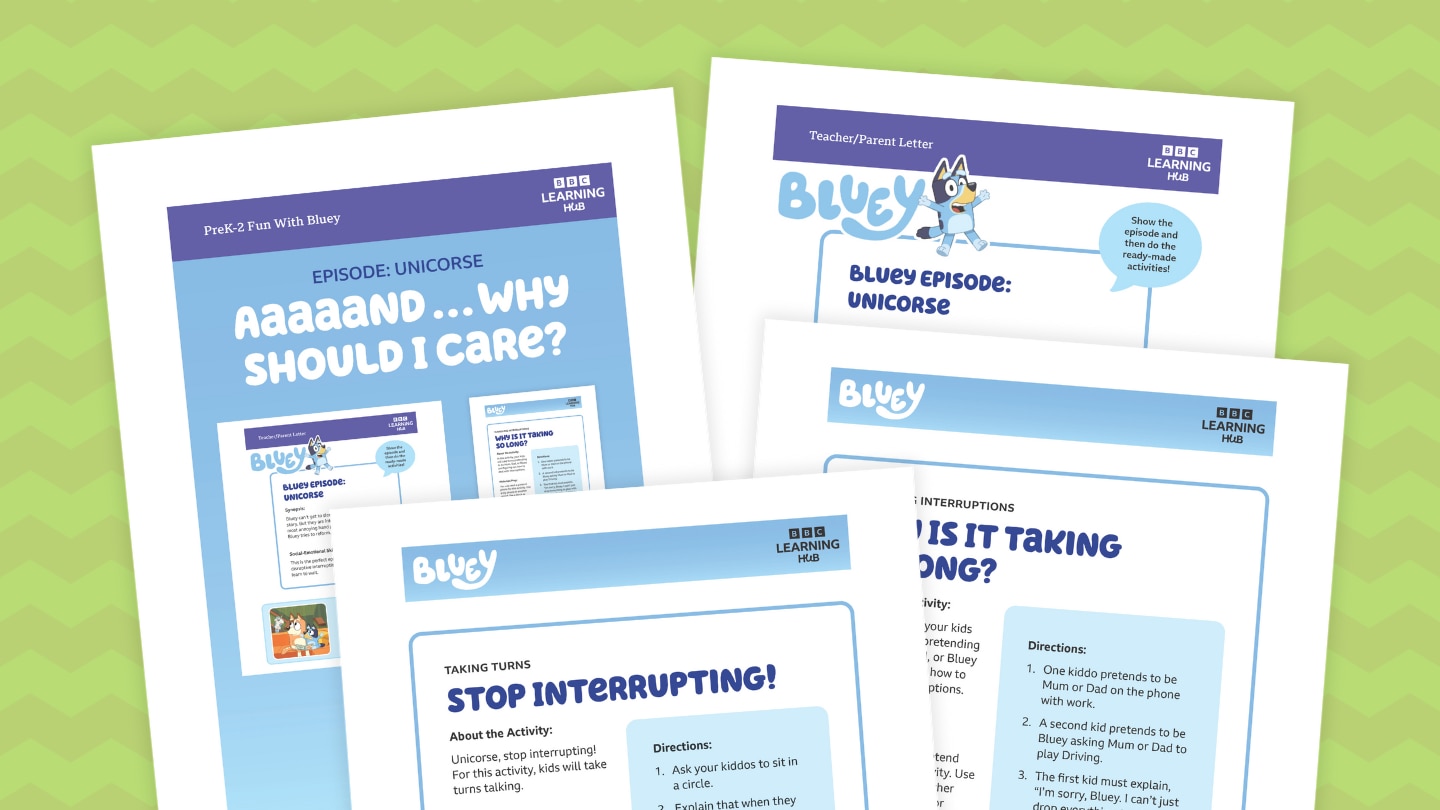
Unicorse, stop interrupting! Watch the Bluey episode "Unicorse" before you teach this lesson about taking turns. The lesson includes printables for three activities in which kids take turns talking, make their own Unicorse puppet, and practice dealing with interruptions (Mum is on the phone and Bluey wants to play Driving!).
Unicorse Episode Summary: Bluey can’t get to sleep, so Mum reads her one last story. But they are interrupted by Unicorse, the most annoying hand puppet in the world, whom Bluey tries to reform.
Watch the episode here! (Click here to watch in Australia.)
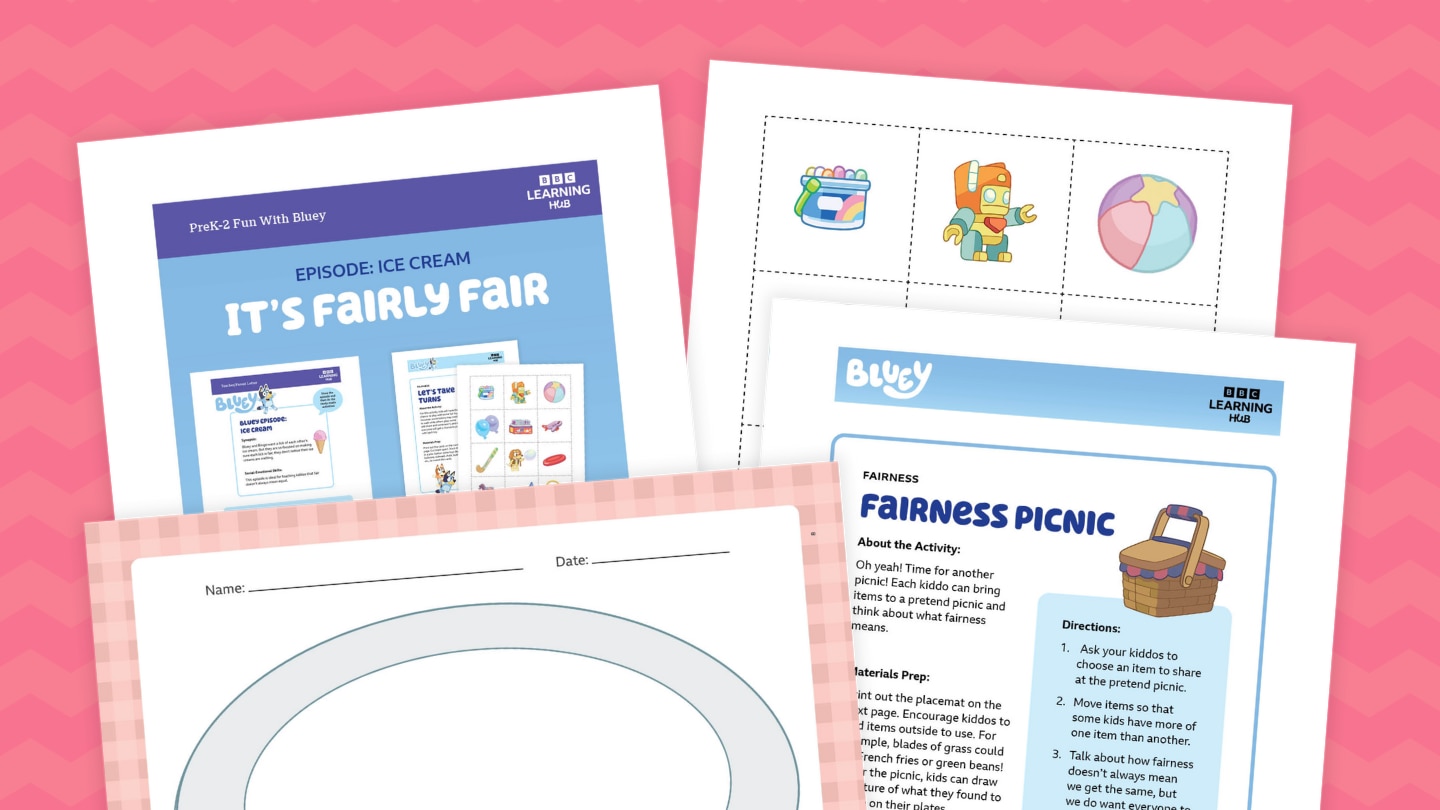
Hint: fair doesn't mean always mean equal! Talk to your class about what fairness really means through the Bluey episode "Ice Cream." The lesson includes printables for three activities in which kids take turns playing with toys, pretend to be patients visiting a doctor's office (where everyone gets the same treatment!), and plan a pretend picnic.
Ice Cream Episode Summary: Bluey and Bingo want a lick of each other’s ice cream. But they are so focused on making sure each lick is fair, they don’t notice their ice creams are melting.
Watch the episode here! (Click here to watch in Australia.)
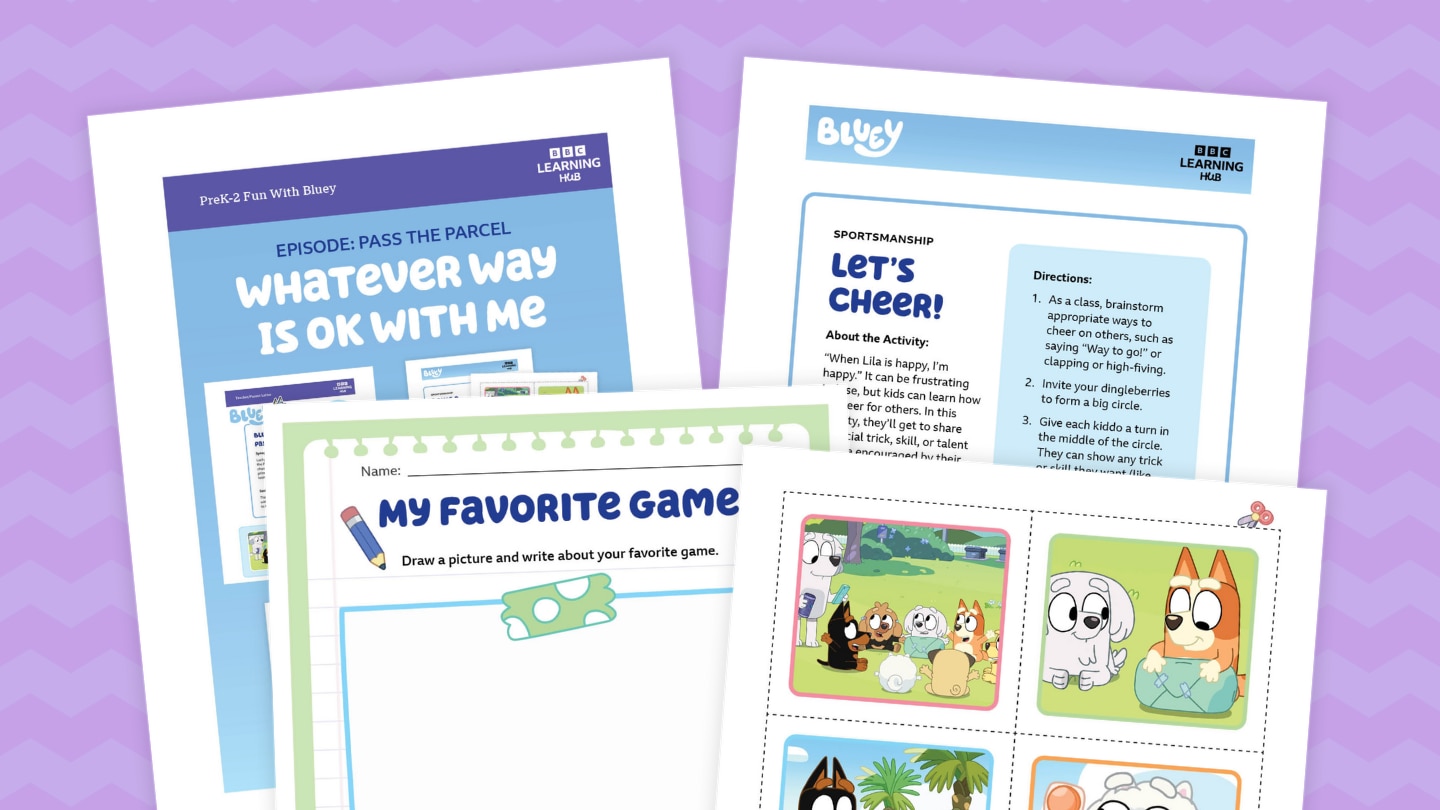
Whether you play Lucky's dad's way or not, you have to be a good sport! Watch the Bluey episode "Pass the Parcel" before you teach this lesson about how to handle it when things don’t go as expected. The lesson includes printables for three activities in which kids look for examples of good sportsmanship in the episode, draw themselves playing their favorite game or sport, and take turns sharing a special skill or talent while being encouraged by friends.
Pass the Parcel Episode Summary: Lucky’s Dad is outraged that modern Pass the Parcel has a present in every layer and changes the rules back to only having one prize in the middle, but Bingo is forever losing.
Watch the episode here! (Click here to watch in Australia.)
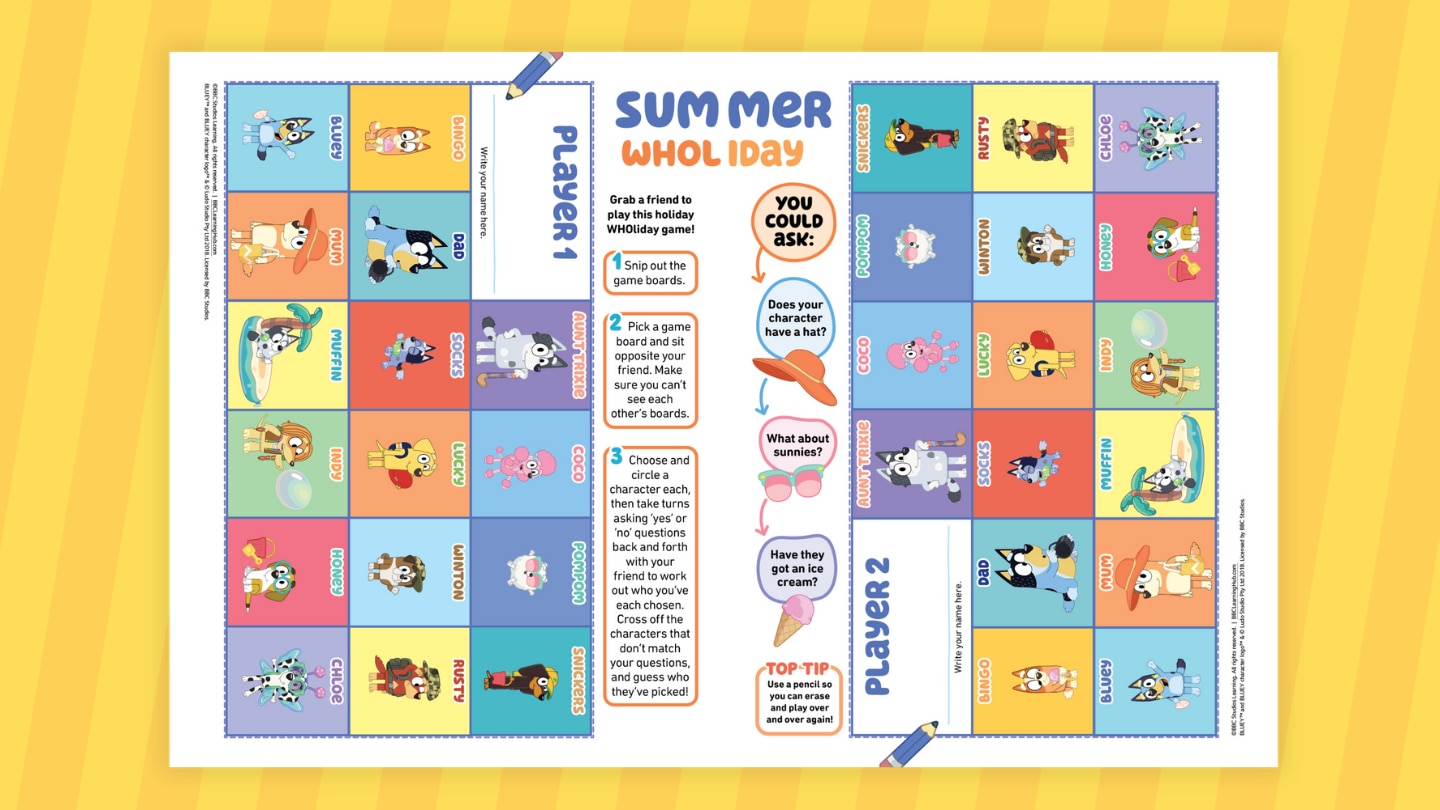
Grab a friend to play this holiday WHOliday game! Here's how to play:
- Snip out the game boards.
- Pick a game board and sit opposite your friend. Make sure you can’t see each other’s boards.
- Choose and circle a character each, then take turns asking "yes" or "no" questions back and forth with your friend to work out who you’ve each chosen. Cross off the characters that don’t match your questions, and guess who they’ve picked!
Top Tip: Use a pencil so you can erase and play over and over again.
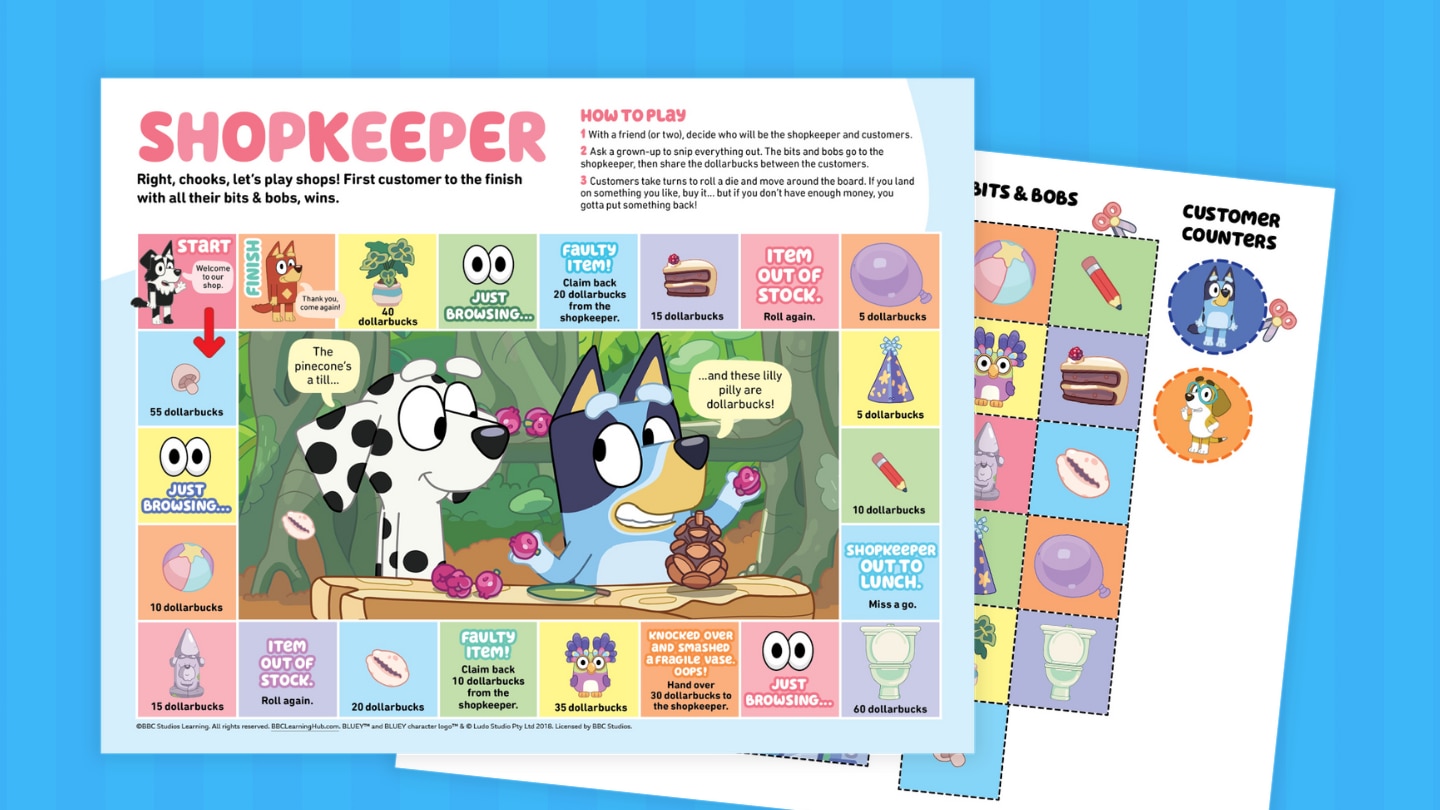
Right, chooks, let’s play shops! First customer to the finish with all their bits & bobs, wins. Here's how to play:
- With a friend (or two), decide who will be the shopkeeper and customers.
- Ask a grown-up to snip everything out. The bits and bobs go to the shopkeeper, then share the dollarbucks between the customers.
- Customers take turns to roll a die and move around the board. If you land on something you like, buy it... but if you don’t have enough money, you gotta put something back!
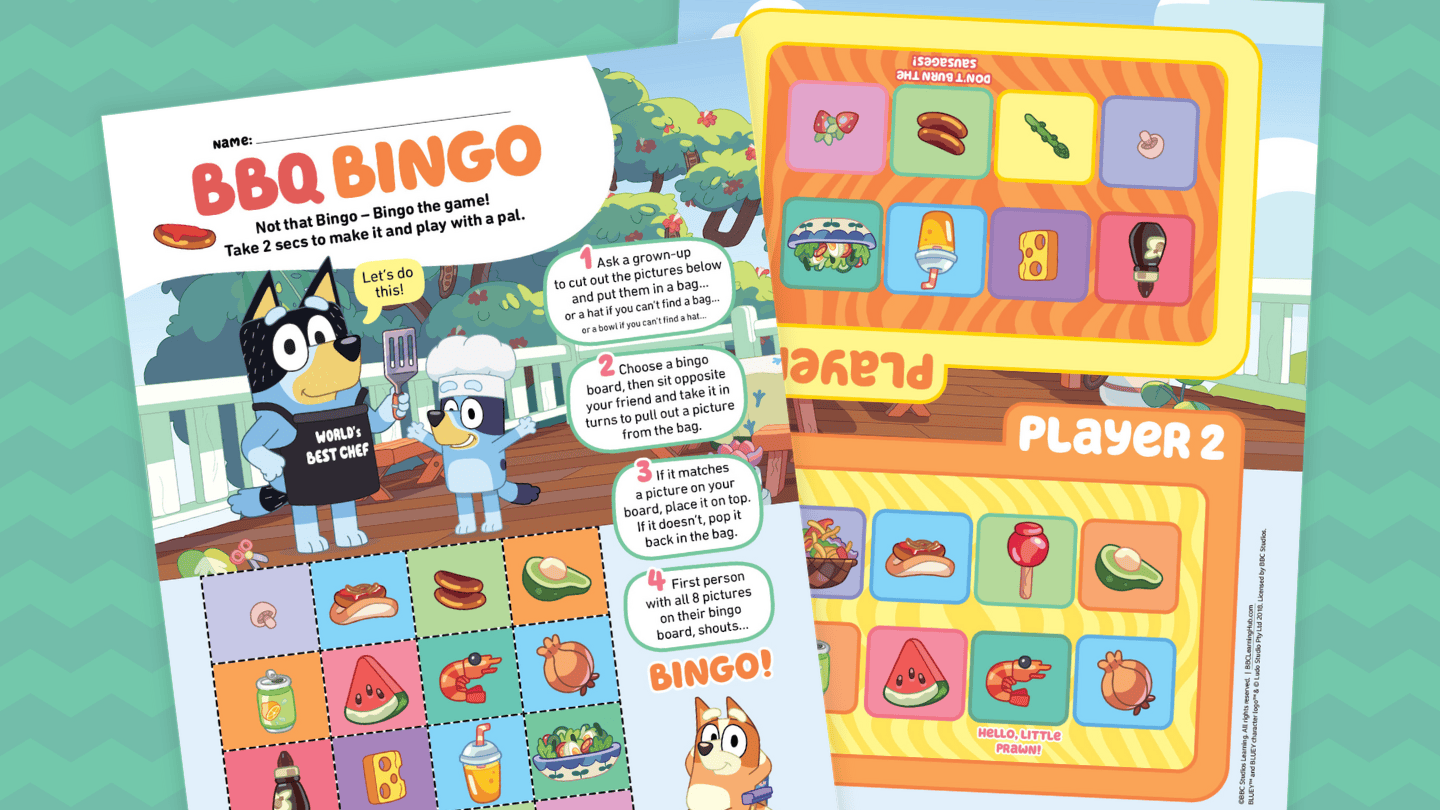
Not that Bingo — Bingo the game! Take two secs to make it and play with a pal. Here's how the game works:
- Ask a grown-up to cut out the pictures below and put them in a bag... or a hat if you can’t find a bag... or a bowl if you can’t find a hat...
- Choose a bingo board, then sit opposite your friend and take it in turns to pull out a picture from the bag.
- If it matches a picture on your board, place it on top. If it doesn’t, pop it back in the bag.
- First person with all eight pictures on their bingo board shouts, "BINGO!"
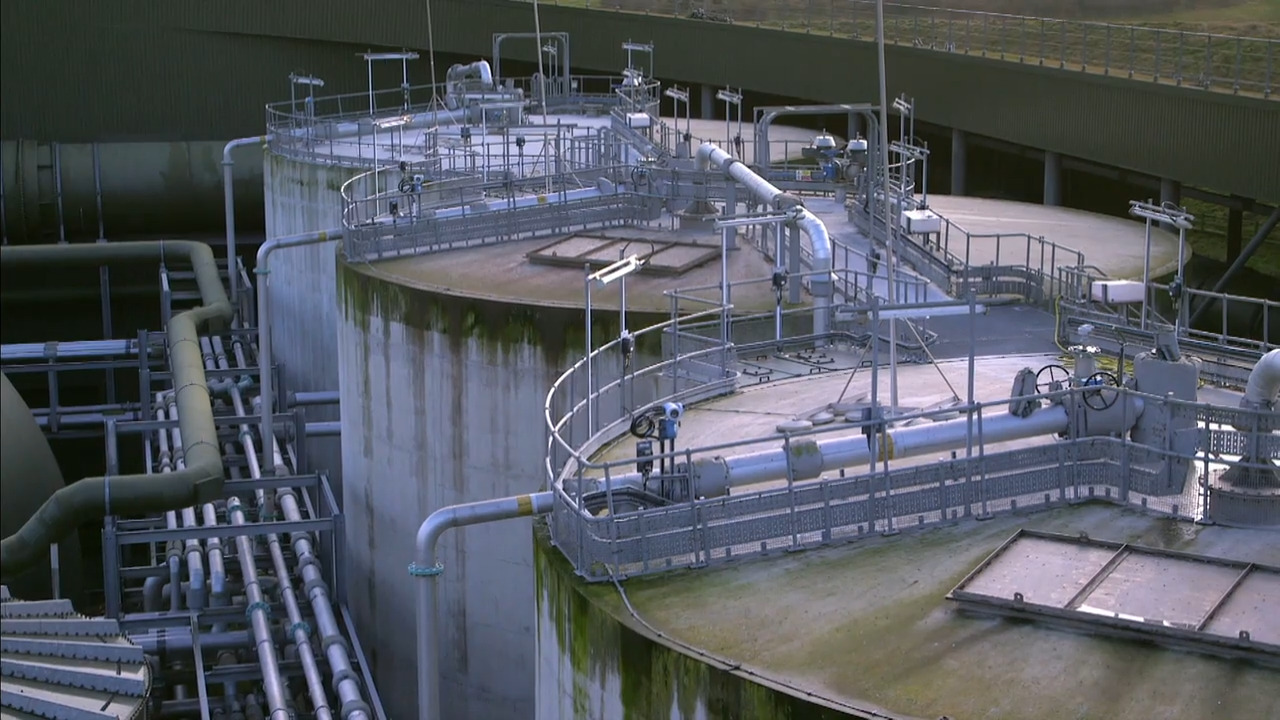
In Sewage Treatment, A Dirty Job, presenter Cherry Healey visits the sewer pipes and a wastewater treatment plant in Brighton to learn exactly what happens after we flush the toilet. Learn various techniques, from egg-shaped pipes to bacteria turning sewage into water that can be returned to the environment. This video is excerpted from BBC’s Inside the Factory, a series that takes viewers behind the scenes in the factories that make our favorite products.
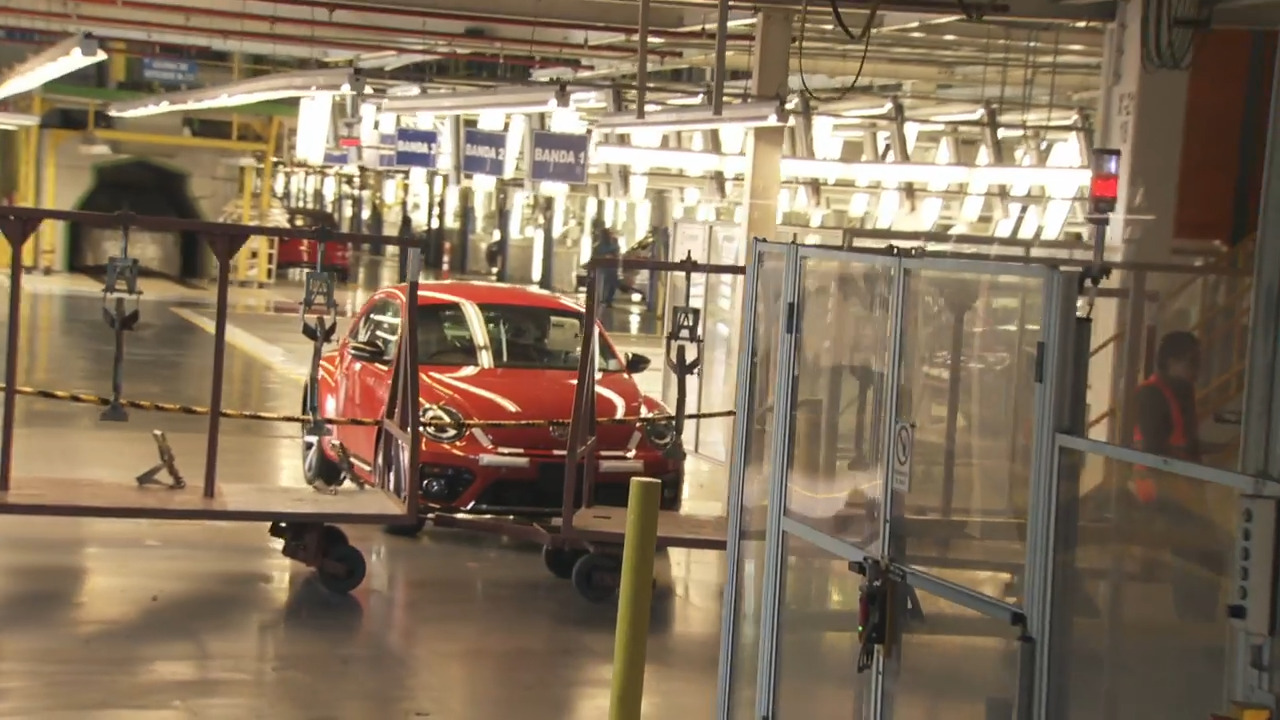
In The Role of Volkswagen in Mexico's Global Car Success, host Simon Reeve takes a tour of the Volkswagen factory in Puebla, Mexico. He learns how four different types of cars are made in four factories under one roof. This massive operation has turned Mexico into a global car export leader, producing over 5 million cars annually. Simon also meets students training to become robotics engineers, gaining hands-on experience while earning higher wages than the average worker in the country. This video is excerpted from BBC’s The Americas With Simon Reeve, in which Simon Reeve explores the landscapes, cultures, and wildlife of North and South America.
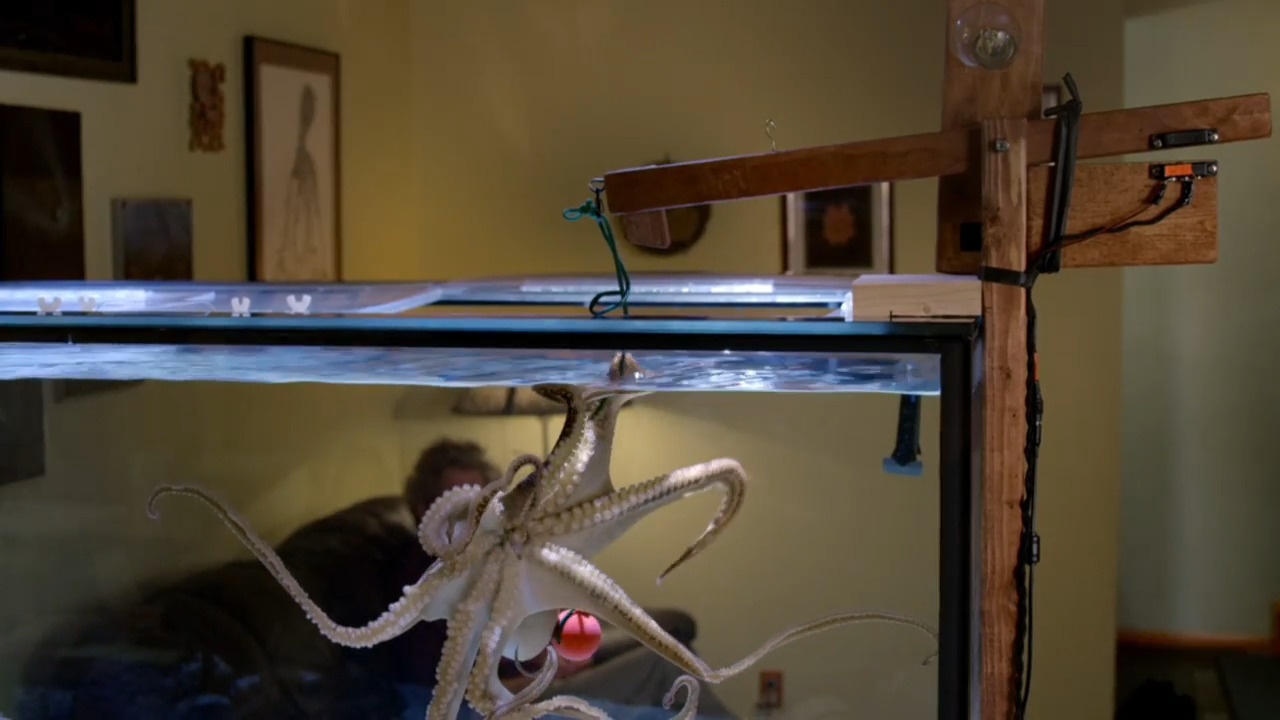
In Heidi the Octopus Learns to Communicate, ecologist David Scheel conducts an exciting experiment inspired by a 1959 Harvard study, to test octopus cognition. This time, he wants to see if Heidi can manipulate a string outside her tank to turn on a light and bring him back into the room. Heidi masters the trick right away, pulling the string again and again, until David has to take it apart because she can’t stop! This video is excerpted from BBC’s Natural World: The Octopus in My House, a remarkable series about a professor and the extraordinary relationship he develops with an octopus when he invites it to live in his home.
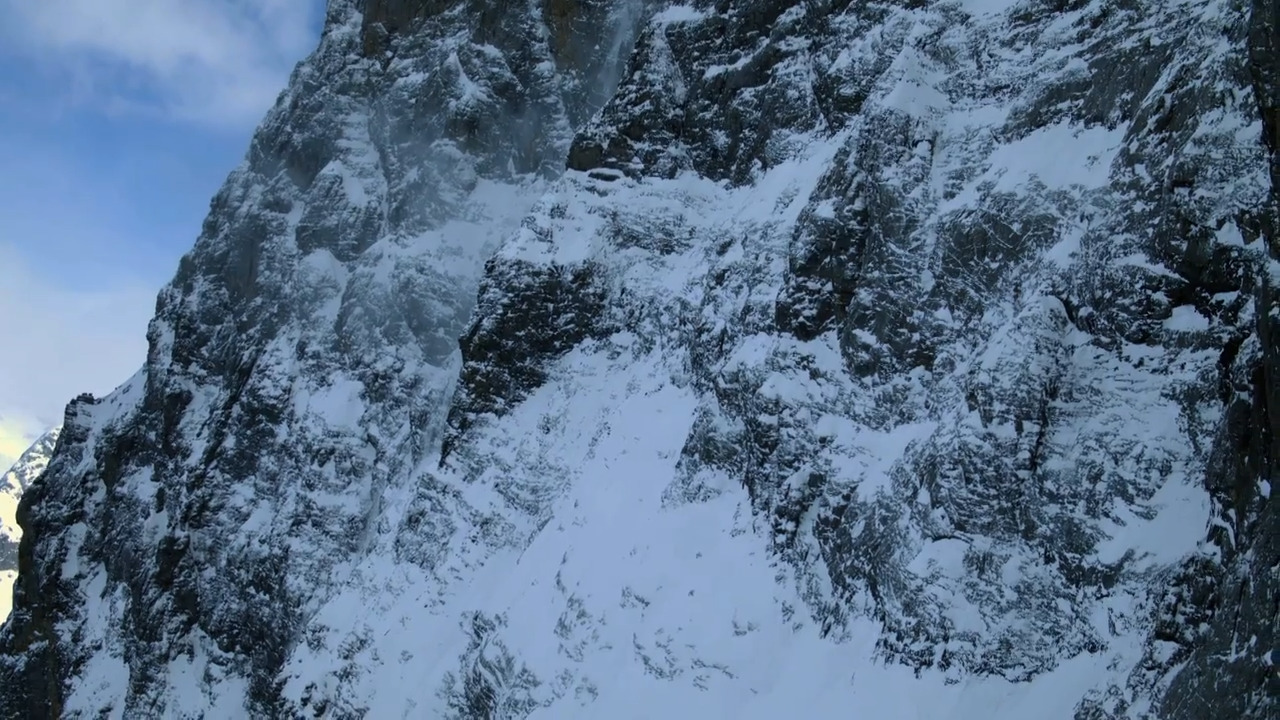
In Surviving the Eiger, Steve Backshall and his team face the deadly challenge of climbing the Eiger’s north face, one of the world’s most dangerous mountains. With temperatures dropping as low as -70°C (-94°F), they must decide if a three-day climb is possible. As they trek through deep snow, they learn why the climb is harder than it was 80 years ago. Will they wait for safer conditions, or will the cold make them turn back? This video is excerpted from BBC’s Steve Backshall vs. the Vertical Mile, a show in which Steve and his team take on one of the deadliest mountain climbs in the world — the north face of the Eiger.
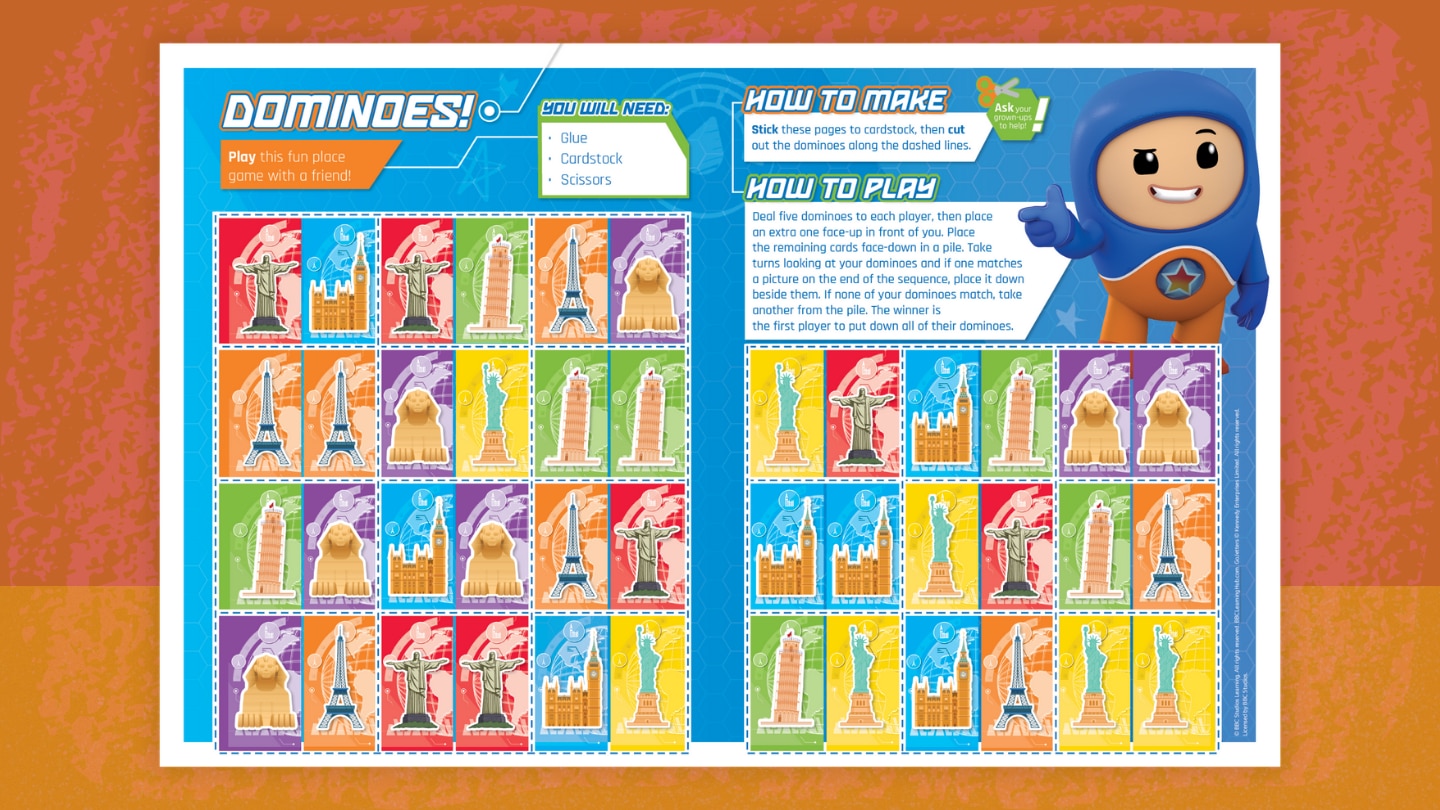
Play this fun Go Jetters dominoes game (featuring famous world landmarks) with a friend! Here's how to play:
- Deal five dominoes to each player, then place an extra one face-up in front of you.
- Place the remaining cards face-down in a pile.
- Take turns looking at your dominoes and if one matches a picture on the end of the sequence, place it down beside them. If none of your dominoes match, take another from the pile.
- The winner is the first player to put down all of their dominoes.
Forests store huge amounts of carbon, likely hundreds of billions of tons. One metric ton is about 2,200 pounds, so hundreds of billions of tons is... let's just say it's a lot. Because trees pull carbon dioxide out of the air and lock it away, forests play a major role in controlling Earth's climate.
To figure out how much carbon a forest holds, scientists can measure individual trees, like how wide the trunk is and how tall the tree grows. But nobody can take a tape measure to millions of square miles of forest, and "a whole bunch" isn't a scientific measurement.
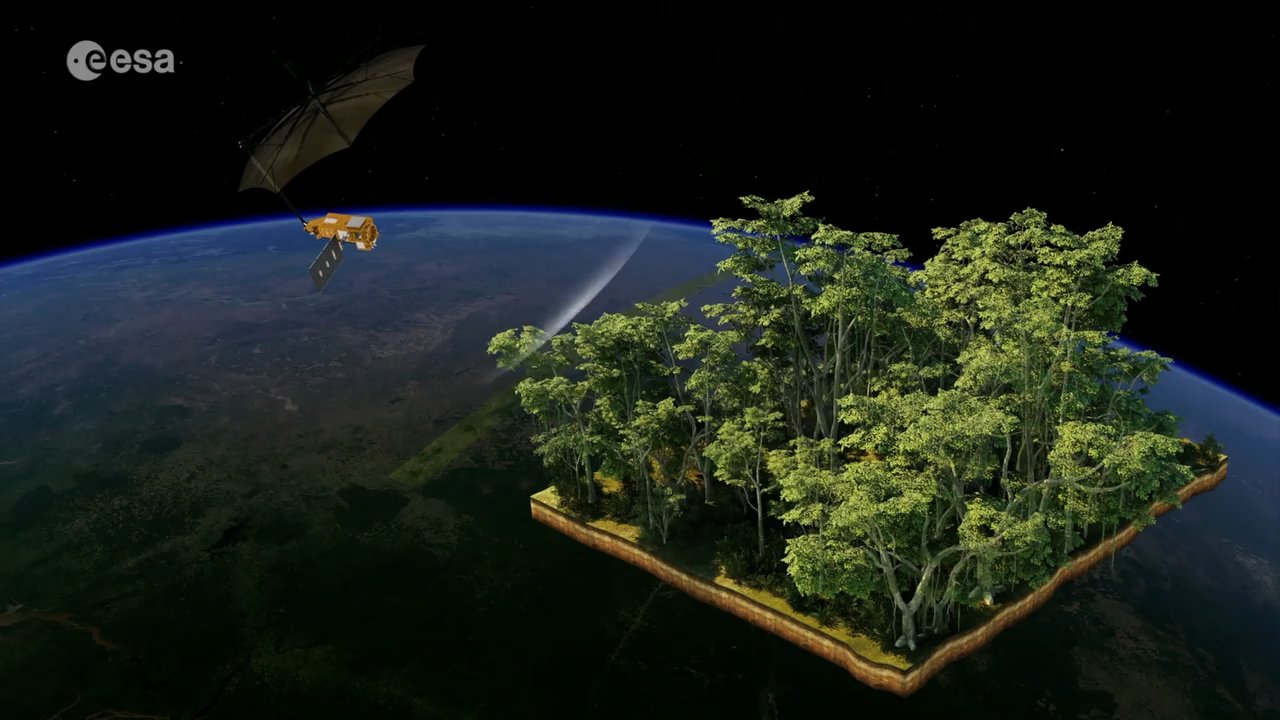
That's where new technology comes in. In 2025, the European Space Agency, which runs space missions for a group of European countries, launched a satellite called Biomass. It uses radar with extra-long wavelengths. The longer the wavelength, the more easily radar can pass through leaves and small branches and pick up bigger things, like trunks and large branches, which hold most of a tree's carbon.
Most earlier satellites, like many launched by NASA, the U.S. space agency, are optical. They work like cameras, capturing sunlight reflected off the treetops. That's useful for seeing where forests are, but it mostly shows the top layer. Radar can reveal what's underneath. It can help scientists estimate how much wood a forest holds, spot deforestation, and study flooded forests that are hard to reach. Scientists then check the satellite data against measurements taken from planes and on the ground.
Another tool is LiDAR, short for Light Detection and Ranging. It sends out pulses of laser light and measures how long they take to bounce back, building detailed 3D maps of forests. Some are precise enough to show individual twigs and leaves. LiDAR isn't new, but it produces enormous amounts of data. Artificial intelligence is now making that data much faster to process, turning LiDAR into a more practical tool for studying forests.
Unicorse, stop interrupting! Watch the Bluey episode "Unicorse" before you teach this lesson about taking turns. The lesson includes printables for three activities in which kids take turns talking, make their own Unicorse puppet, and practice dealing with interruptions (Mum is on the phone and Bluey wants to play Driving!).
Unicorse Episode Summary: Bluey can’t get to sleep, so Mum reads her one last story. But they are interrupted by Unicorse, the most annoying hand puppet in the world, whom Bluey tries to reform.
Watch the episode here! (Click here to watch in Australia.)
Hint: fair doesn't mean always mean equal! Talk to your class about what fairness really means through the Bluey episode "Ice Cream." The lesson includes printables for three activities in which kids take turns playing with toys, pretend to be patients visiting a doctor's office (where everyone gets the same treatment!), and plan a pretend picnic.
Ice Cream Episode Summary: Bluey and Bingo want a lick of each other’s ice cream. But they are so focused on making sure each lick is fair, they don’t notice their ice creams are melting.
Watch the episode here! (Click here to watch in Australia.)
Whether you play Lucky's dad's way or not, you have to be a good sport! Watch the Bluey episode "Pass the Parcel" before you teach this lesson about how to handle it when things don’t go as expected. The lesson includes printables for three activities in which kids look for examples of good sportsmanship in the episode, draw themselves playing their favorite game or sport, and take turns sharing a special skill or talent while being encouraged by friends.
Pass the Parcel Episode Summary: Lucky’s Dad is outraged that modern Pass the Parcel has a present in every layer and changes the rules back to only having one prize in the middle, but Bingo is forever losing.
Watch the episode here! (Click here to watch in Australia.)
Grab a friend to play this holiday WHOliday game! Here's how to play:
- Snip out the game boards.
- Pick a game board and sit opposite your friend. Make sure you can’t see each other’s boards.
- Choose and circle a character each, then take turns asking "yes" or "no" questions back and forth with your friend to work out who you’ve each chosen. Cross off the characters that don’t match your questions, and guess who they’ve picked!
Top Tip: Use a pencil so you can erase and play over and over again.
Right, chooks, let’s play shops! First customer to the finish with all their bits & bobs, wins. Here's how to play:
- With a friend (or two), decide who will be the shopkeeper and customers.
- Ask a grown-up to snip everything out. The bits and bobs go to the shopkeeper, then share the dollarbucks between the customers.
- Customers take turns to roll a die and move around the board. If you land on something you like, buy it... but if you don’t have enough money, you gotta put something back!
Not that Bingo — Bingo the game! Take two secs to make it and play with a pal. Here's how the game works:
- Ask a grown-up to cut out the pictures below and put them in a bag... or a hat if you can’t find a bag... or a bowl if you can’t find a hat...
- Choose a bingo board, then sit opposite your friend and take it in turns to pull out a picture from the bag.
- If it matches a picture on your board, place it on top. If it doesn’t, pop it back in the bag.
- First person with all eight pictures on their bingo board shouts, "BINGO!"
In Sewage Treatment, A Dirty Job, presenter Cherry Healey visits the sewer pipes and a wastewater treatment plant in Brighton to learn exactly what happens after we flush the toilet. Learn various techniques, from egg-shaped pipes to bacteria turning sewage into water that can be returned to the environment. This video is excerpted from BBC’s Inside the Factory, a series that takes viewers behind the scenes in the factories that make our favorite products.
In The Role of Volkswagen in Mexico's Global Car Success, host Simon Reeve takes a tour of the Volkswagen factory in Puebla, Mexico. He learns how four different types of cars are made in four factories under one roof. This massive operation has turned Mexico into a global car export leader, producing over 5 million cars annually. Simon also meets students training to become robotics engineers, gaining hands-on experience while earning higher wages than the average worker in the country. This video is excerpted from BBC’s The Americas With Simon Reeve, in which Simon Reeve explores the landscapes, cultures, and wildlife of North and South America.
In Heidi the Octopus Learns to Communicate, ecologist David Scheel conducts an exciting experiment inspired by a 1959 Harvard study, to test octopus cognition. This time, he wants to see if Heidi can manipulate a string outside her tank to turn on a light and bring him back into the room. Heidi masters the trick right away, pulling the string again and again, until David has to take it apart because she can’t stop! This video is excerpted from BBC’s Natural World: The Octopus in My House, a remarkable series about a professor and the extraordinary relationship he develops with an octopus when he invites it to live in his home.
In Surviving the Eiger, Steve Backshall and his team face the deadly challenge of climbing the Eiger’s north face, one of the world’s most dangerous mountains. With temperatures dropping as low as -70°C (-94°F), they must decide if a three-day climb is possible. As they trek through deep snow, they learn why the climb is harder than it was 80 years ago. Will they wait for safer conditions, or will the cold make them turn back? This video is excerpted from BBC’s Steve Backshall vs. the Vertical Mile, a show in which Steve and his team take on one of the deadliest mountain climbs in the world — the north face of the Eiger.
Play this fun Go Jetters dominoes game (featuring famous world landmarks) with a friend! Here's how to play:
- Deal five dominoes to each player, then place an extra one face-up in front of you.
- Place the remaining cards face-down in a pile.
- Take turns looking at your dominoes and if one matches a picture on the end of the sequence, place it down beside them. If none of your dominoes match, take another from the pile.
- The winner is the first player to put down all of their dominoes.
Forests store huge amounts of carbon, likely hundreds of billions of tons. One metric ton is about 2,200 pounds, so hundreds of billions of tons is... let's just say it's a lot. Because trees pull carbon dioxide out of the air and lock it away, forests play a major role in controlling Earth's climate.
To figure out how much carbon a forest holds, scientists can measure individual trees, like how wide the trunk is and how tall the tree grows. But nobody can take a tape measure to millions of square miles of forest, and "a whole bunch" isn't a scientific measurement.
That's where new technology comes in. In 2025, the European Space Agency, which runs space missions for a group of European countries, launched a satellite called Biomass. It uses radar with extra-long wavelengths. The longer the wavelength, the more easily radar can pass through leaves and small branches and pick up bigger things, like trunks and large branches, which hold most of a tree's carbon.
Most earlier satellites, like many launched by NASA, the U.S. space agency, are optical. They work like cameras, capturing sunlight reflected off the treetops. That's useful for seeing where forests are, but it mostly shows the top layer. Radar can reveal what's underneath. It can help scientists estimate how much wood a forest holds, spot deforestation, and study flooded forests that are hard to reach. Scientists then check the satellite data against measurements taken from planes and on the ground.
Another tool is LiDAR, short for Light Detection and Ranging. It sends out pulses of laser light and measures how long they take to bounce back, building detailed 3D maps of forests. Some are precise enough to show individual twigs and leaves. LiDAR isn't new, but it produces enormous amounts of data. Artificial intelligence is now making that data much faster to process, turning LiDAR into a more practical tool for studying forests.