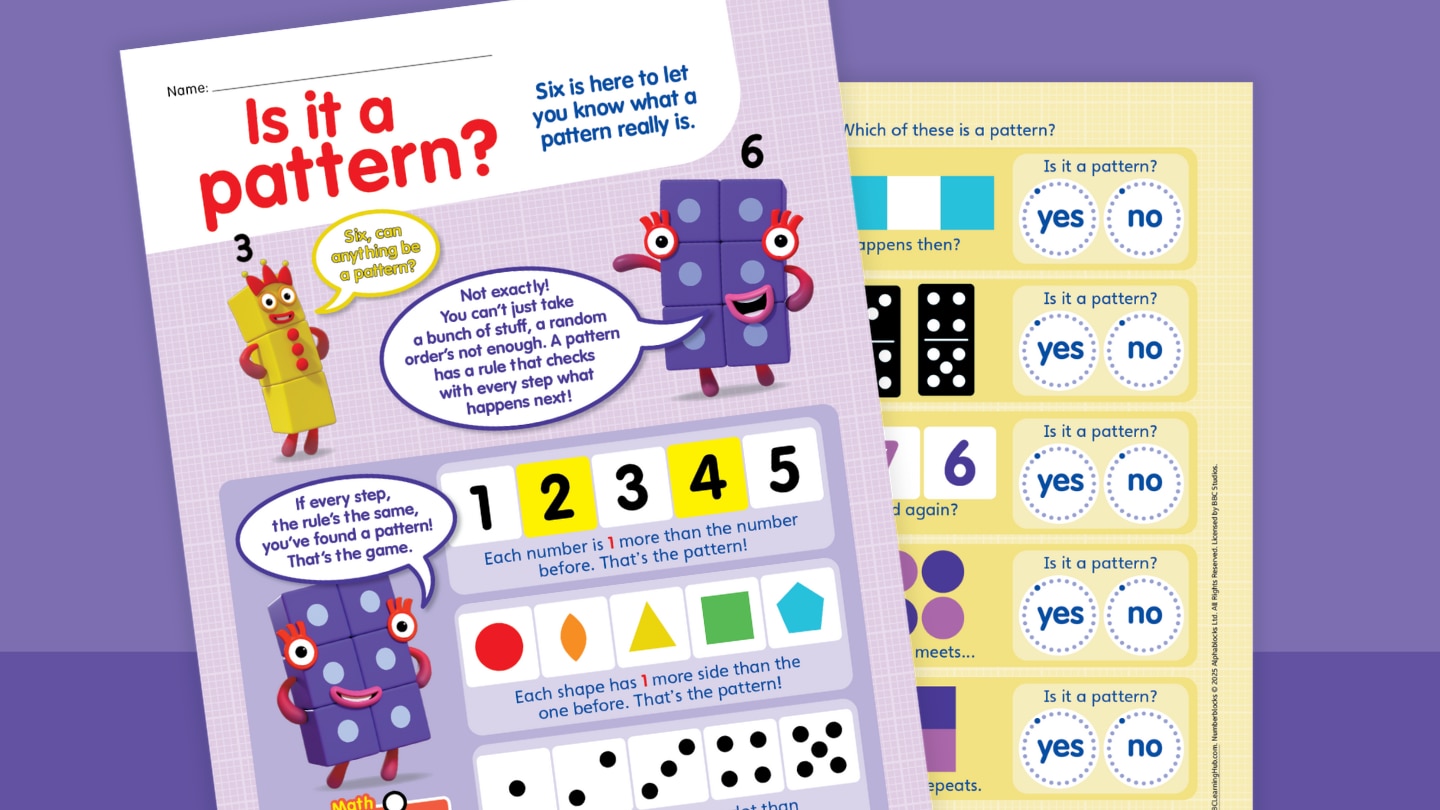
Six is here to let you know what a pattern really is. Can anything be a pattern? Not exactly. You can't just take a bunch of stuff, a random order's not enough. A pattern has a rule that checks with every step what happens next. If every step, the rule's the same, you've found the pattern, that's the game.
Watch full episodes of Numberblocks on their official YouTube channel!
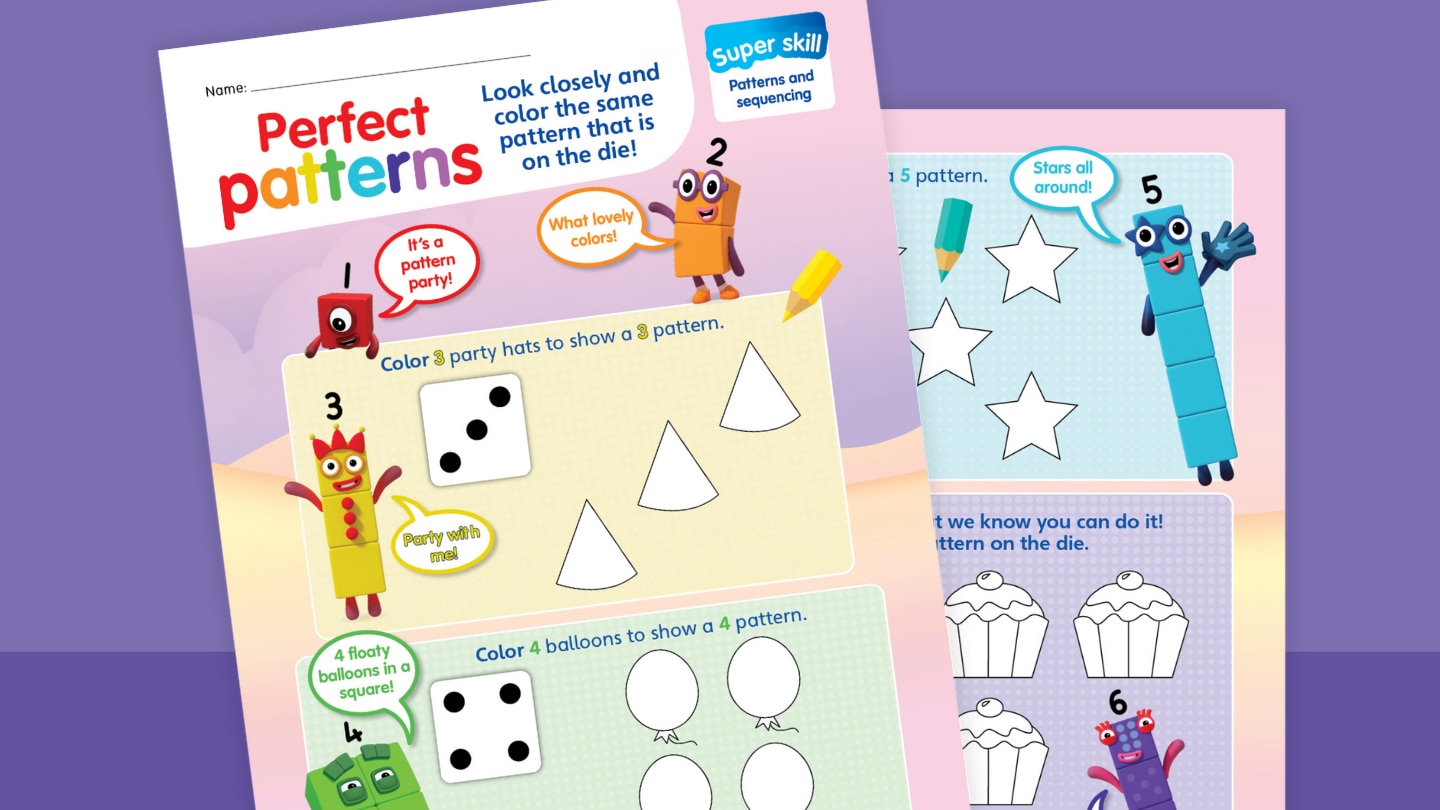
Look closely and color the same pattern that is on the die. Color three party hats to show a three pattern, four balloons to show a four pattern, and five stars to show a five pattern. Then, see if you can figure out the trickier cupcake pattern!
Watch full episodes of Numberblocks on their official YouTube channel!
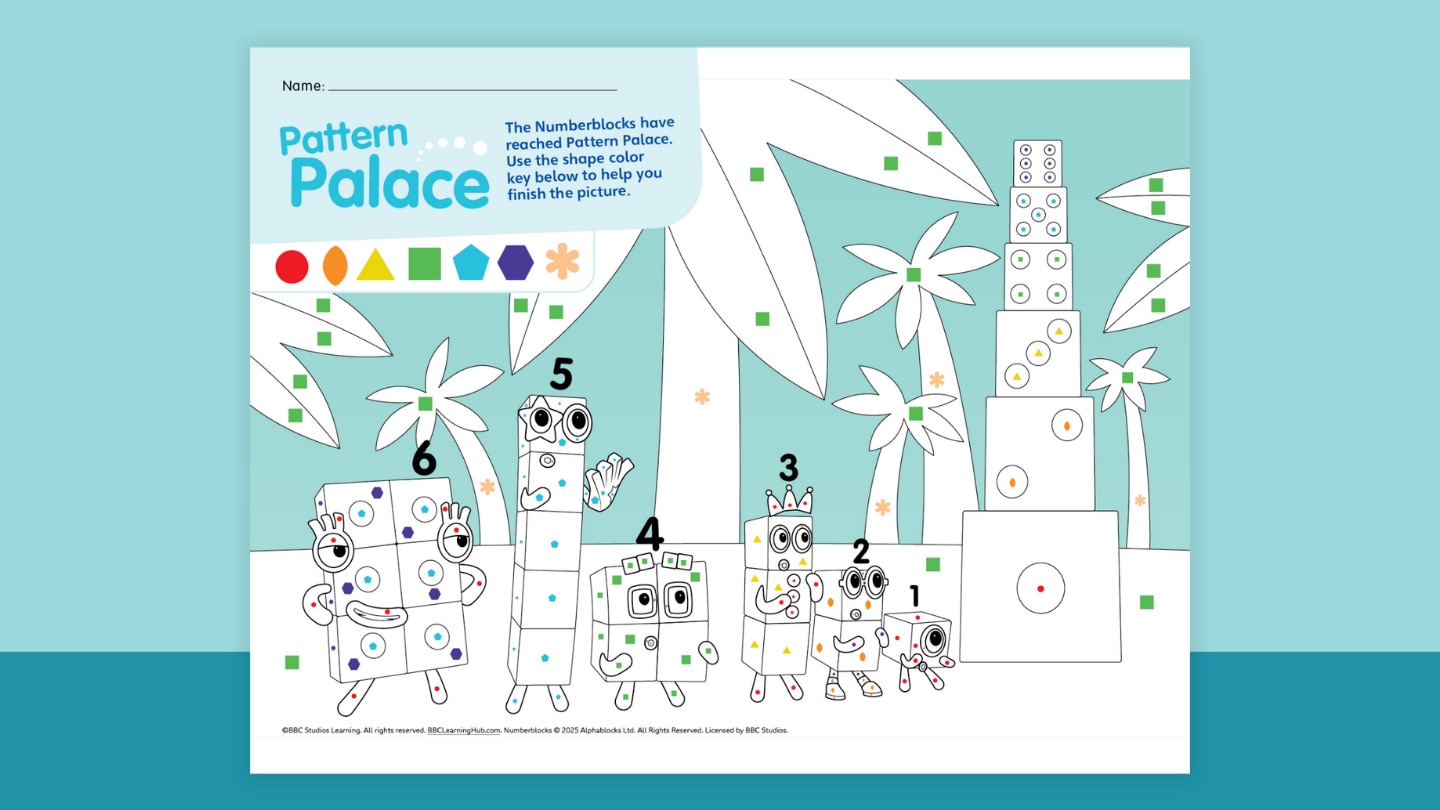
The Numberblocks have reached Pattern Palance. Use the shape color key to help you finish the picture. What patterns do you notice?
Watch full episodes of Numberblocks on their official YouTube channel!
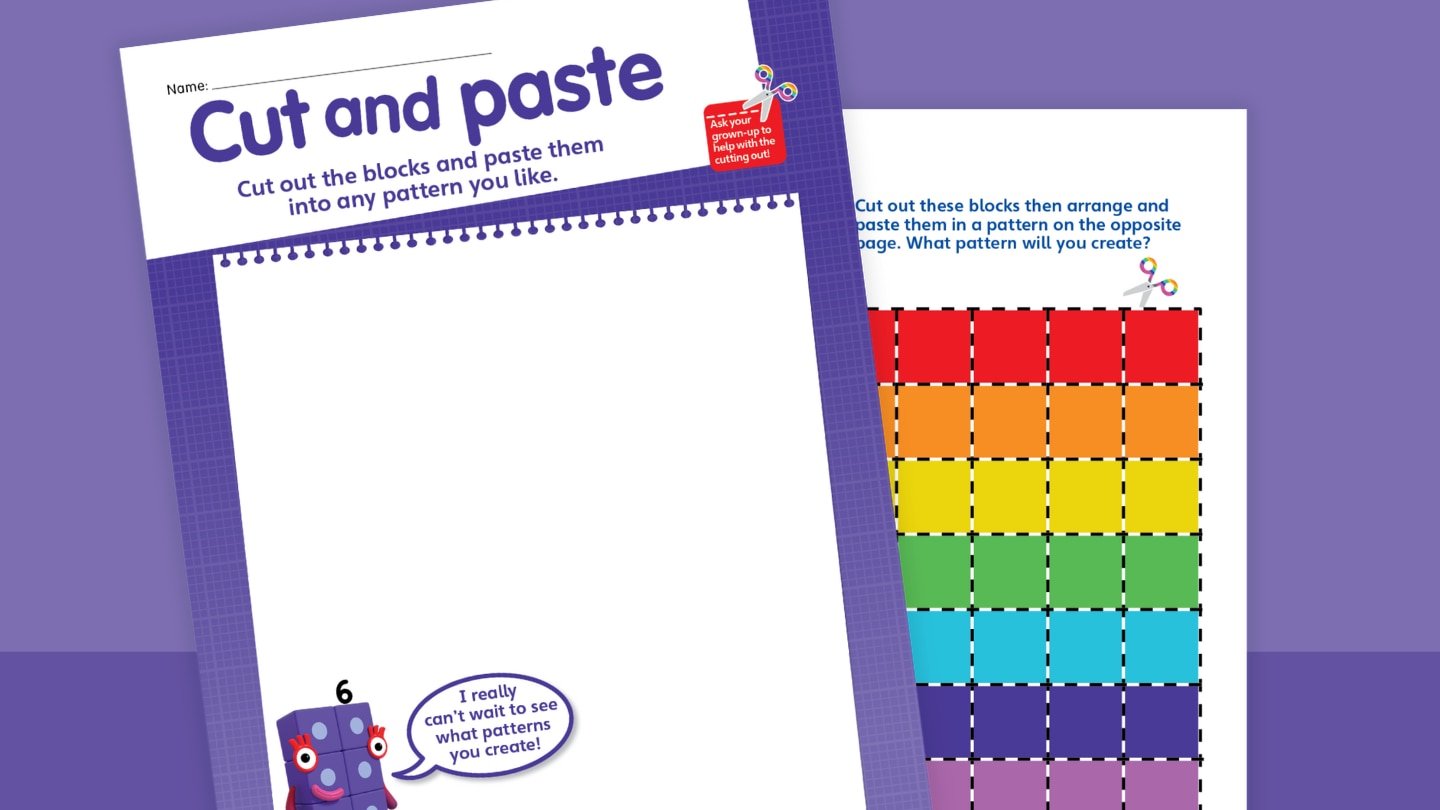
Snip, sort, and stick! Cut out these bright rainbow blocks and arrange them into any design you like. Can you make stripes, zigzags, or even a rainbow mosaic? It’s a hands-on way to explore colors, patterns, and creativity that is perfect for at-home fun or a classroom challenge!
Watch full episodes of Numberblocks on their official YouTube channel!
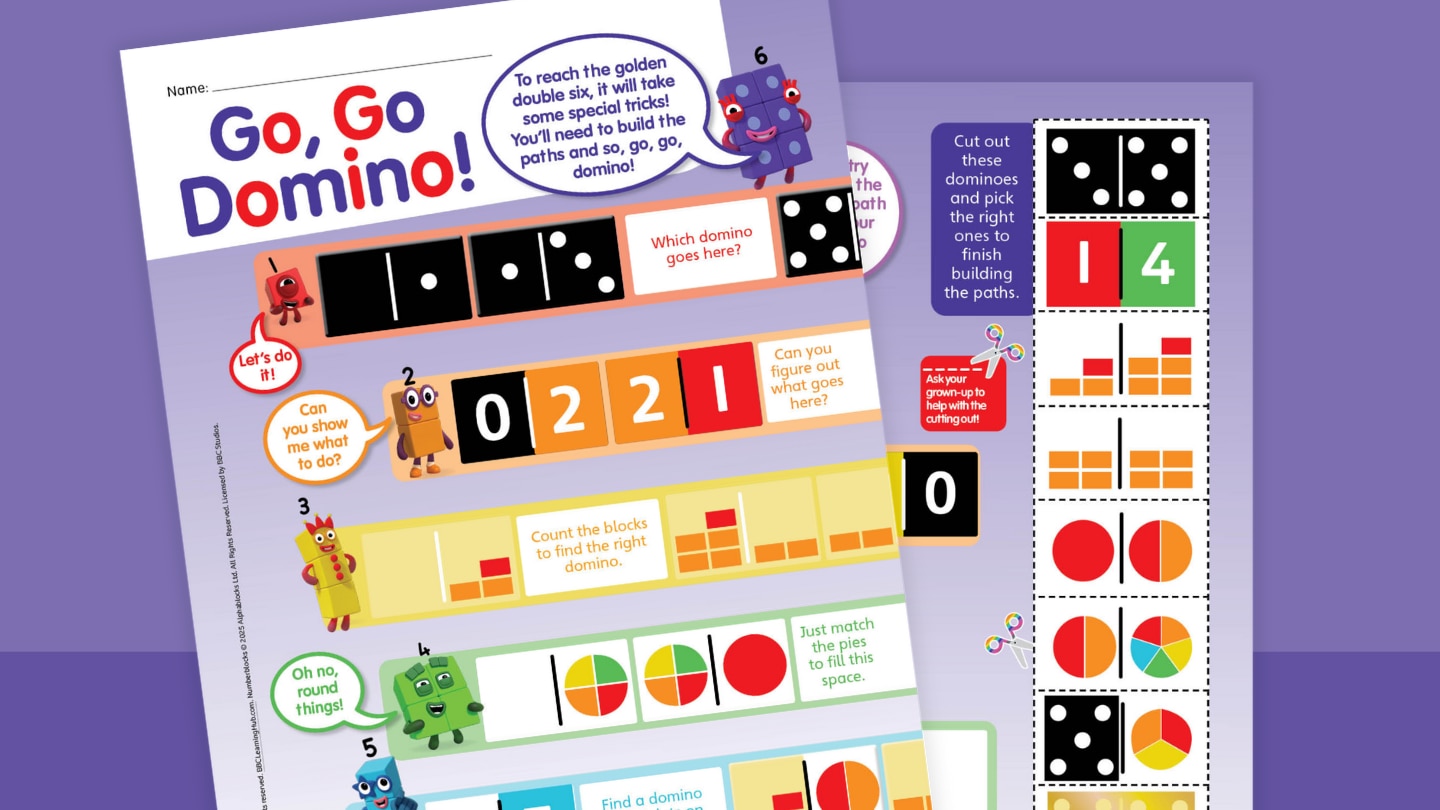
To reach the golden double six, it will take some special tricks! You'll need to build the paths and so, go, go, domino! Cut out the dominoes and pick the right ones to finish building the paths. Where will you put the golden double six?
Watch full episodes of Numberblocks on their official YouTube channel!
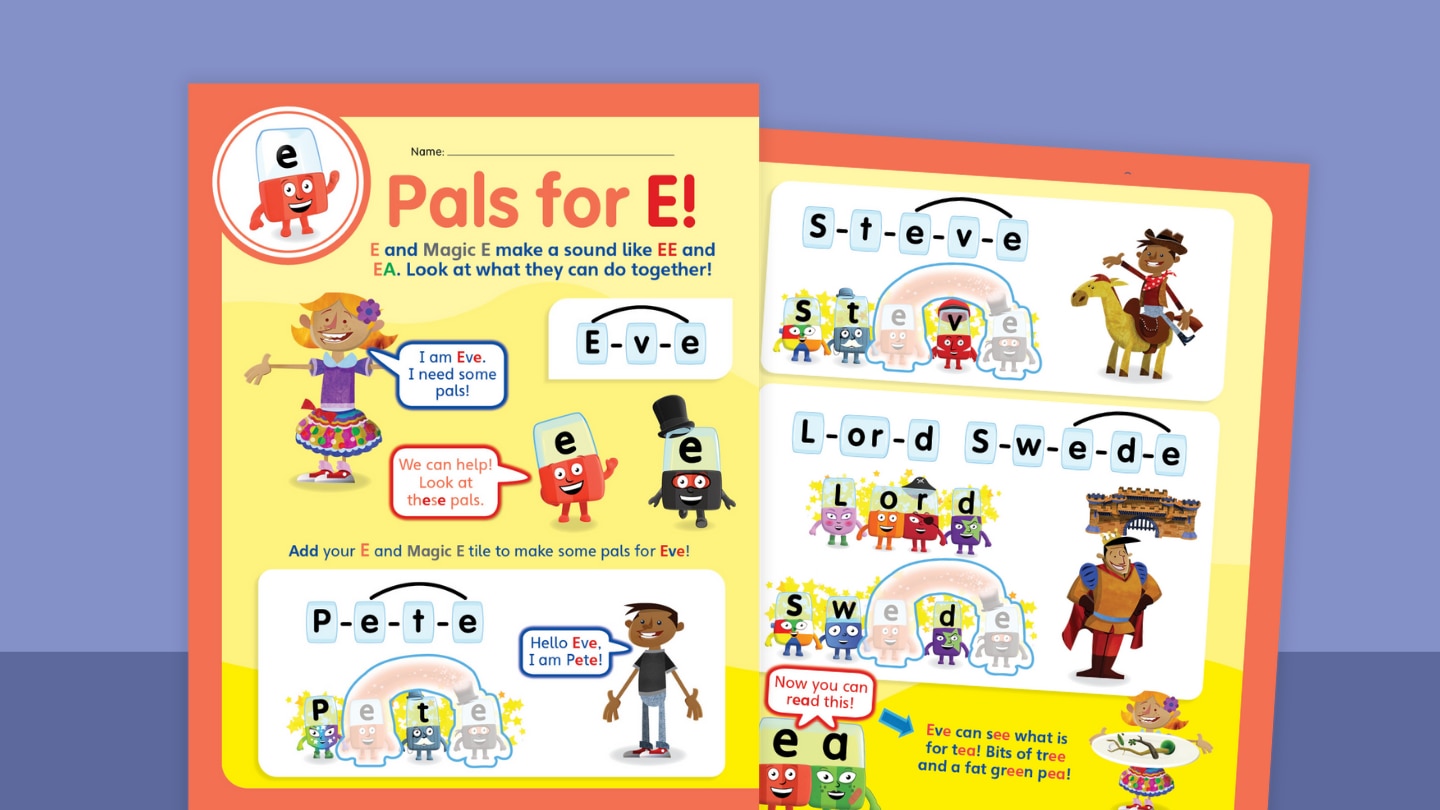
E and Magic E make a sound like EE and EA. Look at what they can do together! Add your E and Magic E tile to make some pals for Eve! Now see if you can read this: Eve can see what is for tea! Bits of tree and a fat green pea!
Watch full episodes of Alphablocks on their official YouTube channel!
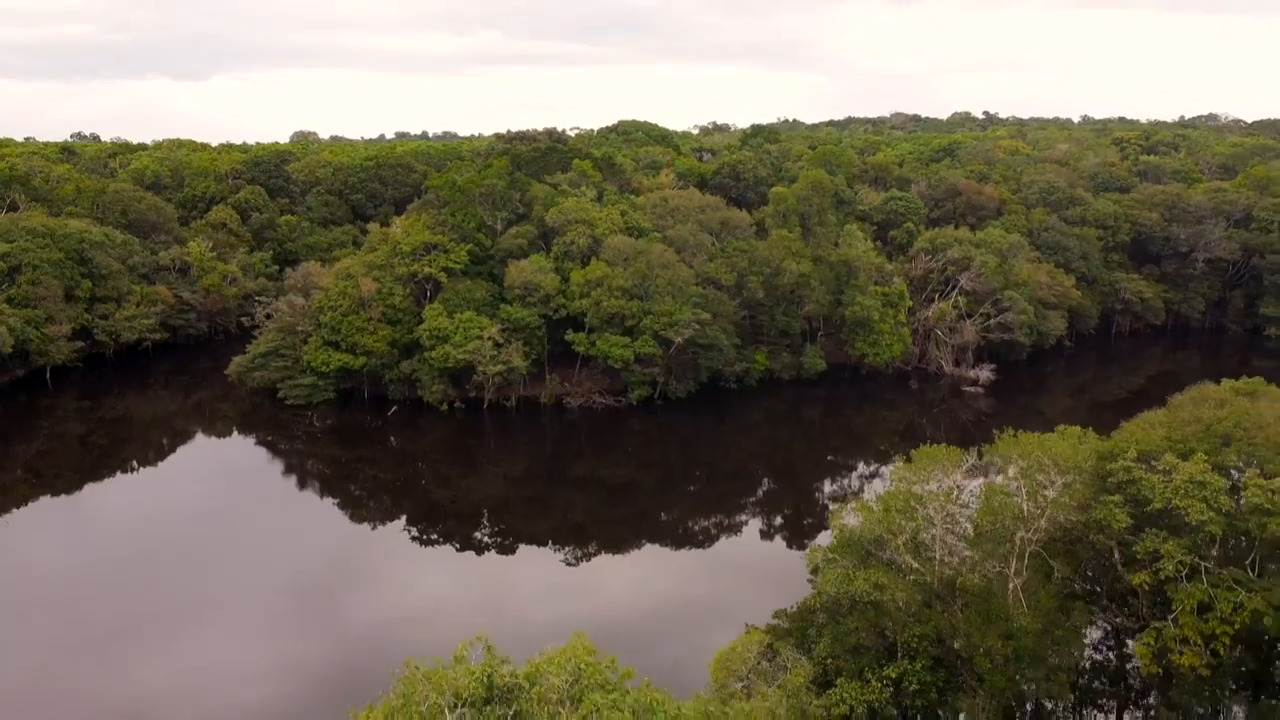
In The Heart and Lungs of the World, host Radzi Chinyanganya explains how the Amazon rainforest plays a critical role in regulating the Earth's climate by recycling water from the trees into the atmosphere. The Amazon takes in and pumps out water, which creates moisture that forms clouds and produces rain. With 400 billion trees cycling water, this process significantly influences global weather patterns, including rainfall in regions far from the rainforest itself, such as the United States’ Midwest. This video is excerpted from BBC’s My World, a program created for teenagers eager to learn more about the important stories shaping our world.
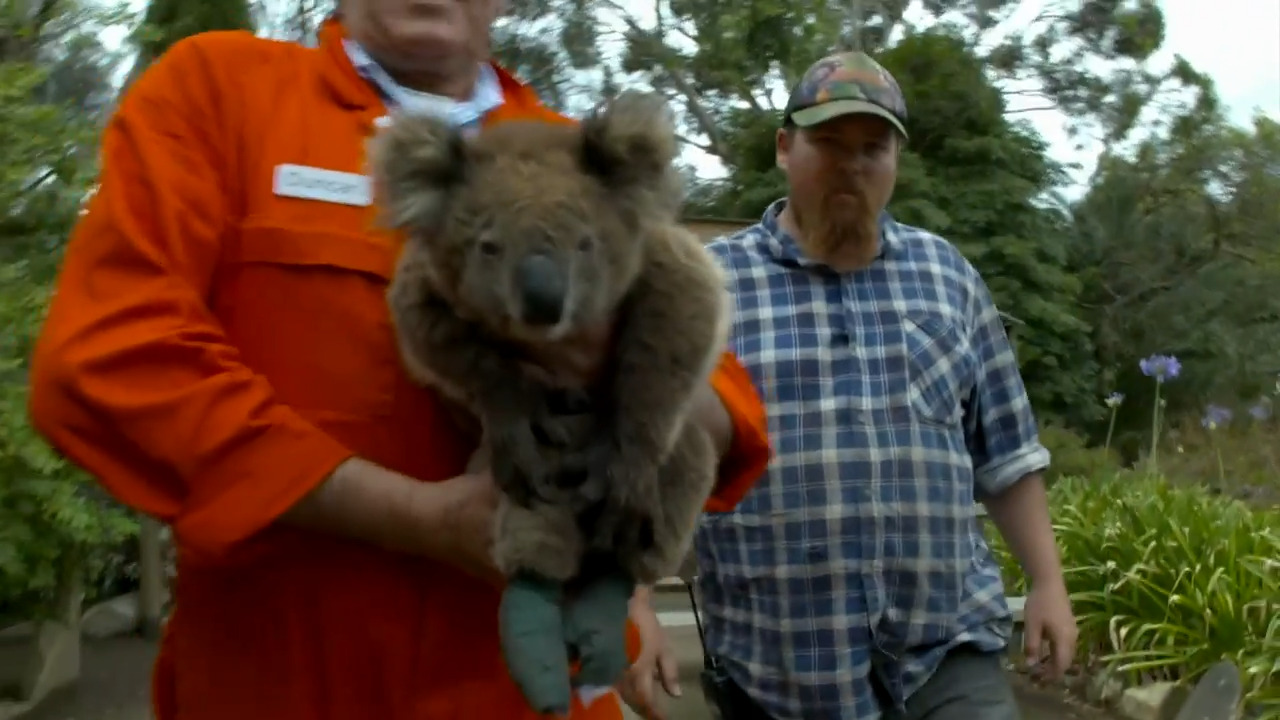
In Wildfires: A Growing Threat, host Radzi Chinyanganya highlights the devastating impact of wildfires around the globe, with a focus on Australia. The segment provides an in-depth look at the causes, local impact, and the global spread of wildfires, highlighting how changes in weather patterns, human activity, and environmental factors are exacerbating this crisis. The episode also covers how the Indian Ocean Dipole (IOD) contributes to the conditions that make wildfires more likely in regions like Australia. This video is excerpted from BBC’s My World, a program created for teenagers eager to learn more about the important stories shaping our world.

The article "How Social Jetlag Is Depriving Teens of Vital Sleep" from BBC's Science Focus explains how sleep needs and patterns change during adolescence, leading to social jetlag. This shift has many consequences, including an association with obesity and depression, but there are also recommendations for managing sleep schedules.

In How Data Transformed Trading, discover how data became a powerful tool for understanding human behavior — and making big money! Meet David Harding, a science graduate who shook up the chaotic world of trading by using math and data to predict price patterns. While others trusted their gut, Harding believed data and the right computer algorithms could crack the code of the stock market. Today, his company invests billions, proving that smart data (and a little science) can change the game! This video is excerpted from BBC’s Horizon: The Age of Big Data, which explores how data has shaped industries, economies, and human behavior.
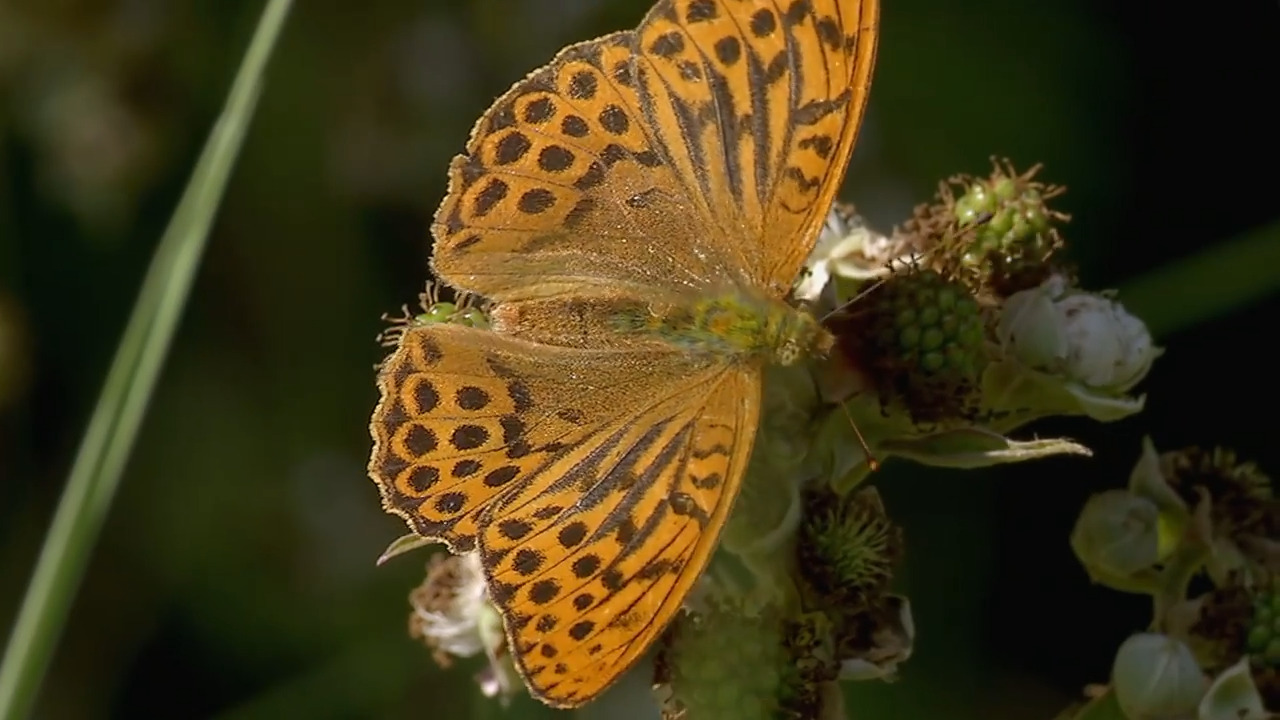
In Butterfly Tales, learn how butterflies bring joy and beauty to the world as they flutter into gardens and woods each spring. Dr. Bullman, a butterfly expert, shows how tracking butterflies helps scientists understand if the environment is healthy or not. She explains how to tell butterflies and moths apart — like how butterflies rest with their wings up, while moths rest with their wings flat. This video is excerpted from BBC’s Countryfile, which explores rural life and traditions of the countryside.
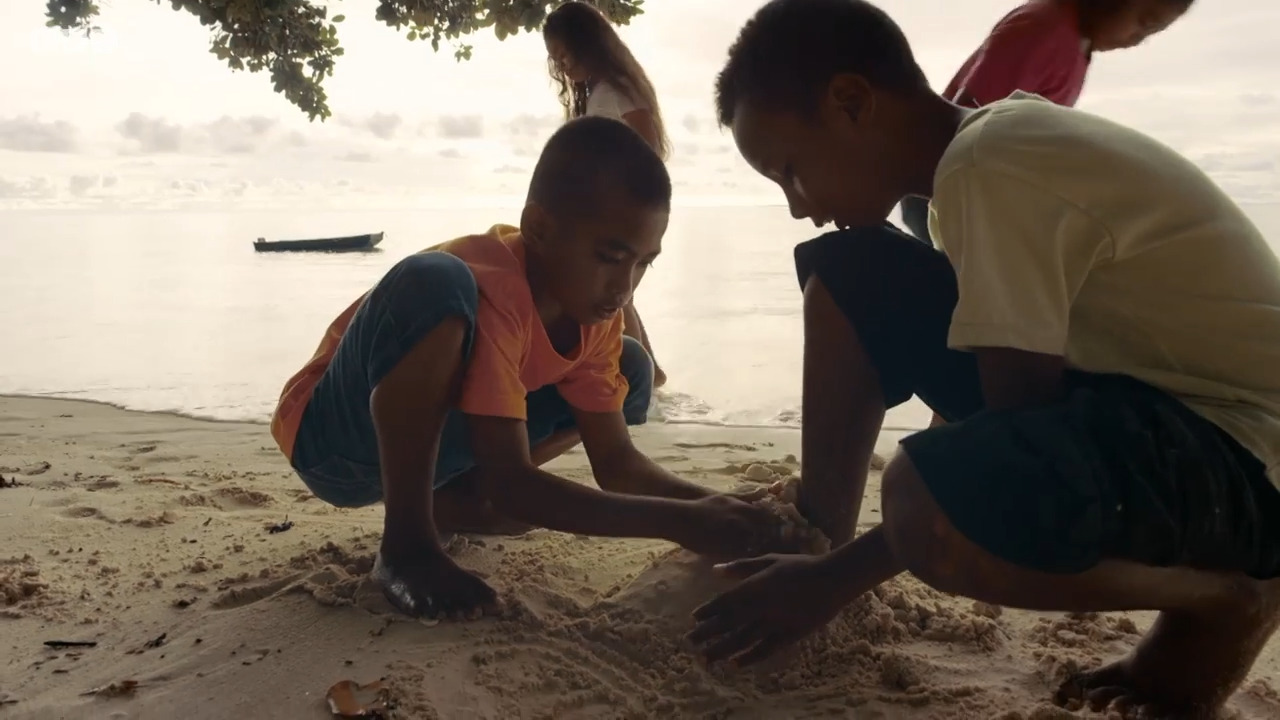
In Protecting the World’s Smallest Islands, host Radzi Chinyanganya highlights the efforts of children in Palau, a small Pacific Island nation, as they fight to protect their environment from the effects of climate change. These young activists are taking action to preserve their island’s natural beauty and ecosystem, which are being threatened by rising sea levels and extreme weather patterns. Through their activism, they are calling for greater global attention to the vulnerabilities of small island nations and their urgent need for climate action. This video is excerpted from BBC’s My World, a program created for teenagers eager to learn more about the important stories shaping our world.
Six is here to let you know what a pattern really is. Can anything be a pattern? Not exactly. You can't just take a bunch of stuff, a random order's not enough. A pattern has a rule that checks with every step what happens next. If every step, the rule's the same, you've found the pattern, that's the game.
Watch full episodes of Numberblocks on their official YouTube channel!
Look closely and color the same pattern that is on the die. Color three party hats to show a three pattern, four balloons to show a four pattern, and five stars to show a five pattern. Then, see if you can figure out the trickier cupcake pattern!
Watch full episodes of Numberblocks on their official YouTube channel!
The Numberblocks have reached Pattern Palance. Use the shape color key to help you finish the picture. What patterns do you notice?
Watch full episodes of Numberblocks on their official YouTube channel!
Snip, sort, and stick! Cut out these bright rainbow blocks and arrange them into any design you like. Can you make stripes, zigzags, or even a rainbow mosaic? It’s a hands-on way to explore colors, patterns, and creativity that is perfect for at-home fun or a classroom challenge!
Watch full episodes of Numberblocks on their official YouTube channel!
To reach the golden double six, it will take some special tricks! You'll need to build the paths and so, go, go, domino! Cut out the dominoes and pick the right ones to finish building the paths. Where will you put the golden double six?
Watch full episodes of Numberblocks on their official YouTube channel!
E and Magic E make a sound like EE and EA. Look at what they can do together! Add your E and Magic E tile to make some pals for Eve! Now see if you can read this: Eve can see what is for tea! Bits of tree and a fat green pea!
Watch full episodes of Alphablocks on their official YouTube channel!
In The Heart and Lungs of the World, host Radzi Chinyanganya explains how the Amazon rainforest plays a critical role in regulating the Earth's climate by recycling water from the trees into the atmosphere. The Amazon takes in and pumps out water, which creates moisture that forms clouds and produces rain. With 400 billion trees cycling water, this process significantly influences global weather patterns, including rainfall in regions far from the rainforest itself, such as the United States’ Midwest. This video is excerpted from BBC’s My World, a program created for teenagers eager to learn more about the important stories shaping our world.
In Wildfires: A Growing Threat, host Radzi Chinyanganya highlights the devastating impact of wildfires around the globe, with a focus on Australia. The segment provides an in-depth look at the causes, local impact, and the global spread of wildfires, highlighting how changes in weather patterns, human activity, and environmental factors are exacerbating this crisis. The episode also covers how the Indian Ocean Dipole (IOD) contributes to the conditions that make wildfires more likely in regions like Australia. This video is excerpted from BBC’s My World, a program created for teenagers eager to learn more about the important stories shaping our world.
The article "How Social Jetlag Is Depriving Teens of Vital Sleep" from BBC's Science Focus explains how sleep needs and patterns change during adolescence, leading to social jetlag. This shift has many consequences, including an association with obesity and depression, but there are also recommendations for managing sleep schedules.
In How Data Transformed Trading, discover how data became a powerful tool for understanding human behavior — and making big money! Meet David Harding, a science graduate who shook up the chaotic world of trading by using math and data to predict price patterns. While others trusted their gut, Harding believed data and the right computer algorithms could crack the code of the stock market. Today, his company invests billions, proving that smart data (and a little science) can change the game! This video is excerpted from BBC’s Horizon: The Age of Big Data, which explores how data has shaped industries, economies, and human behavior.
In Butterfly Tales, learn how butterflies bring joy and beauty to the world as they flutter into gardens and woods each spring. Dr. Bullman, a butterfly expert, shows how tracking butterflies helps scientists understand if the environment is healthy or not. She explains how to tell butterflies and moths apart — like how butterflies rest with their wings up, while moths rest with their wings flat. This video is excerpted from BBC’s Countryfile, which explores rural life and traditions of the countryside.
In Protecting the World’s Smallest Islands, host Radzi Chinyanganya highlights the efforts of children in Palau, a small Pacific Island nation, as they fight to protect their environment from the effects of climate change. These young activists are taking action to preserve their island’s natural beauty and ecosystem, which are being threatened by rising sea levels and extreme weather patterns. Through their activism, they are calling for greater global attention to the vulnerabilities of small island nations and their urgent need for climate action. This video is excerpted from BBC’s My World, a program created for teenagers eager to learn more about the important stories shaping our world.